

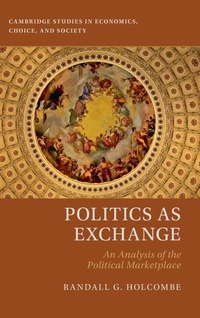
Politics as Exchange
An Analysis of the Political Marketplace
Published on 6. November 2025
Book
Hardback
300 pages
978-1-009-69393-6 (ISBN)
Description
Political institutions have been depicted by academics as a marketplace where citizens transact with each other to accomplish collective ends difficult to accomplish otherwise. This depiction supports a romantic notion of democracy in which democratic governments are accountable to their citizens, and act in their best interests. In Politics as Exchange, Randall Holcombe explains why this view of democracy is too optimistic. He argues that while there is a political marketplace in which public policy is made, access to the political marketplace is limited to an elite few. A small group of well-connected individuals-legislators, lobbyists, agency heads, and others-negotiate to produce public policies with which the masses must comply. Examining the political transactions that determine policy, Holcombe discusses how political institutions, citizen mobility, and competition can limit the ability of elites to abuse their power.
More details
Series
Language
English
Place of publication
Cambridge
United Kingdom
Illustrations
Worked examples or Exercises
Dimensions
Height: 235 mm
Width: 157 mm
Thickness: 22 mm
Weight
640 gr
ISBN-13
978-1-009-69393-6 (9781009693936)
Copyright in bibliographic data and cover images is held by Nielsen Book Services Limited or by the publishers or by their respective licensors: all rights reserved.
Schweitzer Classification
Other editions
Additional editions
Book
11/2025
Cambridge University Press
€35.90
Shipment within 15-20 days
Person
Randall G. Holcombe is DeVoe Moore Professor of Economics at Florida State University. He is past president of the Public Choice Society and the Society for the Development of Austrian Economics. His previous books include Political Capitalism: How Economic and Political Power Is Made and Maintained (2018) and Following Their Leaders: Political Preferences and Public Policy (2023).
Content
1. The political marketplace; 2. Market institutions; 3. Transaction costs and institutions; 4. The characteristics of authority; 5. The ruling class; 6. The institutional structure of the political marketplace; 7. Political transactions; 8. Interest groups: Elites and masses; 9. Welfare maximization, redistribution, and governance; 10. The scope of authority; 11. Mobility and authority; 12. Democracy and authority; 13. Constraining leviathan: competition among elites; 14. Politics as exchange.