

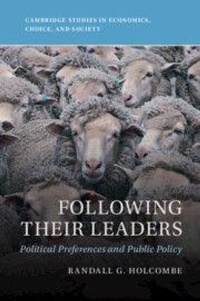
Following Their Leaders
Political Preferences and Public Policy
Published on 23. March 2023
Book
Paperback/Softback
230 pages
978-1-009-32319-2 (ISBN)
Description
Models of democratic decision-making tend to assume that voters have preferences and that candidates adjust their platforms to conform with those preferences; however, the direction of causation is largely the opposite. Political elites offer policy platforms to voters, and voters adopt those policies - they follow their leaders. Following Their Leaders argues that policies are designed by the elite and the electorate has little say. Preferences for public policy tend to be anchored in a political identity associated with a candidate, party, or ideology; voters' preferences on most issues are derived from their anchor preferences. Holcombe argues that because citizens adopt the policies offered by the elite, democratic institutions are ineffective constraints on the exercise of political power. This volume explores political institutions that help control the elite who exercise political power and discusses the implications political preferences have on democracies.
More details
Series
Language
English
Place of publication
Cambridge
United Kingdom
Product notice
Paperback (trade)
Illustrations
Worked examples or Exercises
Dimensions
Height: 229 mm
Width: 152 mm
Thickness: 19 mm
Weight
358 gr
ISBN-13
978-1-009-32319-2 (9781009323192)
Copyright in bibliographic data and cover images is held by Nielsen Book Services Limited or by the publishers or by their respective licensors: all rights reserved.
Schweitzer Classification
Other editions
Additional editions
Book
03/2023
Cambridge University Press
€102.50
Shipment within 15-20 days
Person
Randall G. Holcombe is DeVoe Moore Professor of Economics at Florida State University. He served on Florida Governor Jeb Bush's Council of Economic Advisors from 2000 to 2006, and is past president of the Public Choice Society and the Society for the Development of Austrian Economics.
Content
1. Introduction; 2. Instrumental and Expressive Preferences; 3. Influences Over Preference Formation; 4. Preference Aggregation Through Voting; 5. The Formation of Political Preferences; 6. Anchor Preferences and Derivative Preferences; 7. Preferences of Elites and Masses; 8. Policies that Maximize Political Power; 9. Patriotism, Propaganda, and the Public Interest; 10. Implications for Democracy.