

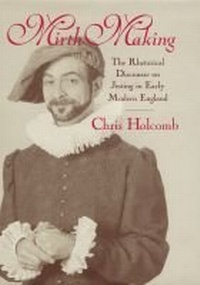
Mirth Making
The Rhetorical Discourse on Jesting in Early Modern England
Will be published approx. on 31. July 2001
Book
Hardback
224 pages
978-1-57003-397-1 (ISBN)
Description
MIRTH MAKING examines the complex and often contradictory ways in which writers of rhetoric and courtesy manuals during the English Renaissance counseled their readers on the powers and hazards of jesting. Shedding light on a subject largely neglected by contemporary scholars, Holcomb's pathbreaking study demonstrates how such humor-related advice points to and participates in broader cultural phenomena - most notably the era's increase in social and geographic mobility and the contest between authority and subversion. Describing the English Renaissance as a brief but crucial phase in the history of jesting discourse, Holcomb differentiates humor-related counsel of the period from that of classical and medieval sources by its focus on communication between people of different stations. Holcomb shows that, in a changing society, handbook writers presented jesting as a socially conservative force and suggests that with a well-placed jest or quip, an orator might enhance his status and persuasive power or shame and ridicule those beneath him. Holcomb also recognizes, however, that rhetoricians confronted significant challenges as they sought to capture, explain, and teach a strategy both powerful and chaotic, elusive and ubiquitous, highly economical in form and potentially unpredictable in effect. Holcomb concludes that because of the disruptive energies inherent in jesting, rhetoricians of the English Renaissance could not escape the fact that jesting is always a flirtation with disaster.
More details
Series
Language
English
Place of publication
South Carolina
United States
Target group
College/higher education
Professional and scholarly
Dimensions
Height: 237 mm
Width: 159 mm
Thickness: 25 mm
Weight
543 gr
ISBN-13
978-1-57003-397-1 (9781570033971)
Copyright in bibliographic data and cover images is held by Nielsen Book Services Limited or by the publishers or by their respective licensors: all rights reserved.
Schweitzer Classification