

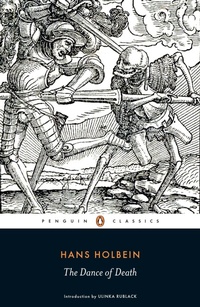
The Dance of Death
Published on 6. October 2016
Book
Paperback/Softback
208 pages
978-0-14-139682-8 (ISBN)
Description
'The underlying message of the series is, of course, that Death comes for us all, and if it interrupts the recreations of the wealthy rather more insolently than those of the poor, then let that be a lesson to us' Nick Lezard, Guardian
A new departure in Penguin Classics: a book containing one of the greatest of all Renaissance woodcut sequences - Holbein's bravura danse macabre
One of Holbein's first great triumphs, The Dance of Death is an incomparable sequence of tiny woodcuts showing the folly of human greed and pride, with each image packed with drama, wit and horror as a skeleton mocks and terrifies everyone from the emperor to a ploughman. Taking full advantage of the new literary culture of the early 16th century, The Dance of Death took an old medieval theme and made it new.
This edition of The Dance of Death reproduces a complete set from the British Museum, with many details highlighted and examples of other works in this grisly field.
Ulinka Rublack introduces the woodcuts with a remarkable essay on the late medieval danse macabre and the world Holbein lived in.
A new departure in Penguin Classics: a book containing one of the greatest of all Renaissance woodcut sequences - Holbein's bravura danse macabre
One of Holbein's first great triumphs, The Dance of Death is an incomparable sequence of tiny woodcuts showing the folly of human greed and pride, with each image packed with drama, wit and horror as a skeleton mocks and terrifies everyone from the emperor to a ploughman. Taking full advantage of the new literary culture of the early 16th century, The Dance of Death took an old medieval theme and made it new.
This edition of The Dance of Death reproduces a complete set from the British Museum, with many details highlighted and examples of other works in this grisly field.
Ulinka Rublack introduces the woodcuts with a remarkable essay on the late medieval danse macabre and the world Holbein lived in.
Reviews / Votes
The underlying message of the series is, of course, that Death comes for us all, and if it interrupts the recreations of the wealthy rather more insolently than those of the poor, then let that be a lesson to us... Rublack's commentary is useful and illuminating, pointing out details, providing information about the time Holbein lived in, and even making a plausible case for her own views on Holbein's position on the reformation. -- Nick Lezard * Guardian *More details
Language
English
Place of publication
London
United Kingdom
Publishing group
Penguin Books Ltd
Product notice
Paperback (UK-B)
Dimensions
Height: 198 mm
Width: 128 mm
Thickness: 22 mm
Weight
200 gr
ISBN-13
978-0-14-139682-8 (9780141396828)
Copyright in bibliographic data and cover images is held by Nielsen Book Services Limited or by the publishers or by their respective licensors: all rights reserved.
Schweitzer Classification
Other editions
Additional editions
Hans Holbein | Ulinka Rublack
The Dance of Death
E-Book
10/2016
1st Edition
Penguin Books Ltd
€9.49
Available for download
Persons
Hans Holbein (Author)
Hans Holbein the Younger (1497-1543) was a Swiss and German artist renowned for his portraiture. As a young artist Holbein worked in Basel where he produced one of his well-known works The Dance of Death, a series of 41 wood cuttings on the medieval concept of the danse macabre. In 1526 Holbein travelled to England on Erasmus's recommendation and there he executed some of his most impressive works, such as his portrait of Sir Thomas More. He returned to England in 1532 at a time of political and religious turmoil under Henry VIII's reign and found favour with the Boleyn family and Thomas Cromwell, becoming the King's Painter in 1536. He died in London in 1543.
Hans Holbein the Younger (1497-1543) was a Swiss and German artist renowned for his portraiture. As a young artist Holbein worked in Basel where he produced one of his well-known works The Dance of Death, a series of 41 wood cuttings on the medieval concept of the danse macabre. In 1526 Holbein travelled to England on Erasmus's recommendation and there he executed some of his most impressive works, such as his portrait of Sir Thomas More. He returned to England in 1532 at a time of political and religious turmoil under Henry VIII's reign and found favour with the Boleyn family and Thomas Cromwell, becoming the King's Painter in 1536. He died in London in 1543.