

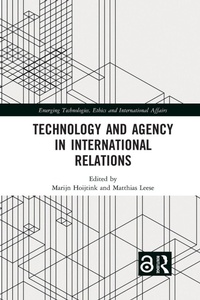
Technology and Agency in International Relations
1st Edition
Published on 30. June 2021
Book
Paperback/Softback
224 pages
978-1-032-09300-0 (ISBN)
Description
This book responds to a gap in the literature in International Relations (IR) by integrating technology more systematically into analyses of global politics.
Technology facilitates, accelerates, automates, and exercises capabilities that are greater than human abilities. And yet, within IR, the role of technology often remains under-studied. Building on insights from science and technology studies (STS), assemblage theory and new materialism, this volume asks how international politics are made possible, knowable, and durable by and through technology. The contributors provide empirically rich and pertinent accounts of a variety of technologies relevant to the discipline, including drones, algorithms, satellite imagery, border management databases, and blockchains.
Problematizing various technologically mediated issues, such as secrecy, violence, and questions of how authority and evidence become constituted in international contexts, this book will be of interest to scholars in IR, in particular those who work in the subfields of (critical) security studies, International Political Economy, and Global Governance.
Technology facilitates, accelerates, automates, and exercises capabilities that are greater than human abilities. And yet, within IR, the role of technology often remains under-studied. Building on insights from science and technology studies (STS), assemblage theory and new materialism, this volume asks how international politics are made possible, knowable, and durable by and through technology. The contributors provide empirically rich and pertinent accounts of a variety of technologies relevant to the discipline, including drones, algorithms, satellite imagery, border management databases, and blockchains.
Problematizing various technologically mediated issues, such as secrecy, violence, and questions of how authority and evidence become constituted in international contexts, this book will be of interest to scholars in IR, in particular those who work in the subfields of (critical) security studies, International Political Economy, and Global Governance.
More details
Series
Language
English
Place of publication
London
United Kingdom
Publishing group
Taylor & Francis Ltd
Target group
College/higher education
Illustrations
1 s/w Abbildung
1 Illustrations, black and white
Dimensions
Height: 234 mm
Width: 156 mm
Thickness: 12 mm
Weight
348 gr
ISBN-13
978-1-032-09300-0 (9781032093000)
Copyright in bibliographic data and cover images is held by Nielsen Book Services Limited or by the publishers or by their respective licensors: all rights reserved.
Schweitzer Classification
Other editions
Additional editions
Marijn Hoijtink | Matthias Leese
Technology and Agency in International Relations
Book
04/2019
1st Edition
Routledge
€205.50
Shipment within 10-20 days
Marijn Hoijtink | Matthias Leese
Technology and Agency in International Relations
E-Book
04/2019
1st Edition
Routledge
€52.49
Available for download
Marijn Hoijtink | Matthias Leese
Technology and Agency in International Relations
E-Book
04/2019
1st Edition
Routledge
€52.49
Available for download
Persons
Marijn Hoijtink is an Assistant Professor in International Relations at VU Amsterdam. Her research interests include emerging security technologies and their relation to the politics of risk, militarism and weapons research, and the global circulation of security and military technologies. She has recently received a 4-years Veni grant from The Netherlands Organisation for Scientific Research (NWO) to study the politics of engineering lethal autonomous weapons systems.
Matthias Leese is a Senior Researcher at the Center for Security Studies (CSS), ETH Zurich. His research is primarily interested in the social effects produced at the intersection between security and technology, and pays specific attention to the normative repercussions of new security technologies across society, both in intended and unintended forms. His work covers various application contexts of security technologies, including airports, borders, policing, and R&D activities.
Matthias Leese is a Senior Researcher at the Center for Security Studies (CSS), ETH Zurich. His research is primarily interested in the social effects produced at the intersection between security and technology, and pays specific attention to the normative repercussions of new security technologies across society, both in intended and unintended forms. His work covers various application contexts of security technologies, including airports, borders, policing, and R&D activities.
Content
Chapter 1 - How (not) to talk about technology: International Relations and the question of agency Chapter 2 - Co-production: The study of productive processes at the level of materiality and discourse Chapter 3 - Configuring warfare: Automation, control, agency Chapter 4 - Security and technology: Unraveling the politics in satellite imagery of North Korea Chapter 5 - Vision, visuality and agency in the US drone program Chapter 6 - What does technology do? Blockchains, co-Production, and extensions of liberal market governance in Anglo-American finance Chapter 7 - Who connects the dots? Agents and agency in predictive policing Chapter 8 - Designing digital borders: The Visa Information System (VIS) Chapter 9 - Technology, agency, critique: An interview with Claudia Aradau