

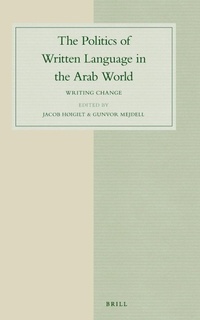
The Politics of Written Language in the Arab World
Writing Change
Published on 16. August 2017
Book
Hardback
330 pages
978-90-04-34616-1 (ISBN)
Description
The Politics of Written Language in the Arab World connects the fascinating field of contemporary written Arabic with the central sociolinguistic notions of language ideology and diglossia. Focusing on Egypt and Morocco, the authors combine large-scale survey data on language attitudes with in-depth analyses of actual language usage and explicit (and implicit) language ideology. They show that writing practices as well as language attitudes in Egypt and Morocco are far more receptive to vernacular forms than has been assumed.
The individual chapters cover a wide variety of media, from books and magazines to blogs and Tweets. A central theme running through the contributions is the social and political function of "doing informality" in a changing public sphere steadily more permeated by written Arabic in a number of media.
The individual chapters cover a wide variety of media, from books and magazines to blogs and Tweets. A central theme running through the contributions is the social and political function of "doing informality" in a changing public sphere steadily more permeated by written Arabic in a number of media.
More details
Series
Edition
x, 308 pp., index
Language
English
Place of publication
Leiden
Netherlands
Target group
Professional and scholarly
Product notice
sewn/stitched
Cloth over boards
Illustrations
35 s/w Abbildungen, 17 s/w Tabellen
17 Tables, black and white; 35 Illustrations, black and white
Dimensions
Height: 239 mm
Width: 160 mm
Thickness: 23 mm
Weight
658 gr
ISBN-13
978-90-04-34616-1 (9789004346161)
Copyright in bibliographic data and cover images is held by Nielsen Book Services Limited or by the publishers or by their respective licensors: all rights reserved.
Schweitzer Classification
Persons
Jacob Hoigilt, Ph.D. (2008), Peace Research Institute Oslo, is senior researcher at that institute. His research revolves around issues of language, politics and ideology in the Arab world, including the monograph Islamist Rhetoric (Routledge, 2011).
Gunvor Mejdell is professor at the Department of Culture Studies and Oriental Languages, University of Oslo. She has many publications in the field of Arabic sociolinguistics, including Mixed Styles in Spoken Arabic in Egypt (Brill 2006), and also works in literary translation.
Contributors are: Emad Abdul-Latif, Mariam Aboelezz, Kristen Brustad, Dominique Caubet, Alexander Elinson, Atiqa Hachimi, Jacob Hoigilt, Eva Marie Haland, Tewodros Aragie Kebede, Kristian Takvam Kindt, Gunvor Mejdell, Catherine Miller, and Jon Nordenson.
Gunvor Mejdell is professor at the Department of Culture Studies and Oriental Languages, University of Oslo. She has many publications in the field of Arabic sociolinguistics, including Mixed Styles in Spoken Arabic in Egypt (Brill 2006), and also works in literary translation.
Contributors are: Emad Abdul-Latif, Mariam Aboelezz, Kristen Brustad, Dominique Caubet, Alexander Elinson, Atiqa Hachimi, Jacob Hoigilt, Eva Marie Haland, Tewodros Aragie Kebede, Kristian Takvam Kindt, Gunvor Mejdell, Catherine Miller, and Jon Nordenson.