

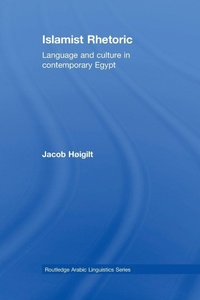
Islamist Rhetoric
Language and Culture in Contemporary Egypt
1st Edition
Published on 9. September 2013
Book
Paperback/Softback
216 pages
978-0-415-86082-6 (ISBN)
Description
Islamism in Egypt is more diversified in terms of its sociology and ideology than is usually assumed. Through linguistic analysis of Islamist rhetoric, this book sheds light upon attitudes towards other Muslims, religious authority and secular society.
Examining the rhetoric of three central Islamist figures in Egypt today - Yusuf al-Qaradawi, Amr Khalid and Muhammad Imara - the author investigates the connection between Islamist rhetoric and the social and political structures of the Islamic field in Egypt. Highlighting the diversity of Islamist rhetoric, the author argues that differences of form disclose sociological and ideological tensions. Grounded in Systemic Functional Grammar, the book explores three linguistic areas in detail: pronoun use, mood choices and configurations of processes and participants. The author explores how the writers relate to their readers and how they construe concepts that are central in the current Islamic revival, such as 'Islamic thought', 'Muslims', and 'the West'.
Introducing an alternative divide in Egyptian public debate - between text cultures rather than ideologies - this book approaches the topic of Islamism from a unique analytical perspective, offering an important addition to the existing literature in the areas of Middle Eastern society and politics, Arabic language and religious studies.
Examining the rhetoric of three central Islamist figures in Egypt today - Yusuf al-Qaradawi, Amr Khalid and Muhammad Imara - the author investigates the connection between Islamist rhetoric and the social and political structures of the Islamic field in Egypt. Highlighting the diversity of Islamist rhetoric, the author argues that differences of form disclose sociological and ideological tensions. Grounded in Systemic Functional Grammar, the book explores three linguistic areas in detail: pronoun use, mood choices and configurations of processes and participants. The author explores how the writers relate to their readers and how they construe concepts that are central in the current Islamic revival, such as 'Islamic thought', 'Muslims', and 'the West'.
Introducing an alternative divide in Egyptian public debate - between text cultures rather than ideologies - this book approaches the topic of Islamism from a unique analytical perspective, offering an important addition to the existing literature in the areas of Middle Eastern society and politics, Arabic language and religious studies.
More details
Series
Language
English
Place of publication
London
United Kingdom
Publishing group
Taylor & Francis Ltd
Target group
College/higher education
Illustrations
2 s/w Abbildungen, 2 s/w Zeichnungen, 7 s/w Tabellen
7 Tables, black and white; 2 Line drawings, black and white; 2 Illustrations, black and white
Dimensions
Height: 234 mm
Width: 156 mm
Thickness: 12 mm
Weight
336 gr
ISBN-13
978-0-415-86082-6 (9780415860826)
Copyright in bibliographic data and cover images is held by Nielsen Book Services Limited or by the publishers or by their respective licensors: all rights reserved.
Schweitzer Classification
Other editions
Additional editions
E-Book
02/2013
1st Edition
Routledge
€64.49
Available for download
E-Book
02/2013
1st Edition
Routledge
€64.49
Available for download
Book
09/2010
1st Edition
Routledge
€231.50
Shipment within 15-20 days
Person
Jacob Hoigilt is a Middle East researcher at Fafo Institute for Applied International Studies in Oslo, Norway. His main research interests include Islamism, Arabic sociolinguistics and politics in the Arab world.
Content
1. Introduction 2. Rhetorical Analysis and the Study of Social Reality 3. Islamic Ideology and the Public Sphere in Egypt 4. The Rhetoric of Religious Authority 5. The Rhetoric of Religious Passion 6. The Rhetoric of Religious Polemics 7. Rhetoric and Religious Ideology 8. Conclusion