

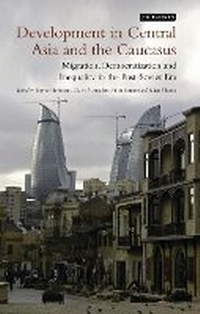
Development in Central Asia and the Caucasus
Migration, Democratisation and Inequality in the Post-Soviet Era
Published on 25. June 2014
Book
Hardback
416 pages
978-1-78076-579-2 (ISBN)
Description
After the final collapse of the Soviet Union, the so-called 'last empire', in 1991, the countries of Central Asia - Kazakhstan, Kyrgyzstan, Uzbekistan, Tajikistan, Turkmenistan - and of the Caucasus - Armenia, Azerbaijan, Georgia - became independent nations. These countries, previously production centres under the socialist planning system of the Soviet Union, have made enormous economic adjustments in order to develop - or attempt to develop - along capitalist lines. As this study will show, however, inequality in Central Asia and the Caucasus is widening, as the Soviet systems of healthcare and state provisions disappear. Rejecting the Cold War-era East/West paradigm often used to analyse the development of these nations, this study analyses development along the North-South lines which characterise the migration patterns and poverty levels of much of the rest of the developed world. This opens up new avenues of research, and helps us understand why it is, for instance, that this region is better characterised as a 'new South' - as skilled workers flood out of the territories and into Russia and Western Europe.
Development in Central Asia and the Caucasus draws together detailed analyses of the development of migration economics as the region's oil wealth further enhances its strategic and economic importance to Russia, the US, the Middle East and to the EU.
Development in Central Asia and the Caucasus draws together detailed analyses of the development of migration economics as the region's oil wealth further enhances its strategic and economic importance to Russia, the US, the Middle East and to the EU.
Reviews / Votes
'An insightful contribution to understanding post-Soviet Central Asia and the Caucasus in world politics and international development.' Olivier Ferrando, French Institute for Central Asian StudiesMore details
Language
English
Place of publication
United Kingdom
Publishing group
Bloomsbury Publishing PLC
Target group
College/higher education
Illustrations
6 bw integrated, 10 figures, 8 maps
Dimensions
Height: 216 mm
Width: 138 mm
Weight
626 gr
ISBN-13
978-1-78076-579-2 (9781780765792)
Copyright in bibliographic data and cover images is held by Nielsen Book Services Limited or by the publishers or by their respective licensors: all rights reserved.
Schweitzer Classification
Other editions
Additional editions
Sophie Hohmann | Claire Mouradian | Silvia Serrano
Development in Central Asia and the Caucasus
Migration, Democratisation and Inequality in the Post-Soviet Era
E-Book
06/2014
1st Edition
I.B. Tauris
€155.99
Available for download
Sophie Hohmann | Claire Mouradian | Silvia Serrano
Development in Central Asia and the Caucasus
Migration, Democratisation and Inequality in the Post-Soviet Era
E-Book
06/2014
I.B. Tauris
€155.99
Available for download
Persons
Sophie Hohmann holds a PhD in social sciences and demography from the EHESS (School of Advanced Studies in Social Sciences) in Paris. Claire Mouradian is senior research fellow at the CNRS (National Centre for Scientific Research) and coordinates Caucasian studies at the CERCEC (Centre for Russian, Caucasian and East-European studies). Silvia Serrano teaches political science at the Law faculty of the Universite d'Auvergne in Clermont-Ferrand and is a research fellow at the CERCEC. Julien Thorez is a research fellow of the CNRS in Paris and member of the unit 'Iranian and Indian Worlds' composed of researchers from the CNRS, EPHE (Practical School of Advanced Studies), Sorbonne Nouvelle and INALCO (National Institute for Oriental Languages and Civilisations).
Content
Introduction The Post-Soviet Caucasus and Central Asia: Another South? 10
Part 1 Post-Soviet Region or Post-Colonial Countries? 19
The Origins of a Colonial Vision of Southern Russia from the Tsars to the Soviets: Selected Imperial Practices in the Caucasus 20
'Trust in Cadres' and the Party-Based Control in Central Asia During the Brezhnev Era 41
Nations and Postcolonialism in Central Asia: Twenty Years Later 64
Functional Clusters and Diverging Paths in Post-Soviet South: The Georgian Case 77
Part 2 Development, Inequalities and Poverty 93
Systemic change in two Central Asian rentier states: Turkmenistan and Kazakhstan 94
Human Capital and Inequality in Tajikistan: Intercommunication and Interdependence 114
Measures of Poverty in the Caucasus and Central Asia: International Approaches and Specificities of Southern Countries of the Former Soviet Union 137
Part 3 The Growth of Labour Migrations. Toward a New North-South Relation? 158
The Post-Soviet Space From North to South: Discontinuities, Disparities and Migrations 159
Female Migration into Russia from Central Asian Countries: Migrants Researching Migrants 180
Labour Migrations in the Omsk Region: Administrative and Economic Workforce Management Practices and Construction of New Social Relations 196
Part 4 New Global Dynamics: States and international organizations Strategies 213
The State and the Diaspora Bureaucratic and Discursive Practices in the Construction of a Transnational Community 214
Turkey's presence in Central Asia: Political and cultural tools of the Turkish presence in Central Asia or the ambiguities of a nationalist modernisation model 242
Paradox of the 'Good Governance Agenda': Geopolitical Externalities and Development Practice in Tajikistan 263
Part 1 Post-Soviet Region or Post-Colonial Countries? 19
The Origins of a Colonial Vision of Southern Russia from the Tsars to the Soviets: Selected Imperial Practices in the Caucasus 20
'Trust in Cadres' and the Party-Based Control in Central Asia During the Brezhnev Era 41
Nations and Postcolonialism in Central Asia: Twenty Years Later 64
Functional Clusters and Diverging Paths in Post-Soviet South: The Georgian Case 77
Part 2 Development, Inequalities and Poverty 93
Systemic change in two Central Asian rentier states: Turkmenistan and Kazakhstan 94
Human Capital and Inequality in Tajikistan: Intercommunication and Interdependence 114
Measures of Poverty in the Caucasus and Central Asia: International Approaches and Specificities of Southern Countries of the Former Soviet Union 137
Part 3 The Growth of Labour Migrations. Toward a New North-South Relation? 158
The Post-Soviet Space From North to South: Discontinuities, Disparities and Migrations 159
Female Migration into Russia from Central Asian Countries: Migrants Researching Migrants 180
Labour Migrations in the Omsk Region: Administrative and Economic Workforce Management Practices and Construction of New Social Relations 196
Part 4 New Global Dynamics: States and international organizations Strategies 213
The State and the Diaspora Bureaucratic and Discursive Practices in the Construction of a Transnational Community 214
Turkey's presence in Central Asia: Political and cultural tools of the Turkish presence in Central Asia or the ambiguities of a nationalist modernisation model 242
Paradox of the 'Good Governance Agenda': Geopolitical Externalities and Development Practice in Tajikistan 263