

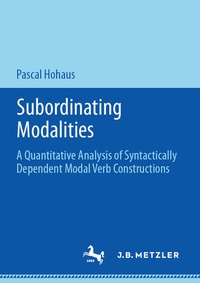
Subordinating Modalities
A Quantitative Analysis of Syntactically Dependent Modal Verb Constructions
Published on 27. February 2020
Book
Paperback/Softback
XV, 286 pages
978-3-476-05642-9 (ISBN)
Description
This study is concerned with the use of the English modals (may, might,can, could, shall, should, will, would and must) in adverbial, relative and complement clauses. It employs synchronic data from the British National Corpus and quantitative methods to investigate similarities and differences between the core modals, as well as modal-specific preferences in subordinate clauses. The main finding is that modal verbs in subordinate clauses may be conceived of as meso-constructions and that they qualify as micro-constructions once further syntagmatic features are considered. This allows for distinguishing modal verb phrases with different degrees of complexity, schematicity, productivity and subjectivity. Further applications give us insights into collocations, modal harmony, semantic preference, and the attraction of dynamic meaning to relative clauses.
More details
Edition
2020 ed.
Language
English
Place of publication
Stuttgart
Germany
Publishing group
J.B. Metzler, Part of Springer Nature - Springer-Verlag GmbH
Target group
Professional and scholarly
Illustrations
29 s/w Abbildungen
XV, 286 p. 29 illus.
Dimensions
Height: 210 mm
Width: 148 mm
Thickness: 17 mm
Weight
396 gr
ISBN-13
978-3-476-05642-9 (9783476056429)
DOI
10.1007/978-3-476-05643-6
Schweitzer Classification
Other editions
Additional editions
Pascal Hohaus
Subordinating Modalities
A Quantitative Analysis of Syntactically Dependent Modal Verb Constructions
E-Book
02/2020
1st Edition
J.B. Metzler
€90.94
Available for download
Person
The Author
Pascal Hohaus
worked as a PhD student at University of Hanover (2014-2019). He is currently coordinating the online study programs Business and Media Informatics at Ostfalia University of Applied Sciences (January 2020).
Content
Contents
Construction Grammar, Behavioural Profile Analysis.- Hierarchical Configural Frequency Analysis, Correspondence Analysis.- Monofactorial Analyses, Multifactorial Analyses.- Complexity, Schematicity, Productivity, Subjectivity.- Multicollinearity, Generalisability, Replicability.