

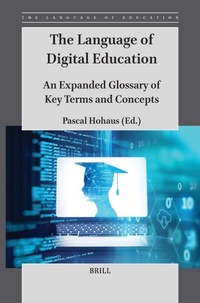
The Language of Digital Education
An Expanded Glossary of Key Terms and Concepts
Published on 18. December 2024
Book
Paperback/Softback
120 pages
978-90-04-71909-5 (ISBN)
Description
This book presents concise definitions and illustrative contexts for many approaches, ideas, and paradigms related to digital education. Unlike existing glossaries that often focus solely on technical terminology, this resource uniquely integrates pedagogical, technological, and socio-cultural perspectives. It not only defines terms but also critically examines their implications for teaching and learning, providing a more holistic understanding of digital education.
Contributors are: Isabel Balteiro, Miguel Angel Campos-Pardillos, Ka Long Roy Chan, Salvatore Ciancitto, Liubov Darzhinova, Derya Duran, Georgios Ellinas, Stella Hadjistassou, Pascal Hohaus, Teppo Jakonen, Marjut Johansson, Merve Kiymaz, Ioannis Lefkos, Ruslana Margova, Claudia Mustroph, Maarit Mutta, Svitlana Nasakina, Liisa Peura, Alessandro Puglisi, Violeta Stojicic, Ralia Thoma, Outi Veivo, Johanathan Woodworth and Siyang Zhou.
Contributors are: Isabel Balteiro, Miguel Angel Campos-Pardillos, Ka Long Roy Chan, Salvatore Ciancitto, Liubov Darzhinova, Derya Duran, Georgios Ellinas, Stella Hadjistassou, Pascal Hohaus, Teppo Jakonen, Marjut Johansson, Merve Kiymaz, Ioannis Lefkos, Ruslana Margova, Claudia Mustroph, Maarit Mutta, Svitlana Nasakina, Liisa Peura, Alessandro Puglisi, Violeta Stojicic, Ralia Thoma, Outi Veivo, Johanathan Woodworth and Siyang Zhou.
More details
Series
Language
English
Place of publication
Leiden
Netherlands
Target group
Professional and scholarly
Product notice
Paperback (trade)
Unsewn / adhesive bound
Dimensions
Height: 234 mm
Width: 161 mm
Thickness: 7 mm
Weight
191 gr
ISBN-13
978-90-04-71909-5 (9789004719095)
Copyright in bibliographic data and cover images is held by Nielsen Book Services Limited or by the publishers or by their respective licensors: all rights reserved.
Schweitzer Classification
Other editions
Additional editions
Book
12/2024
Brill
€192.50
Shipment within 10-20 days
Person
Pascal Hohaus, Leibniz University Hannover & Technische Universitaet Braunschweig, co-edited Re-Assessing Modalising Expressions: Categories, Co-text, and Context (John Benjamins, 2020) and The Future of Teacher Education: Innovations across Pedagogies, Technologies and Societies (Brill, 2023). He is also the editor of Science Communication in Times of Crisis (John Benjamins, 2022). His dissertation Subordinating Modalities: A Quantitative Analysis of Syntactically Dependent Modal Verb Constructions (J. B. Metzler, 2020) applies construction grammar to the use of modal verbs in subordinate clauses.
Content
Foreword: Embarking on a Transformative Journey with Digital Technologies in Education
?Michael A. Peters
Context and Terms in Digital Education
Action Research
Adaptive Courseware
Adaptive Learning
Asynchronous Learning
Audio Feedback
Augmented Reality (AR)
Automated Essay Scoring (AES)
Automated Writing Evaluation (AWE)
Automated Written Corrective Feedback (AWCF)
Blended Learning
Cognitive Load Theory (CLT)
Cognitive Theory of Multimedia Learning (CTML)
Collaborative Writing
Community of Inquiry
Computer Adaptive Test (CAT)
Computer-Aided Language Learning (CALL)
Computer-Mediated Communication (CMC)
Computer Simulation
Connectivism
Corpus Linguistics
Courseware
Culture of Digitality
Debunking
Differentiated Instruction (DI)
DigCompEdu
DigCompOrg
Digital Citizenship
Digital Curriculum Development
Digital Disconnection
Digital Game-Based Learning (DGBL)
Digital Literacy
Digital Literature
Digital Materials Development
Digital Multimodal Composing (DMC)
English for Specific Purposes (ESP)
E-Portfolio
E-Tutor
Evidentiality
Eye Tracking
Fact-Checking
Fake News
Flipped Classroom
Gamification
Human-Robot Interaction (HRI)
Hybrid Feedback
Hybrid Teaching
Inclusive Education
Inequity
Inquiry-Based Learning (IBL)
Large Language Model (LLM)
Learning Transfer
Lifelong Learning
Massive Open Online Course (MOOC)
Misinformation
Multiliteracies
Multimodal Embodiment in Robot-Assisted Language Learning (RALL)
Multimodality
Nano Online Open Course (NOOC)
Natural Language Processing (NLP)
Netnography
Open Educational Practices (OEP)
Open Educational Resources (OER)
Parental Attitudes to Digital Education
Personal Learning Environment (PLE)
Plagiarism
Prebunking
Productive Competencies
Receptive Competencies
Robot-Assisted Language Learning (RALL)
Robot Literacy
Scenario-Based Learning
Screencast Feedback
Self-Paced Learning
Social Media
Speech Technologies
Stem Education
Synchronous Learning
Teacher Education
Teacher Professional Development
Technological Pedagogical Content Knowledge (TPACK)
Technology-Enhanced Language Assessment
Telecollaboration
Telepresence Robots
Tools for Assessment
Tools for Collaboration
Tools for Video Conferencing
Universal Design for Learning (UDL)
Video Feedback
Virtual Exchange
Virtual Laboratories
Virtual Learning Environment (VLE)
Virtual Reality (VR)
Web-Based Learning
Appendix A: Organizations in the Field of Digital Education
Notes on Contributors
?Michael A. Peters
Context and Terms in Digital Education
Action Research
Adaptive Courseware
Adaptive Learning
Asynchronous Learning
Audio Feedback
Augmented Reality (AR)
Automated Essay Scoring (AES)
Automated Writing Evaluation (AWE)
Automated Written Corrective Feedback (AWCF)
Blended Learning
Cognitive Load Theory (CLT)
Cognitive Theory of Multimedia Learning (CTML)
Collaborative Writing
Community of Inquiry
Computer Adaptive Test (CAT)
Computer-Aided Language Learning (CALL)
Computer-Mediated Communication (CMC)
Computer Simulation
Connectivism
Corpus Linguistics
Courseware
Culture of Digitality
Debunking
Differentiated Instruction (DI)
DigCompEdu
DigCompOrg
Digital Citizenship
Digital Curriculum Development
Digital Disconnection
Digital Game-Based Learning (DGBL)
Digital Literacy
Digital Literature
Digital Materials Development
Digital Multimodal Composing (DMC)
English for Specific Purposes (ESP)
E-Portfolio
E-Tutor
Evidentiality
Eye Tracking
Fact-Checking
Fake News
Flipped Classroom
Gamification
Human-Robot Interaction (HRI)
Hybrid Feedback
Hybrid Teaching
Inclusive Education
Inequity
Inquiry-Based Learning (IBL)
Large Language Model (LLM)
Learning Transfer
Lifelong Learning
Massive Open Online Course (MOOC)
Misinformation
Multiliteracies
Multimodal Embodiment in Robot-Assisted Language Learning (RALL)
Multimodality
Nano Online Open Course (NOOC)
Natural Language Processing (NLP)
Netnography
Open Educational Practices (OEP)
Open Educational Resources (OER)
Parental Attitudes to Digital Education
Personal Learning Environment (PLE)
Plagiarism
Prebunking
Productive Competencies
Receptive Competencies
Robot-Assisted Language Learning (RALL)
Robot Literacy
Scenario-Based Learning
Screencast Feedback
Self-Paced Learning
Social Media
Speech Technologies
Stem Education
Synchronous Learning
Teacher Education
Teacher Professional Development
Technological Pedagogical Content Knowledge (TPACK)
Technology-Enhanced Language Assessment
Telecollaboration
Telepresence Robots
Tools for Assessment
Tools for Collaboration
Tools for Video Conferencing
Universal Design for Learning (UDL)
Video Feedback
Virtual Exchange
Virtual Laboratories
Virtual Learning Environment (VLE)
Virtual Reality (VR)
Web-Based Learning
Appendix A: Organizations in the Field of Digital Education
Notes on Contributors