

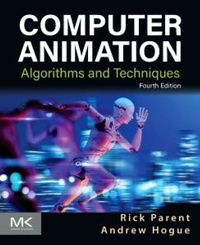
Computer Animation
Algorithms and Techniques
4th Edition
Will be published approx. on 6. March 2026
Book
Paperback/Softback
576 pages
978-0-443-13512-5 (ISBN)
Description
Computer Animation: Algorithms and Techniques, Fourth Edition surveys computer algorithms and programming techniques for specifying and generating motion for graphical objects, that is, computer animation. It is primarily concerned with three-dimensional (3D) computer animation. In this edition, the most current techniques are covered along with the theory and high-level computation that have earned the book a reputation as the best technically oriented animation resource. As in previous editions, the book addresses practical issues, provides accessible techniques, and offers straightforward implementations.
More details
Edition
4th edition
Language
English
Place of publication
San Francisco
United States
Publishing group
Elsevier Science & Technology
Target group
College/higher education
Product notice
Paperback (trade)
Unsewn / adhesive bound
Dimensions
Height: 234 mm
Width: 190 mm
Thickness: 26 mm
Weight
998 gr
ISBN-13
978-0-443-13512-5 (9780443135125)
Copyright in bibliographic data and cover images is held by Nielsen Book Services Limited or by the publishers or by their respective licensors: all rights reserved.
Schweitzer Classification
Other editions
Additional editions
E-Book
12/2025
4th Edition
Morgan Kaufmann
€61.99
Available for download
Previous edition
Book
10/2012
3rd Edition
Morgan Kaufmann
€63.50
Shipment within 15-20 days
Persons
Dr. Andrew Hogue is an Associate Professor at Ontario Tech University within the Faculty of Business and Information Technology's Game Development and Entrepreneurship program. His research interests include the development and evaluation of game design techniques for education, stereoscopic visualization and virtual reality. He is currently interested in understanding how environmental, technology and design parameters affect the user experience in virtual reality. During his Master of Science studies at York University, he developed hardware and software for immersive virtual reality displays, as well as a variety of stereoscopic 3D applications to evaluate the effectiveness of head-tracking on user immersion. He has been the driving force behind the design and development of the Game Development Lab at Ontario Tech University, ensuring it has the latest emerging technology for undergraduate and graduate student training/research. Through his past involvement in the Immersive Visual environment project at York University, he has gained interests in psychophysics, stereoscopic 3D, and determining the factors for engagement and immersion in simulation. Dr. Hogue has supervised more than 40 undergraduates as summer research students and fourth-year Capstone projects, and five graduate (MSc/PhD) students. He has also been involved in securing more than $4 million in research funds for a variety of robotics and simulation projects. He has published more than 30 refereed journal and conference articles. Rick Parent is a Professor Emeritus in the Computer Science and Engineering Department of Ohio State University (OSU). As a graduate student, Rick worked at the Computer Graphics Research Group (CGRG) at OSU under the direction of Charles Csuri. In 1977, he received his Ph.D. from the Computer and Information Science (CIS) Department, majoring in Artificial Intelligence. For the next three years, he worked at CGRG first as a Research Associate, and then as Associate Director. In 1980 he co-founded and was President of The Computer Animation Company. In 1985, he joined the faculty of the CIS Department (now the Department of Computer Science and Engineering, or CSE) at Ohio State. Rick's research interests include various aspects of computer animation with special focus on animation of the human figure.
Content
1. Introduction
2. Technical Background
3. Interpolating Values
4. Three-Dimensional Shape Interpolation
5. Forward Kinematics
6. Motion Capture
7. Physically Based Animation
8. Fluids
9. Modeling and Animating Human Figures
10. Facial Animation
11. Behavioral Animation
12. Special Models for Animation
13. The Future of Animation
2. Technical Background
3. Interpolating Values
4. Three-Dimensional Shape Interpolation
5. Forward Kinematics
6. Motion Capture
7. Physically Based Animation
8. Fluids
9. Modeling and Animating Human Figures
10. Facial Animation
11. Behavioral Animation
12. Special Models for Animation
13. The Future of Animation