

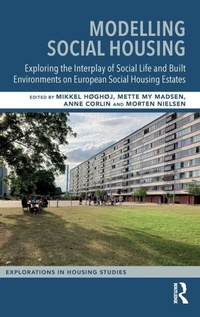
Modelling Social Housing
Exploring the Interplay of Social Life and Built Environments on European Social Housing Estates
1st Edition
Will be published approx. on 28. November 2025
Book
Hardback
216 pages
978-1-032-93402-0 (ISBN)
Description
Modelling Social Housing delves into the intricate relationship between everyday social life and the architectural landscapes of social housing across European cities.
Focusing on social housing across multiple temporal and socio-cultural European urban settings, this book traces how the confluence of distributed knowledges, technological resources, and architectural histories may have considerable effects across different scales, ranging from everyday interactions to welfare planning and economic policies. To capture these intricate socio-spatial relations, this book introduces the concept of 'social urban modelling' as a novel analytical approach to social housing research. Spanning historical trajectories, contemporary challenges, and future potentials, this book brings together scholars from diverse fields including architecture, history, anthropology, sociology, geography, and art history. Through examinations of architectural designs, urban planning assemblages, contemporary redevelopment projects, and everyday appropriations by residents, this book unveils the intricate layers of social housing dynamics in European cities. From the adoption of Mediterranean and Islamic architectural typologies in mid-twentieth century Denmark to the innovative bureaucratic structures of the London County Council in post-war Britain, each chapter provides new insights into the spatial and social transformations of European social housing. Through empirical cases from across Europe, we ask: How might resident-driven initiatives reshape urban landscapes? What are the implications of densification processes on social housing estates? And how do private investors influence the social fabric of these communities?
With its timely interdisciplinary exploration of the modelling capacities of social housing estates, this book will provide an indispensable resource for scholars, practitioners, and policymakers engaged in housing studies, urban development, and architectural history.
Focusing on social housing across multiple temporal and socio-cultural European urban settings, this book traces how the confluence of distributed knowledges, technological resources, and architectural histories may have considerable effects across different scales, ranging from everyday interactions to welfare planning and economic policies. To capture these intricate socio-spatial relations, this book introduces the concept of 'social urban modelling' as a novel analytical approach to social housing research. Spanning historical trajectories, contemporary challenges, and future potentials, this book brings together scholars from diverse fields including architecture, history, anthropology, sociology, geography, and art history. Through examinations of architectural designs, urban planning assemblages, contemporary redevelopment projects, and everyday appropriations by residents, this book unveils the intricate layers of social housing dynamics in European cities. From the adoption of Mediterranean and Islamic architectural typologies in mid-twentieth century Denmark to the innovative bureaucratic structures of the London County Council in post-war Britain, each chapter provides new insights into the spatial and social transformations of European social housing. Through empirical cases from across Europe, we ask: How might resident-driven initiatives reshape urban landscapes? What are the implications of densification processes on social housing estates? And how do private investors influence the social fabric of these communities?
With its timely interdisciplinary exploration of the modelling capacities of social housing estates, this book will provide an indispensable resource for scholars, practitioners, and policymakers engaged in housing studies, urban development, and architectural history.
More details
Series
Language
English
Place of publication
London
United Kingdom
Publishing group
Taylor & Francis Ltd
Target group
College/higher education
Professional and scholarly
Academic, Postgraduate, and Undergraduate Advanced
Illustrations
25 s/w Abbildungen, 18 s/w Photographien bzw. Rasterbilder, 7 s/w Zeichnungen
7 Line drawings, black and white; 18 Halftones, black and white; 25 Illustrations, black and white
Dimensions
Height: 240 mm
Width: 161 mm
Thickness: 17 mm
Weight
520 gr
ISBN-13
978-1-032-93402-0 (9781032934020)
Copyright in bibliographic data and cover images is held by Nielsen Book Services Limited or by the publishers or by their respective licensors: all rights reserved.
Schweitzer Classification
Other editions
Additional editions
Mikkel Hoghoj | Mette My Madsen | Anne Corlin
Modelling Social Housing
Exploring the Interplay of Social Life and Built Environments on European Social Housing Estates
E-Book
11/2025
Routledge
€60.49
Available for download
Mikkel Hoghoj | Mette My Madsen | Anne Corlin
Modelling Social Housing
Exploring the Interplay of Social Life and Built Environments on European Social Housing Estates
E-Book
11/2025
Routledge
€60.49
Available for download
Persons
Mikkel Hoghoj is a cultural historian specialized in modern and contemporary Nordic urban, planning, and welfare history. His research deals widely with the urban and environmental history of the Danish welfare society. He is a researcher and curator in the Danish Museum of Science and Technology and holds a PhD in urban history from Aarhus University.
Mette My Madsen is a postdoctoral researcher and PI at the Research Centre for Social Urban Modelling at the National Museum of Denmark specialized in the cross-field between urban planning and social coherence in the region of Denmark/North. Her research includes formal and informal social organization, welfare-governing, insurgent infrastructure and circular economy. She holds a PhD in anthropology from the University of Copenhagen.
Anne Corlin is Assistant Professor at the Aarhus School of Architecture, where she teaches Urban design in the master's programme Desirable Densities. Her research revolves around socially sustainable urban design and how to design neighbourhoods for community building, focusing on both the design processes and the spatial and physical design.
Morten Nielsen is a social anthropologist working on socially sustainable urban development. Since November 2018, he has been based at the National Museum of Denmark as Research Professor and Head of the Research Center for Social Urban Modelling (SUMO).
Mette My Madsen is a postdoctoral researcher and PI at the Research Centre for Social Urban Modelling at the National Museum of Denmark specialized in the cross-field between urban planning and social coherence in the region of Denmark/North. Her research includes formal and informal social organization, welfare-governing, insurgent infrastructure and circular economy. She holds a PhD in anthropology from the University of Copenhagen.
Anne Corlin is Assistant Professor at the Aarhus School of Architecture, where she teaches Urban design in the master's programme Desirable Densities. Her research revolves around socially sustainable urban design and how to design neighbourhoods for community building, focusing on both the design processes and the spatial and physical design.
Morten Nielsen is a social anthropologist working on socially sustainable urban development. Since November 2018, he has been based at the National Museum of Denmark as Research Professor and Head of the Research Center for Social Urban Modelling (SUMO).
Content
List of figures
List of contributors
1. Introduction: Exploring the Modelling Capacities of Social Housing
Mikkel Hoghoj, Mette My Madsen, Anne Corlin and Morten Nielsen
Part I: Inventing and implementing new models of housing
2. A Danish Kasbah? The Mediterranean-Islamic Homes and Town Centres as Models of Danish Dense-Low Housing (1950s-1980s)
Dorian Bianco
3. Everything in Its Right Place: Henry Roberts' Model Houses and the Fabrication of the Model Family
Joshua Tan
4. Planning, Play, and Participation: The Extra-Parliamentary Residents' Playground at Hoje Gladsaxe (1969) as a Model for Sociospatial Transformation and Engaging Urban Citizenship
Martin Soberg
Part II: Scales and complexity of planning and design
5. Model Assemblages and the Multiple Potentials of Stockholm's 1952 General Plan
Sued Ferreira da Silva and Johan Pries
6. An Architecture of Paperwork: The London County Council's Collaborative Bureaucracy
Jesse Honsa
7. Ecocritical Domo-graphy
Antonio Bernacchi and Alicia Lazzaroni
Part III: Contemporary projects of intervention and transformation
8. Artistic Interventions in Large-scale Urban Transformation Projects
Line Marie Bruun Jespersen and Rune Chr. Bach
9. The Role of Private Investors and Developers in the Social Transformation of Non-Profit Housing Estates
Anne Clementsen
10. Reconfiguring Orders of Worth: A Comparative Analysis of Densification Processes on Social Housing Estates in Denmark and Japan
Nicola C. Thomas
Part IV: Everyday appropriations and resident practices
11. Mimicking Municipal Models: The Potentials and Pitfalls of Resident-Driven Development in Forced Regeneration of Danish Non-Profit Housing
Adam Veng
12. Whose Place is it? Remodelling and Reappropriating Danish Social Housing
Marie Stender
13. Social Housing Beyond the City: Migration and Remote Productions of Welfare on the Danish Island of Lolland
Trine Brinkmann
14. Epilogue: Models that Make us Act
Albena Yaneva
Index
List of contributors
1. Introduction: Exploring the Modelling Capacities of Social Housing
Mikkel Hoghoj, Mette My Madsen, Anne Corlin and Morten Nielsen
Part I: Inventing and implementing new models of housing
2. A Danish Kasbah? The Mediterranean-Islamic Homes and Town Centres as Models of Danish Dense-Low Housing (1950s-1980s)
Dorian Bianco
3. Everything in Its Right Place: Henry Roberts' Model Houses and the Fabrication of the Model Family
Joshua Tan
4. Planning, Play, and Participation: The Extra-Parliamentary Residents' Playground at Hoje Gladsaxe (1969) as a Model for Sociospatial Transformation and Engaging Urban Citizenship
Martin Soberg
Part II: Scales and complexity of planning and design
5. Model Assemblages and the Multiple Potentials of Stockholm's 1952 General Plan
Sued Ferreira da Silva and Johan Pries
6. An Architecture of Paperwork: The London County Council's Collaborative Bureaucracy
Jesse Honsa
7. Ecocritical Domo-graphy
Antonio Bernacchi and Alicia Lazzaroni
Part III: Contemporary projects of intervention and transformation
8. Artistic Interventions in Large-scale Urban Transformation Projects
Line Marie Bruun Jespersen and Rune Chr. Bach
9. The Role of Private Investors and Developers in the Social Transformation of Non-Profit Housing Estates
Anne Clementsen
10. Reconfiguring Orders of Worth: A Comparative Analysis of Densification Processes on Social Housing Estates in Denmark and Japan
Nicola C. Thomas
Part IV: Everyday appropriations and resident practices
11. Mimicking Municipal Models: The Potentials and Pitfalls of Resident-Driven Development in Forced Regeneration of Danish Non-Profit Housing
Adam Veng
12. Whose Place is it? Remodelling and Reappropriating Danish Social Housing
Marie Stender
13. Social Housing Beyond the City: Migration and Remote Productions of Welfare on the Danish Island of Lolland
Trine Brinkmann
14. Epilogue: Models that Make us Act
Albena Yaneva
Index