

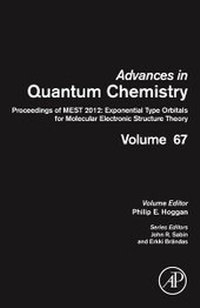
Proceedings of MEST 2012: Exponential Type Orbitals for Molecular Electronic Structure Theory: Volume 67
Published on 30. December 2013
Book
Hardback
312 pages
978-0-12-411544-6 (ISBN)
Description
Advances in Quantum Chemistry presents surveys of current topics in this rapidly developing field that has emerged at the cross section of the historically established areas of mathematics, physics, chemistry, and biology. It features detailed reviews written by leading international researchers. This volume focuses on the theory of heavy ion physics in medicine.
More details
Series
Language
English
Place of publication
San Diego
United States
Publishing group
Elsevier Science Publishing Co Inc
Target group
Professional and scholarly
Quantum chemists, physical chemists, physicists
Dimensions
Height: 229 mm
Width: 152 mm
Weight
540 gr
ISBN-13
978-0-12-411544-6 (9780124115446)
Copyright in bibliographic data and cover images is held by Nielsen Book Services Limited or by the publishers or by their respective licensors: all rights reserved.
Schweitzer Classification
Other editions
Additional editions
E-Book
11/2013
Academic Press
€185.00
Available for download
Person
Born in Aberystwyth, Wales and educated at Trinity College Cambridge, Philip Hoggan has always been French and British. After a mathematical chemistry background, he has studied a number of theoretical systems, with a DSc by research obtained in 1991 at Nancy, France on the way physical interaction between molecules and solid surfaces is a precursor to catalysis. This was treated entirely on the basis of Quantum Mechanics and applied, first to cis-trans butadiene isomerization on alumina and then a number of 'organic' reactions.
The first lectureship was at Caen, Normandy from 1992. This period led to some fundamental research of ab initio Slater electronic structure calculations for more than 3 atoms. The first related code STOP was published in February 1996 after much work by a postdoctoral fellow A. Bouferguene, now Professor at U Alberta. After continuing to study catalytic systems at Caen, from a theoretical viewpoint, Philip Hoggan was appointed to the Chair of Theoretical Chemistry in Clermont from May 1998. This is still essentially his teaching position, although research interests have switched to solid-state (surface) physics joining the Pascal Institute for physics in Clermont from 2005. This followed a visiting professor stay of 18 months at Tallahassee, Florida in Theoretical Physics.
Research emphasis has shifted from the STOP era (where the problem was solved by Coulomb Resolution in 2008) to Quantum Monte Carlo (QMC). The CNRS paid leave for a couple of years for Philip Hoggan to learn about this technique from Cyrus Umrigar, Julien Toulouse, Michel Caffarel and others. Of course, it eventually led to a project to calculate catalytic reactions on metal surfaces that was initiated by G-J Kroes (Leiden, NL) and his ERC in 2014. K Doblhoff-Dier arrived in Clermont for a ground-breaking research fellowship and each of us continues to produce very accurate work e.g. on hydrogen (production and dissociation on metals), as a clean fuel for renewable energy.
Now, in 2023 we enter the 400th anniversary of Blaise Pascal's birth. He invented calculators, some of which are in the Clermont museum. It is wonderful to work in the institute that bears his name conducting QMC on catalytic hydrogen synthesis on super-calculators: the tools that trace their roots to his 'Pascaline'.
Philip Hoggan is married and has twin daughters.
The first lectureship was at Caen, Normandy from 1992. This period led to some fundamental research of ab initio Slater electronic structure calculations for more than 3 atoms. The first related code STOP was published in February 1996 after much work by a postdoctoral fellow A. Bouferguene, now Professor at U Alberta. After continuing to study catalytic systems at Caen, from a theoretical viewpoint, Philip Hoggan was appointed to the Chair of Theoretical Chemistry in Clermont from May 1998. This is still essentially his teaching position, although research interests have switched to solid-state (surface) physics joining the Pascal Institute for physics in Clermont from 2005. This followed a visiting professor stay of 18 months at Tallahassee, Florida in Theoretical Physics.
Research emphasis has shifted from the STOP era (where the problem was solved by Coulomb Resolution in 2008) to Quantum Monte Carlo (QMC). The CNRS paid leave for a couple of years for Philip Hoggan to learn about this technique from Cyrus Umrigar, Julien Toulouse, Michel Caffarel and others. Of course, it eventually led to a project to calculate catalytic reactions on metal surfaces that was initiated by G-J Kroes (Leiden, NL) and his ERC in 2014. K Doblhoff-Dier arrived in Clermont for a ground-breaking research fellowship and each of us continues to produce very accurate work e.g. on hydrogen (production and dissociation on metals), as a clean fuel for renewable energy.
Now, in 2023 we enter the 400th anniversary of Blaise Pascal's birth. He invented calculators, some of which are in the Clermont museum. It is wonderful to work in the institute that bears his name conducting QMC on catalytic hydrogen synthesis on super-calculators: the tools that trace their roots to his 'Pascaline'.
Philip Hoggan is married and has twin daughters.
Content
Fully Correlated Wavefunctions for Three-and Four-Body Systems - Frank E. Harris and Victor V. Albert
Electron and Electron-Pair Number and Momentum Densities for Low-Lying States of He, H?, and Li+ - Ajit J. Thakkar and Shane P. McCarthy
A Basis Sets Composed of Only 1s Slater Orbitals and 1s Gaussian Orbitals to Perform Molecular Calculations, SCF-LCAO Approach - J. E. Perez , O. E. Taurian, J. C. Cesco, A. E. Rosso, C. C. Denner, C. J. Alturria Lanzardo, F. S. Ortiz and A. Bouferguene
On a Transformation for the Electrostatic Potential, Generated by the Product of Two 1s Slater Type Orbitals, Giving an Efficient Expression - J. E. Perez, O. E. Taurian, A. Bouferguene and Philip E. Hoggan
d-dimensional Kepler-Coulomb Sturmians and Hyperspherical Harmonics as Complete Orthonormal Atomic and Molecular Orbitals - Cecilia Coletti, Danilo Calderini and Vincenzo Aquilanti
Fast Electron Repulsion Integrals for Molecular Coulomb Sturmians - James Emil Avery
Three-Body Coulomb Problems with Generalized Sturmian Functions - G. Gasaneo, L. U. Ancarani, D. M. Mitnik, J. M. Randazzo, A. L. Frapiccini and F. D. Colavecchia
Further Improvements on - ETOs with Hyperbolic Cosine Functions and Their Effectiveness in Atomic Calculations - S. Aksoy, S. Firat and M. Erturk
Reducing and Solving Electric Multipole Moment Integrals - Niyazi Yuekcue and Emin OEztekin
Recurrence Relations for Radial Parts of STOs and Evaluation of Overlap Integrals via the Fourier Transform Methods - S. OEzay and E. OEztekin
On the ?-decay in the Li and Li atoms - Maria Belen Ruiz and Alexei M. Frolov
Electron and Electron-Pair Number and Momentum Densities for Low-Lying States of He, H?, and Li+ - Ajit J. Thakkar and Shane P. McCarthy
A Basis Sets Composed of Only 1s Slater Orbitals and 1s Gaussian Orbitals to Perform Molecular Calculations, SCF-LCAO Approach - J. E. Perez , O. E. Taurian, J. C. Cesco, A. E. Rosso, C. C. Denner, C. J. Alturria Lanzardo, F. S. Ortiz and A. Bouferguene
On a Transformation for the Electrostatic Potential, Generated by the Product of Two 1s Slater Type Orbitals, Giving an Efficient Expression - J. E. Perez, O. E. Taurian, A. Bouferguene and Philip E. Hoggan
d-dimensional Kepler-Coulomb Sturmians and Hyperspherical Harmonics as Complete Orthonormal Atomic and Molecular Orbitals - Cecilia Coletti, Danilo Calderini and Vincenzo Aquilanti
Fast Electron Repulsion Integrals for Molecular Coulomb Sturmians - James Emil Avery
Three-Body Coulomb Problems with Generalized Sturmian Functions - G. Gasaneo, L. U. Ancarani, D. M. Mitnik, J. M. Randazzo, A. L. Frapiccini and F. D. Colavecchia
Further Improvements on - ETOs with Hyperbolic Cosine Functions and Their Effectiveness in Atomic Calculations - S. Aksoy, S. Firat and M. Erturk
Reducing and Solving Electric Multipole Moment Integrals - Niyazi Yuekcue and Emin OEztekin
Recurrence Relations for Radial Parts of STOs and Evaluation of Overlap Integrals via the Fourier Transform Methods - S. OEzay and E. OEztekin
On the ?-decay in the Li and Li atoms - Maria Belen Ruiz and Alexei M. Frolov