

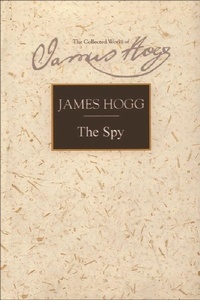
The Spy
A Periodical Paper of Literary Amusement and Instruction
Will be published approx. on 15. March 2000
Book
Hardback
712 pages
978-0-7486-1417-2 (ISBN)
Description
Hogg's extremely rare periodical of 1810-11 shows him reacting to the writers, personalities, and locales of Scotland's capital city after his move to Edinburgh from Ettrick and his career-change from shepherd and farmer to professional author. His characteristically astute and idiosyncratic vision reveals a rather different city from that of Walter Scott and Francis Jeffrey, and his band of contributors form another audience for his work than the middle-class Tories associated with the later Blackwood's Edinburgh Magazine. The Spy includes early versions of some of Hogg's best-known poetry and prose besides a wealth of fascinating lesser-known material.This is the first edition of The Spy since the original edition of 1810-11 was published, and offers a carefully corrected text, full annotation, notes on Hogg's contributors to his paper, and a history of its making. It represents an advance in our knowledge both of Hogg's early writing career and of the city he encountered early in the nineteenth century.
Reviews / Votes
When complete, Mack's edition will contain more volumes than the Waverley Novels. Hogg, so vitally displaced, yet so easily able to articulate his native terrain, is finding his true home at last ! In her shrewd and elegant introduction to the Spy, Gillian Hughes points out that by 1809 Hogg [ ! ] urgently needed money, work, company. He had to reinvent himself. The Spy was his solution ! Reprinting the periodical in full, Gillian Hughes lets us see all the more clearly the milieu in which Hogg's deep and tricksy gift acquired its protean flexibility. Here, cannily, he learned the taste of the market, but he did not simply follow fashion. Experimenting with points of view, tuning and retuning his voices, he became the author who would write some of the strangest fiction of his age, and whose sense of generic mobility would take him from being an exponent of the ballad and essay to a pioneer of the short-story form. The Spy documents his self-education as a writer. Through it he made himself, for good and bad, a Romantic icon. -- Robert Crawford The text of a literary magazine published by Hogg in 1810-11 containing fascinating insights not only into the poet but also the Edinburgh of his day. Again, superbly annotated, very handsomely produced, the publication of this shows real confidence in Scottish writers and their universal appeal ! This is a bold, masterly stroke in Scottish publishing. A volume as handsome as its predecessors in the Stirling/South Carolina Research Edition. We can indeed delight on proving Hogg wrong in his prediction that The Spy would never be printed. When complete, Mack's edition will contain more volumes than the Waverley Novels. Hogg, so vitally displaced, yet so easily able to articulate his native terrain, is finding his true home at last ! In her shrewd and elegant introduction to the Spy, Gillian Hughes points out that by 1809 Hogg [ ! ] urgently needed money, work, company. He had to reinvent himself. The Spy was his solution ! Reprinting the periodical in full, Gillian Hughes lets us see all the more clearly the milieu in which Hogg's deep and tricksy gift acquired its protean flexibility. Here, cannily, he learned the taste of the market, but he did not simply follow fashion. Experimenting with points of view, tuning and retuning his voices, he became the author who would write some of the strangest fiction of his age, and whose sense of generic mobility would take him from being an exponent of the ballad and essay to a pioneer of the short-story form. The Spy documents his self-education as a writer. Through it he made himself, for good and bad, a Romantic icon. The text of a literary magazine published by Hogg in 1810-11 containing fascinating insights not only into the poet but also the Edinburgh of his day. Again, superbly annotated, very handsomely produced, the publication of this shows real confidence in Scottish writers and their universal appeal ! This is a bold, masterly stroke in Scottish publishing. A volume as handsome as its predecessors in the Stirling/South Carolina Research Edition. We can indeed delight on proving Hogg wrong in his prediction that The Spy would never be printed.More details
Series
Language
English
Place of publication
Edinburgh
United Kingdom
Target group
Professional and scholarly
Product notice
sewn/stitched
Cloth over boards
Dimensions
Height: 240 mm
Width: 161 mm
Thickness: 58 mm
Weight
1184 gr
ISBN-13
978-0-7486-1417-2 (9780748614172)
Copyright in bibliographic data and cover images is held by Nielsen Book Services Limited or by the publishers or by their respective licensors: all rights reserved.
Schweitzer Classification
Persons
James Hogg was a Scottish poet, novelist and essayist who wrote in both Scots and English. He is best known for his novel The Private Memoirs and Confessions of a Justified Sinner. Gillian Hughes, Independent Scholar, has been a General Editor of the Stirling/South Carolina Research Edition of the Collected Works of James Hogg, and is currently an advisory editor for the Edinburgh Edition of Walter Scott's Poetry and for the New Edinburgh Edition of the Works of Robert Louis Stevenson. She has published critical editions of works by each of these writers, and also a biography of James Hogg.