

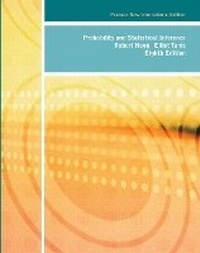
Probability and Statistical Inference: Pearson New International Edition
8th Edition
Published on 23. July 2013
Book
Mixed media product
640 pages
978-1-292-02478-3 (ISBN)
Description
Written by two leading statisticians, this applied introduction to the mathematics of probability and statistics emphasizes the existence of variation in almost every process, and how the study of probability and statistics helps us understand this variation. Designed for students with a background in calculus, this book continues to reinforce basic mathematical concepts with numerous real-world examples and applications to illustrate the relevance of key concepts.
More details
Edition
8th edition
Language
English
Place of publication
Harlow
United Kingdom
Target group
Adult education
Dimensions
Height: 275 mm
Width: 215 mm
Thickness: 20 mm
Weight
1142 gr
ISBN-13
978-1-292-02478-3 (9781292024783)
Copyright in bibliographic data and cover images is held by Nielsen Book Services Limited or by the publishers or by their respective licensors: all rights reserved.
Schweitzer Classification
Other editions
New editions
Robert Hogg | Elliot Tanis | Dale Zimmerman
Probability and Statistical Inference, Global Edition
Book
10/2014
9th Edition
Pearson Education Limited
€111.60
Shipment within 10-20 days
Previous edition
Book
03/2009
8th Edition
Pearson
€139.57
Article exhausted; check for reprint
Content
Preface
Prologue
1. Probability
1.1 Basic Concepts
1.2 Properties of Probability
1.3 Methods of Enumeration
1.4 Conditional Probability
1.5 Independent Events
1.6 Bayes's Theorem
2. Discrete Distributions
2.1 Random Variables of the Discrete Type
2.2 Mathematical Expectation
2.3 The Mean, Variance, and Standard Deviation
2.4 Bernoulli Trials and the Binomial Distribution
2.5 The Moment-Generating Function
2.6 The Poisson Distribution
3. Continuous Distributions
3.1 Continuous-Type Data
3.2 Exploratory Data Analysis
3.3 Random Variables of the Continuous Type
3.4 The Uniform and Exponential Distributions
3.5 The Gamma and Chi-Square Distributions
3.6 The Normal Distribution
3.7 Additional Models
4. Bivariate Distributions
4.1 Distributions of Two Random Variables
4.2 The Correlation Coefficient
4.3 Conditional Distributions
4.4 The Bivariate Normal Distribution
5. Distributions of Functions of Random Variables
5.1 Functions of One Random Variable
5.2 Transformations of Two Random Variables
5.3 Several Independent Random Variables
5.4 The Moment-Generating Function Technique
5.5 Random Functions Associated with Normal Distributions
5.6 The Central Limit Theorem
5.7 Approximations for Discrete Distributions
6. Estimation
6.1 Point Estimation
6.2 Confidence Intervals for Means
6.3 Confidence Intervals for Difference of Two Means
6.4 Confidence Intervals for Variances
6.5 Confidence Intervals for Proportions
6.6 Sample Size.
6.7 A Simple Regression Problem
6.8 More Regression
7. Tests of Statistical Hypotheses
7.1 Tests about Proportions
7.2 Tests about One Mean
7.3 Tests of the Equality of Two Means
7.4 Tests for Variances
7.5 One-Factor Analysis of Variance
7.6 Two-Factor Analysis of Variance
7.7 Tests Concerning Regression and Correlation
8. Nonparametric Methods
8.1 Chi-Square Goodness of Fit Tests
8.2 Contingency Tables
8.3 Order Statistics
8.4 Distribution-Free Confidence Intervals for Percentiles
8.5 The Wilcoxon Tests
8.6 Run Test and Test for Randomness
8.7 Kolmogorov-Smirnov Goodness of Fit Test
8.8 Resampling Methods
9. Bayesian Methods
9.1 Subjective Probability
9.2 Bayesian Estimation
9.3 More Bayesian Concepts
10. Quality Improvement Through Statistical Methods
10.1 Time Sequences
10.2 Statistical Quality Control
10.3 General Factorial and 2k Factorial Designs
10.4 Understanding Variation
11. Some Theory
11.1 Sufficient Statistics
11.2 Power of a Statistical Test
11.3 Best Critical Regions
11.4 Likelihood Ratio Tests
11.5 Chebyshev's Inequality and Convergence in Probability
11.6 Limiting Moment-Generating Functions
11.7 Asymptotic Distributions of Maximum Likelihood Estimators
A. Review of Selected Mathematical Techniques
A.1 Algebra of Sets
A.2 Mathematical Tools for the Hypergeometric Distribution
A.3 Limits
A.4 Infinite Series
A.5 Integration
A.6 Multivariate Calculus
B. References
C. Tables
D. Answers to Odd-Numbered Exercises
Prologue
1. Probability
1.1 Basic Concepts
1.2 Properties of Probability
1.3 Methods of Enumeration
1.4 Conditional Probability
1.5 Independent Events
1.6 Bayes's Theorem
2. Discrete Distributions
2.1 Random Variables of the Discrete Type
2.2 Mathematical Expectation
2.3 The Mean, Variance, and Standard Deviation
2.4 Bernoulli Trials and the Binomial Distribution
2.5 The Moment-Generating Function
2.6 The Poisson Distribution
3. Continuous Distributions
3.1 Continuous-Type Data
3.2 Exploratory Data Analysis
3.3 Random Variables of the Continuous Type
3.4 The Uniform and Exponential Distributions
3.5 The Gamma and Chi-Square Distributions
3.6 The Normal Distribution
3.7 Additional Models
4. Bivariate Distributions
4.1 Distributions of Two Random Variables
4.2 The Correlation Coefficient
4.3 Conditional Distributions
4.4 The Bivariate Normal Distribution
5. Distributions of Functions of Random Variables
5.1 Functions of One Random Variable
5.2 Transformations of Two Random Variables
5.3 Several Independent Random Variables
5.4 The Moment-Generating Function Technique
5.5 Random Functions Associated with Normal Distributions
5.6 The Central Limit Theorem
5.7 Approximations for Discrete Distributions
6. Estimation
6.1 Point Estimation
6.2 Confidence Intervals for Means
6.3 Confidence Intervals for Difference of Two Means
6.4 Confidence Intervals for Variances
6.5 Confidence Intervals for Proportions
6.6 Sample Size.
6.7 A Simple Regression Problem
6.8 More Regression
7. Tests of Statistical Hypotheses
7.1 Tests about Proportions
7.2 Tests about One Mean
7.3 Tests of the Equality of Two Means
7.4 Tests for Variances
7.5 One-Factor Analysis of Variance
7.6 Two-Factor Analysis of Variance
7.7 Tests Concerning Regression and Correlation
8. Nonparametric Methods
8.1 Chi-Square Goodness of Fit Tests
8.2 Contingency Tables
8.3 Order Statistics
8.4 Distribution-Free Confidence Intervals for Percentiles
8.5 The Wilcoxon Tests
8.6 Run Test and Test for Randomness
8.7 Kolmogorov-Smirnov Goodness of Fit Test
8.8 Resampling Methods
9. Bayesian Methods
9.1 Subjective Probability
9.2 Bayesian Estimation
9.3 More Bayesian Concepts
10. Quality Improvement Through Statistical Methods
10.1 Time Sequences
10.2 Statistical Quality Control
10.3 General Factorial and 2k Factorial Designs
10.4 Understanding Variation
11. Some Theory
11.1 Sufficient Statistics
11.2 Power of a Statistical Test
11.3 Best Critical Regions
11.4 Likelihood Ratio Tests
11.5 Chebyshev's Inequality and Convergence in Probability
11.6 Limiting Moment-Generating Functions
11.7 Asymptotic Distributions of Maximum Likelihood Estimators
A. Review of Selected Mathematical Techniques
A.1 Algebra of Sets
A.2 Mathematical Tools for the Hypergeometric Distribution
A.3 Limits
A.4 Infinite Series
A.5 Integration
A.6 Multivariate Calculus
B. References
C. Tables
D. Answers to Odd-Numbered Exercises