

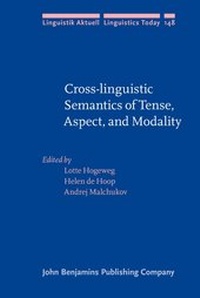
Cross-linguistic Semantics of Tense, Aspect, and Modality
Published on 30. November 2009
Book
Hardback
406 pages
978-90-272-5531-0 (ISBN)
Description
In recent years, we have witnessed, on the one hand, an increased interest in cross-linguistic data in formal semantic studies, and, on the other hand, an increased concern for semantic issues in language typology. However, only few studies combine semantic and typological research for a particular semantic domain (such as the papers in Bach et al. (1995) on quantification and Smith (1997) on aspect). This book brings together formal semanticists with a cross-linguistic perspective and/or those working on lesser-known languages, and typologists interested in semantic theory, to discuss semantic variation in the specific domain of Tense, Aspect, and Mood/Modality.
More details
Series
Language
English
Place of publication
Amsterdam
Netherlands
Target group
Professional and scholarly
Dimensions
Height: 245 mm
Width: 164 mm
Weight
890 gr
ISBN-13
978-90-272-5531-0 (9789027255310)
Copyright in bibliographic data and cover images is held by Nielsen Book Services Limited or by the publishers or by their respective licensors: all rights reserved.
Schweitzer Classification
Other editions
Additional editions
Lotte Hogeweg | Helen de Hoop | Andrej Malchukov
Cross-linguistic Semantics of Tense, Aspect, and Modality
E-Book
11/2009
1st Edition
John Benjamins Publishing Company
€130.99
Available for download
Persons
Content
1. Preface; 2. The semantics of tense, aspect and modality in the languages of the world (by Hogeweg, Lotte); 3. Incompatible categories: Resolving the "present perfective paradox" (by Malchukov, Andrej); 4. The perfective/imperfective distinction: Coercion or aspectual operators? (by Bary, Corien); 5. Lexical and compositional factors in the aspectual system of Adyghe (by Arkadiev, Peter M.); 6. Event structure of non-culminating accomplishments (by Tatevosov, Sergei); 7. The grammaticalised use of the Burmese verbs la 'come' and thwa 'go' (by Romeo, Nicoletta); 8. Irrealis in Yurakare and other languages: On the cross-linguistic consistency of an elusive category (by Gijn, Rik van); 9. On the selection of mood in complement clauses (by Marques, Rui); 10. 'Out of control' marking as circumstantial modality in St'at'imcets (by Davis, Henry); 11. Modal geometry: Remarks on the structure of a modal map (by Schepper, Kees de); 12. Acquisitive modals (by Auwera, Johan van der); 13. Conflicting constraints on the interpretation of modal auxiliaries (by Foolen, Ad); 14. Modality and context dependence (by Nauze, Fabrice); 15. Verbal semantic shifts under negation, intensionality, and imperfectivity: Russian genitive objects (by Partee, Barbara H.); 16. The Estonian partitive evidential: Some notes on the semantic parallels between aspect and evidential categories (by Tamm, Anne); 17. Index