

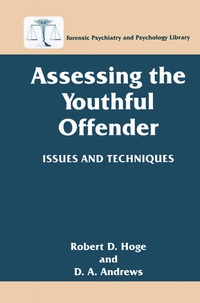
Assessing the Youthful Offender
Issues and Techniques
Published on 31. December 1996
Book
Paperback/Softback
XV, 139 pages
978-0-306-45467-7 (ISBN)
Description
Our society's preoccupation with crime and fear of crime appears to have shifted its focus to the juvenile offender. Both electronic and print media continuously warn us that juvenile offenders are increasingly younger and more virulent. The demographics of our population suggest that there will only be more juvenile offenders to fear in the near future. All of these concerns arise in a social climate that is characterized by an ever increasing demand for stronger retributive measures against the offender. The belief that only harsh justice will protect us from the ravages of juveniles has become dominant. Increasingly, perceptions and politics, rather than scientific data, dominate policy making with regard to youthful offenders. In Assessing the Youthful Offender: Issues and Techniques, Robert D. Hoge and D. A. Andrews make a restrained, rational, and ultimately persuasive argu ment for the use of standardized psychological assessments in the effective management of youth within juvenile justice systems. They clarify how what we already know about the cause and management of youthful criminal activity can be incorporated into standardized testing and that the information obtained from testing can improve the administration of criminal justice. Moreover, this informa tion is useful whatever the theoretical biases of those who administer the justice system. The efficiency of policies of either retribution, deterrence, or rehabilitation is only enhanced by reliance on data.
Reviews / Votes
` ...the book lies in its clear outline of the differentiation between models of juvenile justice and the implications of the different models for the offender. The summary of the diagnostics tools available to the forensic decision maker is also extremely useful. However, the most impressive contribution of this book is in the excellent tables which provide succinct and accessible summaries of the major issues, which will be of interest not only to those system. 'Legal and Criminological Psychology, 6 (2001)
More details
Series
Edition
Softcover reprint of the original 1st ed. 1996
Language
English
Place of publication
New York
United States
Publishing group
Springer Science+Business Media
Target group
Professional and scholarly
Research
Illustrations
XV, 139 p.
Dimensions
Height: 235 mm
Width: 155 mm
Thickness: 9 mm
Weight
248 gr
ISBN-13
978-0-306-45467-7 (9780306454677)
DOI
10.1007/978-1-4757-9296-6
Schweitzer Classification
Other editions
Additional editions
E-Book
06/2013
Springer
€96.29
Available for download
Book
12/1996
Plenum Publishing Co.,N.Y.
€106.99
Shipment within 10-15 days
Content
1. Conceptual and Theoretical Background.- 2. Decision Making within Juvenile Justice Systems.- 3. The Role of Psychological Assessments in the Juvenile Justice Decision Process.- 4. Assessing Aptitudes and Achievement Levels.- 5. Assessing Personality, Attitudes, and Behaviors.- 6. Assessing Environmental Factors.- 7. Diagnostic and Classification Systems.- 8. Conclusions and Recommendations.- Appendix 1: Instruments and Procedures Identified in This Volume.- Appendix 2: Addresses of Major Test Publishers.- References.- Author Index.