

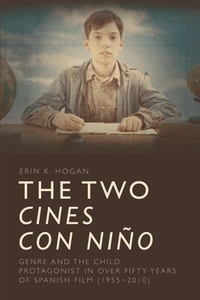
The Two cines con nino
Genre and the Child Protagonist in Over Fifty Years of Spanish Film (1955-2010)
Published on 12. September 2018
Book
Hardback
244 pages
978-1-4744-3611-3 (ISBN)
Description
This is the first genre study of child-starred cinemas from Spain. It illuminates continuities in the political use of the child protagonist in over fifty years of Spanish cinema and how the child-starred genres deploy the concept of childhood to retrospectively define the nation and its future.
From Francoist popular to oppositional auteur films, and including Spanish and Latin American cinema, this monograph examines commonalities in aesthetics, narratives and genre functions. It demonstrates the impact of these narratives within Spanish film history and Francoist biopolitics, as well as providing a broader transatlantic perspective on the genre in select productions from Chile and Argentina.
From Francoist popular to oppositional auteur films, and including Spanish and Latin American cinema, this monograph examines commonalities in aesthetics, narratives and genre functions. It demonstrates the impact of these narratives within Spanish film history and Francoist biopolitics, as well as providing a broader transatlantic perspective on the genre in select productions from Chile and Argentina.
Reviews / Votes
The clarity of Hogan's writing and the striking historical ambition of her chapters mean that The Two 'cines con nino' will be a key resource for students and researchers interested in the child in Hispanic cinemas across the twentieth and twenty-?rst centuries. -- Geoffrey Maguire, University of Cambridge * Bulletin of Spanish Visual Studies * In this extraordinarily rich study, Erin Hogan helps us to understand the distinction of the child in Spanish cinema as well as its resilience. Using dialogism as theoretical frame of reference, this intelligent book shows how the child has been variously ventriloquized and how it has learned to talk back. Through exhilarating close readings of films which speak to one another through time or across geographical boundaries, the child transforms from biopolitical tool into a flexible icon with which to interrogate some of the most deeply held precepts of Spanish culture. -- Professor Sarah Wright, Royal Holloway, University of LondonMore details
Language
English
Place of publication
Edinburgh
United Kingdom
Target group
Professional and scholarly
Product notice
sewn/stitched
Cloth over boards
Illustrations
27 black and white illustrations
Dimensions
Height: 236 mm
Width: 163 mm
Thickness: 18 mm
Weight
540 gr
ISBN-13
978-1-4744-3611-3 (9781474436113)
Copyright in bibliographic data and cover images is held by Nielsen Book Services Limited or by the publishers or by their respective licensors: all rights reserved.
Schweitzer Classification
Other editions
Additional editions
Erin K. Hogan
Two cines con nino
Genre and the Child Protagonist in Fifty Years of Spanish Film (1955-2010)
E-Book
08/2018
1st Edition
Edinburgh University Press
€24.49
Available for download
Person
Erin Hogan is an Assistant Professor of Spanish at the University of Maryland, Baltimore County. Dr. Hogan's scholarship on the construction of childhood in Hispanic literary, visual and cinematic arts since the eighteenth century has appeared in 'Studies in Spanish and Latin American Cinemas', 'Hispanic Research Journal' and 'The Comparatist', along with edited volumes.
Content
ACKNOWLEDGEMENTS
LIST OF ILLUSTRATIONS
INTRODUCTION. The Two cines con nino: The Ventriloquism, Dialogism and Biopolitics of the Children of Franco in Genre Film
CHAPTER ONE. The Black Market and the Stolen Children of Franco in Demonios en el jardin (Gutierrez Aragon 1982)
CHAPTER TWO. The Appropriative and Carnivalesque Ventriloquism of Altar Boys from Joselito in El pequeno ruisenor (del Amo 1956) to Ignacio in La mala educacion (Almodovar 2004)
CHAPTER THREE. Ventriloquism, Kidnapping and the Carnivalesque in Marisol's Tombola (Lucia 1962)
CHAPTER FOUR. Adopting, Adapting, Appropriating in the cines con nino: Un rayo de luz (Lucia 1960) and El viaje de Carol (Uribe 2002)
CHAPTER FIVE. Prosopopeia and the Gothic Child from Marcelino pan y vino (Vajda 1955) to El orfanato (Bayona 2007)
CHAPTER SIX. Dialogism and Ritual Function of the nuevo cine con nino: El espiritu de la colmena (Erice 1973), Secretos del corazon (Armendariz 1997) and El laberinto del fauno (Del Toro 2006)
CHAPTER SEVEN. Queering Postwar Childhood in Urte ilunak (Lazkano 1992) and Pa negre (Villaronga 2010)
CHAPTER EIGHT. The Transatlantic Dialogism in Narrative and Aesthetics of Bildungsfilms: La lengua de las mariposas (Cuerda 1999 Spain) & Machuca (Wood 2004 Chile), El espiritu de la colmena (Erice 1973 Spain) & El premio (Markovitch 2011 Argentina-Mexico), El laberinto del fauno (Del Toro 2006 Spain-Mexico) & Infancia clandestina (Avila 2011 Argentina)
CONCLUSION. Spanish Movies: Genre, Nation and Spanish Movie (Ruiz Caldera 2009)
SELECT FILMOGRAPHY
BIBLIOGRAPHY
LIST OF ILLUSTRATIONS
INTRODUCTION. The Two cines con nino: The Ventriloquism, Dialogism and Biopolitics of the Children of Franco in Genre Film
CHAPTER ONE. The Black Market and the Stolen Children of Franco in Demonios en el jardin (Gutierrez Aragon 1982)
CHAPTER TWO. The Appropriative and Carnivalesque Ventriloquism of Altar Boys from Joselito in El pequeno ruisenor (del Amo 1956) to Ignacio in La mala educacion (Almodovar 2004)
CHAPTER THREE. Ventriloquism, Kidnapping and the Carnivalesque in Marisol's Tombola (Lucia 1962)
CHAPTER FOUR. Adopting, Adapting, Appropriating in the cines con nino: Un rayo de luz (Lucia 1960) and El viaje de Carol (Uribe 2002)
CHAPTER FIVE. Prosopopeia and the Gothic Child from Marcelino pan y vino (Vajda 1955) to El orfanato (Bayona 2007)
CHAPTER SIX. Dialogism and Ritual Function of the nuevo cine con nino: El espiritu de la colmena (Erice 1973), Secretos del corazon (Armendariz 1997) and El laberinto del fauno (Del Toro 2006)
CHAPTER SEVEN. Queering Postwar Childhood in Urte ilunak (Lazkano 1992) and Pa negre (Villaronga 2010)
CHAPTER EIGHT. The Transatlantic Dialogism in Narrative and Aesthetics of Bildungsfilms: La lengua de las mariposas (Cuerda 1999 Spain) & Machuca (Wood 2004 Chile), El espiritu de la colmena (Erice 1973 Spain) & El premio (Markovitch 2011 Argentina-Mexico), El laberinto del fauno (Del Toro 2006 Spain-Mexico) & Infancia clandestina (Avila 2011 Argentina)
CONCLUSION. Spanish Movies: Genre, Nation and Spanish Movie (Ruiz Caldera 2009)
SELECT FILMOGRAPHY
BIBLIOGRAPHY