

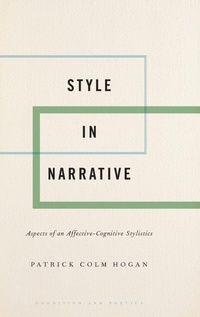
Style in Narrative
Aspects of an Affective-Cognitive Stylistics
Published on 1. March 2021
Book
Hardback
320 pages
978-0-19-753957-6 (ISBN)
Description
Literary style is something many people talk about, but few could define. Yet it is crucial for our response to narrative art. Style can facilitate or obscure the events of a story or the motivations of a character, enhance the aesthetic appeal of a narrative or complicate its emotional impact, and even inflect the political or ethical implications of a work. It is precisely this complex operation of style that Patrick Colm Hogan explains in Style in Narrative.
Drawing on recent psychological research, this book proposes a new and clear definition of style and provides a systematic theoretical account of style in relation to cognitive and affective science. Hogan's definition stresses that style varies by both scope, or the range of text or texts that may share a style, and level, the components of an individual work that might involve a shared style. The book uses rich examples from literature, film, and graphic fiction, including analysis of Virginia Woolf's Mrs. Dalloway, Shakespeare's canon, William Faulkner's As I Lay Dying, and Art Spiegelman's Maus, as well as visual analysis of films by Robert Rodriguez, Deepa Mehta, Eric Rohmer, M.F.Husain, Yasujiro Ozu, and Chuan Lu. Through these studies Hogan identifies stylistic concerns common across mediums as well as the most consequential stylistic differences between them.
Bringing together three often separated mediums within a coherent framework, Style in Narrative makes an important contribution to and necessary intervention in the field of stylistics.
Drawing on recent psychological research, this book proposes a new and clear definition of style and provides a systematic theoretical account of style in relation to cognitive and affective science. Hogan's definition stresses that style varies by both scope, or the range of text or texts that may share a style, and level, the components of an individual work that might involve a shared style. The book uses rich examples from literature, film, and graphic fiction, including analysis of Virginia Woolf's Mrs. Dalloway, Shakespeare's canon, William Faulkner's As I Lay Dying, and Art Spiegelman's Maus, as well as visual analysis of films by Robert Rodriguez, Deepa Mehta, Eric Rohmer, M.F.Husain, Yasujiro Ozu, and Chuan Lu. Through these studies Hogan identifies stylistic concerns common across mediums as well as the most consequential stylistic differences between them.
Bringing together three often separated mediums within a coherent framework, Style in Narrative makes an important contribution to and necessary intervention in the field of stylistics.
Reviews / Votes
Throughout Hogan demonstrates the intellectual and practical value of stylistic analysis as a means of understanding, appreciating, and producing narratives. Recommended. Upper-division undergraduates through faculty and professionals. * J. D. Harding, Saint Leo University, CHOICE * Hogan applies research from cognitive and affective science to develop a new branch of stylistics he calls affective-cognitive stylistics. . . . Throughout Hogan demonstrates the intellectual and practical value of stylistic analysis as a means of understanding, appreciating, and producing narratives. * CHOICE * It is a beautifully written and gratifying text. * William Brown, Projections: The Journal for Movies and Mind *More details
Series
Language
English
Place of publication
New York
United States
Target group
Professional and scholarly
Illustrations
85
Dimensions
Height: 240 mm
Width: 161 mm
Thickness: 25 mm
Weight
867 gr
ISBN-13
978-0-19-753957-6 (9780197539576)
Copyright in bibliographic data and cover images is held by Nielsen Book Services Limited or by the publishers or by their respective licensors: all rights reserved.
Schweitzer Classification
Other editions
Additional editions
E-Book
11/2020
OUP eBook
€62.99
Available for download
E-Book
11/2020
OUP eBook
€62.99
Available for download
Person
Patrick Colm Hogan is a Board of Trustees Distinguished Professor in the English Department and the Cognitive Science Program at the University of Connecticut. Hogan is the author of twenty-four books and over 200 articles and book chapters, as well as the editor or co-editor of five books, six special issues of journals, and the web-based Literary Universals Project. His research combines cognitive and affective science with narrative theory to address problems in literary aesthetics and politics.
Content
Introduction. Cognitive and Affective Stylistics
Part One: Literature
I. Literary Style
II. Story Structure: Shakespeare and the Integration of Genres
III. Verbal Narration: Ambiguities of Faulkner's As I Lay Dying
Part Two: Film
IV. Film Style
V. Perceptual Interface and Painterly Cinema: Three Minutes of Robert Rodriguez's Sin City
VI. Emplotment: Ellipsis and Excess in Yasujiro Ozu's Postwar Films
VII. Visual Narration: Embodiment and Point of View in Lu Chuan's Nanjing! Nanjing!
Part Three: Graphic Narrative
VIII. Stylistic Choices in Graphic Narrative: Particularity and Its Functions
in Art Spiegelman's Maus
Afterword. Keep Stylistics Great: A Note on Politics and the Analysis of Style
Works Cited
Part One: Literature
I. Literary Style
II. Story Structure: Shakespeare and the Integration of Genres
III. Verbal Narration: Ambiguities of Faulkner's As I Lay Dying
Part Two: Film
IV. Film Style
V. Perceptual Interface and Painterly Cinema: Three Minutes of Robert Rodriguez's Sin City
VI. Emplotment: Ellipsis and Excess in Yasujiro Ozu's Postwar Films
VII. Visual Narration: Embodiment and Point of View in Lu Chuan's Nanjing! Nanjing!
Part Three: Graphic Narrative
VIII. Stylistic Choices in Graphic Narrative: Particularity and Its Functions
in Art Spiegelman's Maus
Afterword. Keep Stylistics Great: A Note on Politics and the Analysis of Style
Works Cited