

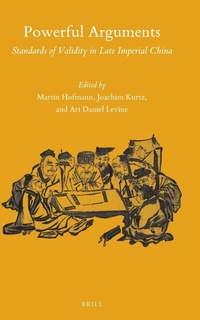
Powerful Arguments
Standards of Validity in Late Imperial China
Published on 5. March 2020
Book
Hardback
634 pages
978-90-04-42280-3 (ISBN)
Description
The essays in Powerful Arguments reconstruct the standards of validity underlying argumentative practices in a wide array of late imperial Chinese discourses, from the Song through the Qing dynasties. The fourteen case studies analyze concrete arguments defended or contested in areas ranging from historiography, philosophy, law, and religion to natural studies, literature, and the civil examination system. By examining uses of evidence, habits of inference, and the criteria by which some arguments were judged to be more persuasive than others, the contributions recreate distinct cultures of reasoning. Together, they lay the foundations for a history of argumentative practice in one of the richest scholarly traditions outside of Europe and add a chapter to the as yet elusive global history of rationality.
More details
Series
Language
English
Place of publication
Leiden
Netherlands
Target group
Professional and scholarly
Product notice
sewn/stitched
Cloth over boards
Dimensions
Height: 236 mm
Width: 155 mm
Thickness: 41 mm
Weight
1043 gr
ISBN-13
978-90-04-42280-3 (9789004422803)
Copyright in bibliographic data and cover images is held by Nielsen Book Services Limited or by the publishers or by their respective licensors: all rights reserved.
Schweitzer Classification
Persons
Martin Hofmann, Ph.D. (2007) is Assistant Professor for East Asian Intellectual History at Heidelberg University's Centre for Asian and Transcultural Studies. He has mainly published on historical cartography, practices of argumentation, and the text-image relation in late imperial China.
Joachim Kurtz, Ph.D. (2003), is Professor of Intellectual History at Heidelberg University. He is the author of The Discovery of Chinese Logic (Brill, 2011), and has published widely on circulations of knowledge between China and Europe.
Ari Daniel Levine, Ph.D (2002) is Associate Professor of History at the University of Georgia. The author of Divided by a Common Language (University of Hawai'i Press, 2008), he is currently the Editor of the Journal of Song-Yuan Studies.
Joachim Kurtz, Ph.D. (2003), is Professor of Intellectual History at Heidelberg University. He is the author of The Discovery of Chinese Logic (Brill, 2011), and has published widely on circulations of knowledge between China and Europe.
Ari Daniel Levine, Ph.D (2002) is Associate Professor of History at the University of Georgia. The author of Divided by a Common Language (University of Hawai'i Press, 2008), he is currently the Editor of the Journal of Song-Yuan Studies.
Content
Contents
Acknowledgements
List of Figures
Notes on Contributors
Introduction: Toward a History of Argumentative Practice in Late Imperial China
?Martin Hofmann, Joachim Kurtz, and Ari Daniel Levine
Part 1: Comparison, Collation, Validation
?1?Historical and Political Arguments: Debates on the Veritable Records in the Ming Dynasty (1368-1644)
??Peter Ditmanson
?2?A Performance of Transparency: Discourses of Veracity and Practices of Verification in Li Tao's Long Draft
??Ari Daniel Levine
?3?Learning with Metal and Stone: On the Discursive Formation of Song Epigraphy
??Jeffrey Moser
Part 2: Visualization, Demonstration, Calculation
?4?The Persuasive Power of Tu: A Case Study on Commentaries to the Book of Documents
??Martin Hofmann
?5?Inductive Arguments in the Midst of Smoke: "Proving" Rhetorically and Visually That Algorithms Work
??Andrea Breard
?6?Keeping Your Ear to the Cosmos: Coherence as the Standard of Good Music in the Northern Song
??Ya Zuo
?7?The Textual Nature of Nature: Astronomical Debates in Eighteenth-Century China
??Ori Sela
Part 3: Verification, Evaluation, Authentication
?8?Identity Verification as a Standard of Validity in Late Imperial Civil Service Examinations
??John Williams
?9?Standards of Validity and Essay Grading in Early Qing Civil Service Examinations
??Li Yu??
?10?Some Problems with Corpses: Standards of Validity in Qing Homicide Cases
??Matthew H. Sommer
?11?Value and Validity: Seeing through Silver in Late Imperial China
??Bruce Rusk
Part 4: Corroboration, Refutation, Presentation
?12?Philological Arguments as Religious Suasion: Liu Ning and His Study of Chinese Characters
??Pingyi Chu
?13?A Moral Verdict of Reasonable Doubts: Ouyi Zhixu's Argumentative Strategies in the Collection of Refutations against Vicious Doctrines
??Manuel Sassmann
?14?Reasoning in Style: The Formation of "Logical Writing" in Late Qing China
??Joachim Kurtz
Index
Acknowledgements
List of Figures
Notes on Contributors
Introduction: Toward a History of Argumentative Practice in Late Imperial China
?Martin Hofmann, Joachim Kurtz, and Ari Daniel Levine
Part 1: Comparison, Collation, Validation
?1?Historical and Political Arguments: Debates on the Veritable Records in the Ming Dynasty (1368-1644)
??Peter Ditmanson
?2?A Performance of Transparency: Discourses of Veracity and Practices of Verification in Li Tao's Long Draft
??Ari Daniel Levine
?3?Learning with Metal and Stone: On the Discursive Formation of Song Epigraphy
??Jeffrey Moser
Part 2: Visualization, Demonstration, Calculation
?4?The Persuasive Power of Tu: A Case Study on Commentaries to the Book of Documents
??Martin Hofmann
?5?Inductive Arguments in the Midst of Smoke: "Proving" Rhetorically and Visually That Algorithms Work
??Andrea Breard
?6?Keeping Your Ear to the Cosmos: Coherence as the Standard of Good Music in the Northern Song
??Ya Zuo
?7?The Textual Nature of Nature: Astronomical Debates in Eighteenth-Century China
??Ori Sela
Part 3: Verification, Evaluation, Authentication
?8?Identity Verification as a Standard of Validity in Late Imperial Civil Service Examinations
??John Williams
?9?Standards of Validity and Essay Grading in Early Qing Civil Service Examinations
??Li Yu??
?10?Some Problems with Corpses: Standards of Validity in Qing Homicide Cases
??Matthew H. Sommer
?11?Value and Validity: Seeing through Silver in Late Imperial China
??Bruce Rusk
Part 4: Corroboration, Refutation, Presentation
?12?Philological Arguments as Religious Suasion: Liu Ning and His Study of Chinese Characters
??Pingyi Chu
?13?A Moral Verdict of Reasonable Doubts: Ouyi Zhixu's Argumentative Strategies in the Collection of Refutations against Vicious Doctrines
??Manuel Sassmann
?14?Reasoning in Style: The Formation of "Logical Writing" in Late Qing China
??Joachim Kurtz
Index