

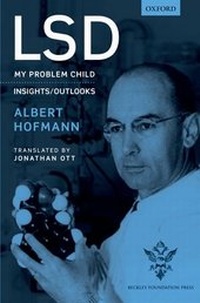
LSD
My problem child
Published on 28. March 2013
Book
Hardback
248 pages
978-0-19-963941-0 (ISBN)
Description
Albert Hofmann, who died in 2008 aged 102, first synthesized lysergic acid diethylamide (LSD) in 1938, but the results of animal tests were so unremarkable that the chemical was abandoned. Driven by intuition, he synthesized it again in 1943, and serendipitously noticed its profound effects on himself. Although his work produced other important drugs, including methergine, hydergine and dihydroergotamine, it was LSD that shaped his career.
After his discovery of LSD's properties, Hofmann spent years researching sacred plants. He succeeded in isolating and synthesizing the active compounds in the Psilocybe mexicana mushroom, which he named psilocybin and psilocin. During the 60s, Hofmann struck up friendships with personalities such as Aldous Huxley, Gordon Wasson, and Timothy Leary. He continued to work at Sandoz until 1971 when he retired as Director of Research for the Department of Natural Products. He subsequently served as a
member of the Nobel Prize Committee, and was nominated by Time magazine as one of the most influential figures of the 20th century.
In 2007, Albert Hofmann asked Amanda Feilding if she could publish his Problem Child, and shortly before his death he approved a new and updated translation of his autobiography (first published by McGraw Hill in 1979). It appears here for the first time in print.
After his discovery of LSD's properties, Hofmann spent years researching sacred plants. He succeeded in isolating and synthesizing the active compounds in the Psilocybe mexicana mushroom, which he named psilocybin and psilocin. During the 60s, Hofmann struck up friendships with personalities such as Aldous Huxley, Gordon Wasson, and Timothy Leary. He continued to work at Sandoz until 1971 when he retired as Director of Research for the Department of Natural Products. He subsequently served as a
member of the Nobel Prize Committee, and was nominated by Time magazine as one of the most influential figures of the 20th century.
In 2007, Albert Hofmann asked Amanda Feilding if she could publish his Problem Child, and shortly before his death he approved a new and updated translation of his autobiography (first published by McGraw Hill in 1979). It appears here for the first time in print.
Reviews / Votes
Hofmann's LSD will be of high interest to a wide audience of curious and scientifically minded readers. Few books about how science unfolds are as captivating and intriguing as this volume. * Journal of Clinical Psychiatry *More details
Language
English
Place of publication
Oxford
United Kingdom
Target group
College/higher education
Professional and scholarly
Anyone interested in psychology, philosophy, and the history of the counterculture
Dimensions
Height: 240 mm
Width: 162 mm
Thickness: 20 mm
Weight
586 gr
ISBN-13
978-0-19-963941-0 (9780199639410)
Copyright in bibliographic data and cover images is held by Nielsen Book Services Limited or by the publishers or by their respective licensors: all rights reserved.
Schweitzer Classification
Other editions
Additional editions
Book
12/2018
Oxford University Press
€40.40
Shipment within 15-20 days
Persons
Albert Hofmann is one of the most important scientists of our time, whose discoveries have powerfully influenced culture, society and science. Until its prohibition LSD was seen as a consciousness -expanding "wonder-drug", inducing self-awareness. Between 1943 and 1970 it generated almost 10,000 scientific publications, leading to its description as "the most intensively researched pharmacological substance ever".
Hofmann realised that a substance with such profound effects on perception was likely to arouse interest beyond the medical field - though he never expected it to find worldwie recreational use. But "the more its use as an inebriant was disseminated... the more LSD became a problem child." And so LSD was prohibited in the late 1960s, and scientific research into its properties was terminated in the early 1970s.
Hofmann realised that a substance with such profound effects on perception was likely to arouse interest beyond the medical field - though he never expected it to find worldwie recreational use. But "the more its use as an inebriant was disseminated... the more LSD became a problem child." And so LSD was prohibited in the late 1960s, and scientific research into its properties was terminated in the early 1970s.
Content
FOREWORD BY AMANDA FEILDING ; TRANSLATOR'S PREFACE BY JONATHAN OTT ; LSD: MY PROBLEM CHILD ; INSIGHTS/OUTLOOKS