

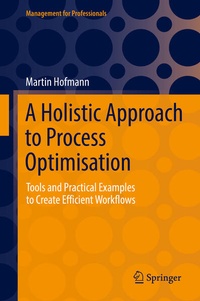
A Holistic Approach to Process Optimisation
Tools and Practical Examples to Create Efficient Workflows
Published on 30. July 2021
Book
Hardback
XIII, 186 pages
978-3-658-34096-4 (ISBN)
Description
This book provides an overview of the various methods for creating and implementing efficient work processes. The author presents the most important tools for working on improvement projects such as process mapping, Ishikawa diagram, burn-down chart, or Pareto chart. Using successfully realized improvement projects from practice, the concrete implementation of process optimization is illustrated. In addition, it is shown how these methods, which originate from the production sector, can be successfully used in the office sector.
More details
Series
Edition
2021 ed.
Language
English
Place of publication
Wiesbaden
Germany
Publishing group
Springer Fachmedien Wiesbaden GmbH
Target group
Professional and scholarly
Illustrations
93 s/w Abbildungen
XIII, 186 p. 93 illus.
Dimensions
Height: 241 mm
Width: 160 mm
Thickness: 17 mm
Weight
471 gr
ISBN-13
978-3-658-34096-4 (9783658340964)
DOI
10.1007/978-3-658-34097-1
Schweitzer Classification
Other editions
Additional editions
Martin Hofmann
A Holistic Approach to Process Optimisation
Tools and Practical Examples to Create Efficient Workflows
Book
07/2022
Springer
€53.49
Shipment within 10-15 days
Martin Hofmann
A Holistic Approach to Process Optimisation
Tools and Practical Examples to Create Efficient Workflows
E-Book
07/2021
1st Edition
Springer
€53.49
Available for download
Person
Martin Hofmann is an expert in accounting and controlling and holds an EMBA with a specialisation in controlling and consulting as well as training as a Six Sigma Green Belt. He has several years of experience in process management and in leading improvement projects.
Content
Part 1: Basics.- 1. Vision of Efficient Processes.- 2. Prerequisites and Framework Conditions for a Successful Improvement Culture.- 3. Process Improvement Methods.- 4. Tools for the Optimisation of Workflows.- 5. Influence of Digitalisation on Process Optimisation.- Part 2: Practice.- 6. Putting Process Optimisation in Practice.- 7. Simulations to Illustrate the Improvement Methods.