

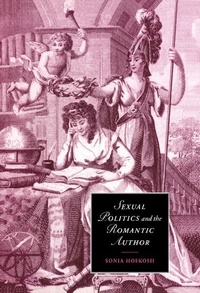
Sexual Politics and the Romantic Author
Published on 18. June 1998
Book
Hardback
204 pages
978-0-521-49654-4 (ISBN)
Description
Exploring a range of early nineteenth-century cultural materials from canonical poetry and critical prose to women's magazines and gift-book engravings, Sexual Politics and the Romantic Author offers new perspectives on the role of gender in Romanticism's defining paradigms of authorship. The Romantic author's claim to individual agency is complicated by its articulation in a market system perceived to be impelled in large part by fantasies of female desire - by what women read and write, what they buy and sell, how they look, and where they look for pleasure. These studies in the contested public spaces of literary labour elaborate the fundamental, if invisible, function of the woman as embodiment of authorial ambivalence in writing by Austen, Byron, Coleridge, William Hazlitt, Sarah Hazlitt, Leigh Hunt, Keats, Mary Shelley, William Wordsworth, and others.
Reviews / Votes
'This beautiful study has been under preparation for over a decade, and the reader is the beneficiary. Hofkosch's work is gracefully literary, uncompromisingly feminist, and theoretically adept.' European Romantic ReviewMore details
Series
Language
English
Place of publication
Cambridge
United Kingdom
Target group
Professional and scholarly
Illustrations
5 Halftones, unspecified
Dimensions
Height: 235 mm
Width: 157 mm
Thickness: 17 mm
Weight
489 gr
ISBN-13
978-0-521-49654-4 (9780521496544)
Copyright in bibliographic data and cover images is held by Nielsen Book Services Limited or by the publishers or by their respective licensors: all rights reserved.
Schweitzer Classification
Other editions
Additional editions
Sonia Hofkosh
Sexual Politics and the Romantic Author
Book
11/2006
Cambridge University Press
€48.60
Shipment within 15-20 days
Person
Content
List of illustrations; Acknowledgments; Introduction: invisible girls; 1. A woman's profession: sexual difference and the romance of authorship; 2. The writer's ravishment: Byron's body politics; 3. Classifying romanticism: the milliner girl and the magazines; 4. Disfiguring economies: Mary Shelley's gift-book stories; 5. The author's progress: William Hazlitt's Keswick escapade and Sarah Hazlitt's Journal; 6. Romanticism in the drawing room: Austen's interiority; Notes; List of works cited; Index.