

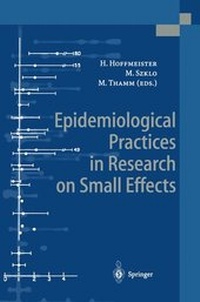
Epidemiological Practices in Research on Small Effects
Published on 18. March 1998
Book
Hardback
VIII, 134 pages
978-3-540-63345-7 (ISBN)
Description
Epidemiology faces its limits: the search for subtle links between diet, lifestyle, or environmental factors and disease is an unending source of fear - but often yields little certainty. Studies on weak associations - or small effects - often produce contradictory results which confuse the public. In this book, numerous contributions and illustrated examples show the effects of this problem, and sets out how future research should be approached in order to minimize the problems, thus producing clear results of significance.
More details
Edition
1998
Language
English
Place of publication
Berlin
Germany
Publishing group
Springer Berlin
Target group
Professional and scholarly
Research
Illustrations
18 s/w Tabellen
18 Tables, black and white; VIII, 134 p.
Dimensions
Height: 23.5 cm
Width: 15.5 cm
Weight
350 gr
ISBN-13
978-3-540-63345-7 (9783540633457)
DOI
10.1007/978-3-642-80463-2
Schweitzer Classification
Other editions
Additional editions
Hans Hoffmeister | Moyses Szklo | Michael Thamm
Epidemiological Practices in Research on Small Effects
E-Book
12/2012
Springer
€96.29
Available for download
Hans Hoffmeister | Moyses Szklo | Michael Thamm
Epidemiological Practices in Research on Small Effects
Book
01/2012
Springer
€106.99
Shipment within 7-9 days
Content
Small effects as a main problem in epidemiology.- Obstacles in evaluating small effects.- Towards good epidemiological practices.- Problems in detecting small effects in case-control and cohort studies.- Proposals and recommendations concerning small effects in case-control and cohort studies.- Comments on problems with small effects in case-control and cohort studies.- Small effects and the selection of study participants in case-control and cohort studies.- Commentary on small effects and the selection of study participants in case-control and cohort studies.- Confounding: Its role in weak associations.- Commentary on confounding: Examples of its influence in weak associations.- Bias in observational studies.- Research strategies for assessing epidemiolgic associations, in relation to the distribution and measurement of exposures.- Commentary on "Bias in observational studies".- Small effects: Subgroup analysis and interaction.- Enhancing small risks in epidemiologic studies.- Is meta-analysis a valid approach to the evaluation of small effects?.- Commentary on meta-analysis.- Discussion remarks on meta-analysis.- Publication bias.- Concluding remarks.