

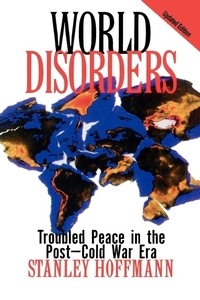
World Disorders
Troubled Peace in the Post-Cold War Era
Published on 22. March 2000
Book
Paperback/Softback
296 pages
978-0-8476-8575-2 (ISBN)
Description
(ACADEMIC PAPERBACK DESCRIPTION) Long one of the fieldOs most distinguished thinkers, Hoffmann brings together in this volume his important recent work on international politics. Many published here for the first time, these essays offer incisive reflections upon the reemergence of nationalism and ethnic conflicts in Europe, the redefined role of military intervention, and other uncertainties brought on by the demise of the Cold War. New to this edition is a current analysis of the Kosovo conflict. Woven throughout are his clear-eyed assessments of contending approaches to the study of international relations. (LONG TRADE CLOTH) Stanley Hoffmann has remarked that OIt wasnOt I who chose to study world politics. World politics forced themselves upon me.O A rootless child of World War II; Austrian, French, and later American, he has always maintained a unique balance and perspective on global affairs. Long one of the fieldOs most distinguished thinkers, Hoffmann brings together in this volume his important recent work on international politics. Many published here for the first time, these essays offer incisive reflections upon the reemergence of nationalism and ethnic conflicts in Europe, the redefined role of military intervention, and other uncertainties brought on by the demise of the Cold War. Hoffmann weighs the influence on theory and policy of such disparate figures as John Rawls, Hedley Bull, and George Schultz. Woven throughout are his clear-eyed assessments of contending approaches to the study of international relations.
Reviews / Votes
Nuanced meditations on the nature of world politics in the post-Cold War era. . . . [Hoffmann is] unfailingly insightful and compassionate, attributes often missing in the discipline of political science. Overall, he has two concerns here: to examine the state of current international relations, to critique the methods and approaches used to understand these relations. . . . Sophisticated and provocative, Hoffmann's writing gives the reader much to consider. * Kirkus Reviews * This collection of remarkable essays addresses the great complexities of post-Cold War world politics. . . . [Hoffmann] is at his best in illuminating the shaky foundations of modern world politics and underscoring the limitations of the theoretical and policy constructs in vogue today. -- G. John Ikenberry, Princeton University * Foreign Affairs * Stanley Hoffmann, a sober idealist in the tradition of Hedley Bull, shows how a foreign policy that blends interests and values-as well as order and justice-is not only desirable but possible. Along the way, he elegantly but ruthlessly skewers proponents of both narrow realism and liberal internationalism. The thoughtful essays that constitute World Disorders make clear why Hoffmann enjoys a reputation as one of this country's leading analysts of world affairs. -- Richard N. Haas, The Brookings Institution In this seminal work, Hoffmann takes on the 'realists' by questioning whether their appreciation of power is too narrow and leaves out the influence of domestic politics and ideals. He also challenges the growing academic influence on those who would make a science of politics, pointing out that they have forgotten the value of common sense and looking things up. Finally, he does again what he has done so brilliantly many times before: He helps us put in place the major jigsaw pieces of the international puzzle. -- Leslie H. Gelb, Council on Foreign Relations The essays make the case for an ambitious agenda: to focus state craft on the problems of governance for the future. * Foreign Affairs * There is no better guide to the riddles and puzzles of international relations after the Cold War than these collected essays by America's (and Europe's) leading philosopher of world politics. Without a trace of dogma or pretension of retrospective omniscience, Stanley Hoffmann offers us a wide-ranging portrait of our times. The essays illuminate the most troubling issues of nationalisms old and new, humanitarian intervention, the collapse of states and economies in the developing world, and the arrogances and complacencies of the developed world. Ten years' worth of the collected wisdom of this deeply learned and generously humane critic, this volume should be read (and re-read) by every student of the field and every citizen who will need to judge the role the United States and its allies should play in a world that, as Hoffmann explains, we can neither legitimately control nor safely escape. -- Michael W. Doyle, Princeton University For those who like their analyses well written, this is an excellent book. Stanley Hoffmann is revealed in these essays as a nuanced and refined realist thinker who is concerned to provide 'some small steps to world order', on the basis both of a healthy scepticism and prerequisite optimism. What this book provides is an urbane and coherent sense of an interpretation of the nature of the problems of world politics infused with the experience of a lifetime of analysis and an interesting mix of acerbic wit and compassionate humour. * International Affairs * Hoffmann lucidly points out the limits of Realism, the shortcomings of international Liberalism, and above all challenges the views of those who try to make a science of politics. * Political Studies Review * Stanley Hoffmann, a well-respected professor of world politics at Harvard University, has been among the more outspoken and articulate commentators on the condition of the post-Cold War era. In this well-written volume he seeks both to describe the post-Cold War world and to prescribe ways in which to make it a better place for humanity. * Journal of Strategic Studies * The book is a collection of essays written by one of the most distinguished scholars of international affairs throughout the 1990s. Hoffmann addresses, as usual, the important themes in world politics. * Political Studies Association *More details
Language
English
Place of publication
United States
Publishing group
Bloomsbury Publishing Plc
Dimensions
Height: 229 mm
Width: 152 mm
Thickness: 17 mm
Weight
471 gr
ISBN-13
978-0-8476-8575-2 (9780847685752)
Copyright in bibliographic data and cover images is held by Nielsen Book Services Limited or by the publishers or by their respective licensors: all rights reserved.
Schweitzer Classification
Other editions
New editions
Book
11/1998
Rowman & Littlefield
€33.50
Article is exhausted, reprint undefined
Additional editions
E-Book
03/2000
1st Edition
Rowman & Littlefield Publishers
€40.99
Available for download
E-Book
03/2000
1st Edition
Rowman & Littlefield Publishers
€40.99
Available for download
Person
Stanley Hoffmann (1928-2015) was the Paul and Catherine Buttenwieser Professor Emeritus at Harvard University. His books include World Disorders (Rowman & Littlefield, 1998), Gulliver Unbound (Rowman & Littlefield, 2004), and Chaos and Violence (Rowman & Littlefield 2006).
Content
Chapter 1 Introduction: From this Century to the Next
Part 2 Part I. Theorists, Theories
Chapter 3 Hedley Bull and His Contribution to International Relations
Chapter 4 Ideal Worlds
Chapter 5 Beyond Realism and Idealism in International Politics
Chapter 6 The Crisis of Liberal Internationalism
Part 7 Part II. From the End of the Cold War to the Search for a New World Order
Chapter 8 What Should We Do in the World?
Chapter 9 A New World and Its Troubles
Chapter 10 Delusions of World Order
Chapter 11 The Price of War
Chapter 12 In Defense of Mother Teresa
Chapter 13 The Politics and Ethics of Military Intervention
Chapter 14 Thoughts on the UN at Fifty
Part 15 Part III. Ethnicity, Nationalism and World Order
Chapter 16 The Passion of Modernity
Chapter 17 Nationalism and World Order
Chapter 18 On Ethnic Conflicts and Their Resolution
Chapter 19 (paper edition only) Intervention in Kosovo
Chapter 20 Nation and Nationalism in America Today
Chapter 21 Conclusion: Principles of a Liberal Ethics of International Relations: A Normative Outline
Part 22 Notes
Part 23 Credits
Part 24 Index
Part 25 About the Author
Part 2 Part I. Theorists, Theories
Chapter 3 Hedley Bull and His Contribution to International Relations
Chapter 4 Ideal Worlds
Chapter 5 Beyond Realism and Idealism in International Politics
Chapter 6 The Crisis of Liberal Internationalism
Part 7 Part II. From the End of the Cold War to the Search for a New World Order
Chapter 8 What Should We Do in the World?
Chapter 9 A New World and Its Troubles
Chapter 10 Delusions of World Order
Chapter 11 The Price of War
Chapter 12 In Defense of Mother Teresa
Chapter 13 The Politics and Ethics of Military Intervention
Chapter 14 Thoughts on the UN at Fifty
Part 15 Part III. Ethnicity, Nationalism and World Order
Chapter 16 The Passion of Modernity
Chapter 17 Nationalism and World Order
Chapter 18 On Ethnic Conflicts and Their Resolution
Chapter 19 (paper edition only) Intervention in Kosovo
Chapter 20 Nation and Nationalism in America Today
Chapter 21 Conclusion: Principles of a Liberal Ethics of International Relations: A Normative Outline
Part 22 Notes
Part 23 Credits
Part 24 Index
Part 25 About the Author