

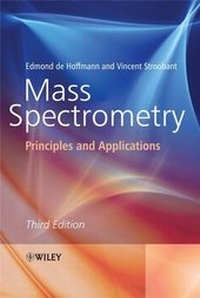
Mass Spectrometry
Principles and Applications
3rd Edition
Published on 21. September 2007
Book
Hardback
502 pages
978-0-470-03310-4 (ISBN)
Description
Mass Spectrometry: Principles and Applications, Third Edition
Edmond de Hoffmann, UniversitÃ(c) Catholique de Louvain, Belgium and Vincent Stroobant, Ludwig Institute for Cancer Research, Brussels Branch, Belgium.
Mass Spectrometry, Third Edition provides students with a complete overview of the principles, theories and key applications of modern mass spectrometry. Extensively revised and updated, the third edition of this successful textbook focuses on recent developments in techniques and applications. All instrumental aspects of mass spectrometry are clearly and concisely described. Emphasis is placed throughout the text on practical application examples. As with previous editions, it contains numerous tables of useful data, references and a series of exercises of increasing difficulty to encourage student understanding.
* Provides a complete overview of the principles, theories and applications of modern mass spectrometry
* An extensive revision and update including: increased coverage of MALDI and ESI, resolution and mass accuracy and activation of ions
* New material about instruments such as linear traps, Orbitrap, TOF/TOF, hybrid instruments, and about new atmospheric ionisation techniques such as APPI, DESI, DART. The range of applications has been expanded and newer methods such as metabolome are included
* Contains numerous examples and exercises to encourage student understanding
Mass Spectrometry: Principles and Applications, Third Edition will prove invaluable to undergraduates and postgraduates using this technique in departments of chemistry, biochemistry, medicine, pharmacology, agriculture, materials science and food science. It will also appeal to researchers looking for an overview of the latest techniques and developments.
Reviews / Votes
"Es ist eine Freude in diesem Buch nach apparativen oder Messprinzipien zu suchen. ... Man bekommt nur selten soviel Information auf knapp 500 Seiten geboten." Mitteilungsblatt GDChMore details
Other editions
Additional editions
E-Book
04/2013
3rd Edition
Wiley
€54.99
Available for download
E-Book
10/2007
3rd Edition
Wiley
€54.99
Available for download
Book
09/2007
3rd Edition
Wiley
€66.00
Shipment within 10-20 days
Previous edition

Book
08/2001
2nd Edition
Wiley
€149.00
Article exhausted; check for reprint
Persons
Edmond de Hoffmann
Universit´e Catholique de Louvain, Belgium & Ludwig Institute for
Cancer Research, Brussels, Belgium
Vincent Stroobant
Ludwig Institute for Cancer Research, Brussels, Belgium
Content
Preface.
Introduction.
Principles.
Diagram of a Mass Spectrometer.
History.
Ion Free Path.
1 Ion Sources.
1.1 Electron Ionization.
1.2 Chemical Ionization.
1.3 Field Ionization.
1.4 Fast Atom Bombardment and Liquid Secondary Ion Mass Spectrometry.
1.5 Field Desorption.
1.6 Plasma Desorption.
1.7 Laser Desorption.
1.8 Matrix-Assisted Laser Desorption Ionization.
1.9 Thermospray.
1.10 Atmospheric Pressure Ionization.
1.11 Electrospray.
1.12 Atmospheric Pressure Chemical Ionization.
1.13 Atmospheric Pressure Photoionization (APPI).
1.14 Atmospheric Pressure Secondary Ion Mass Spectrometry (APSIMS).
1.15 Inorganic Ionization Sources.
1.16 Gas-Phase Ion-Molecule Reactions.
1.17 Formation and Fragmentation of Ions: Basic Rules.
2 Mass Analyzers.
2.1 Quadrupole Analyzers.
2.2 Ion Trap Analyzers.
2.3 The Electrostatic Trap or "Orbitrap".
2.4 Time-of-Flight Analyzers.
2.5 Magnetic and Electromagnetic Analyzers.
2.6 Ion Cyclotron Resonance and Fourier Transform Mass Spectrometry.
2.7 Hybrid Instruments.
3 Detectors and Computers.
3.1 Detectors.
3.2 Computers.
4 Tandem Mass Spectrometry (MS/MS).
4.1 Tandem Mass Spectrometry in Space or in Time.
4.2 Tandem Mass Spectrometry Scan Modes.
4.3 Collision-activated or Collision-induced Dissociation (CAD or CID).
4.4 Other Methods of Ion Activation.
4.5 Reactions Studied in MS/MS.
4.6 Tandem Mass Spectrometry Applications.
5 Mass Spectrometry/Chromatography Coupling.
5.1 Elution Chromatography Coupling Techniques.
5.2 Chromatography Data Acquisition Modes.
5.3 Data Recording and Treatment.
6 Analytical Information.
6.1 Mass Spectrometry Spectral Collections.
6.2 High Resolution.
6.3 Isotopic Abundances.
6.4 Low-mass Fragments and Lost Neutrals.
6.5 Number of Rings or Unsaturations.
6.6 Mass and Electron Parities, Closed-shell Ions and Open-shell Ions.
6.7 Quantitative Data.
7 Fragmentation Reactions.
7.1 Electron Ionization and Fragmentation Rates.
7.2 Quasi-equilibrium and RRKM Theory.
7.3 Ionization and Appearance Energies.
7.4 Fragmentation Reactions of Positive Ions.
7.5 Fragmentation Reactions of Negative Ions.
7.6 Charge Remote Fragmentation (CRF).
7.7 Spectrum Interpretation.
8 Analysis of Biomolecules.
8.1 Biomolecules and Mass Spectrometry.
8.2 Proteins and Peptides.
8.3. Oligonucleotides.
8.4. Oligosaccharides.
8.5. Lipids.
8.6 Metabolomics.
9 Exercises.
A. Questions.
B. Answers.
Appendices.
Appendix 1. Nomenclature.
1.1. Units.
1.2. Definitions.
1.3. Analyzers.
1.4. Detection.
1.5. Ionization.
1.6 Ion Types.
1.7. Ion-molecule Reaction.
1.8. Fragmentation.
Appendix 2. Abbreviations.
Appendix 3. Fundamental Physical Constants.
Appendix 4A . Table of Isotopes in Ascending Mass Order.
Appendix 4B. Table of Isotopes in Alphabetical Order.
Appendix 5. Isotopic Abundances in % for Various Elemental Compositions CHON (M = 100%).
Appendix 6. Gas-Phase Ion Thermochemical Data of Molecules.
Appendix 7. Gas-Phase Ion Thermochemical Data of Radicals.
Appendix 8. Literature on Mass Spectrometry.
Appendix 9. Mass Spectrometry on Internet.
Index.