

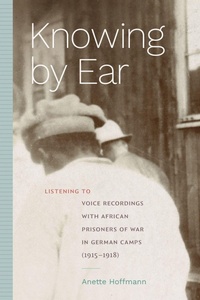
Knowing by Ear
Listening to Voice Recordings with African Prisoners of War in German Camps (1915-1918)
Published on 29. March 2024
Book
Paperback/Softback
224 pages
978-1-4780-3002-7 (ISBN)
Description
During World War I, thousands of young African men conscripted to fight for France and Britain were captured and held as prisoners of war in Germany, where their stories and songs were recorded and archived by German linguists. In Knowing by Ear, Anette Hoffmann demonstrates that listening to these acoustic recordings as historical sources, rather than linguistic samples, opens up possibilities for new historical perspectives and the formation of alternate archival practices and knowledge production. She foregrounds the archival presence of individual speakers and positions their recorded voices as responses to their experiences of colonialism, war, and the journey from Africa to Europe. By engaging with the recordings alongside written sources, photographs, and artworks depicting the speakers, Hoffmann personalizes speakers from present-day Senegal, Somalia, Togo, and Congo. Knowing by Ear includes transcriptions of numerous recordings of spoken and sung texts, revealing acoustic archives as significant yet under-researched sources for recovering the historical speaking positions of colonized subjects and listen to the acoustic echo of colonial knowledge production.
Reviews / Votes
"Baffling, confronting, and revealing-those are a few of the qualities that struck me as I read Anette Hoffmann's new book. I read it in one breath but with vicarious shame. Like her Listening to Colonial History, Knowing by Ear makes clear how much undiscovered information about colonial history is waiting for us in sonic archives all over the world. By investigating these sonic archives Hoffmann shows how African prisoners of war were simultaneously misunderstood, mistreated, and dehumanized." - Marcel Cobussen, Professor of Auditory Culture at Leiden University, the Netherlands "Knowing by Ear is a much-anticipated, urgent study of the coercive recording of African prisoners of war by German researchers during World War I. Challenging the original epistemic frames of this archive, Anette Hoffmann offers a sensitive analysis of the African speakers and their recordings. A highly rewarding read for all interested in war, media, and colonial archives, Knowing by Ear engages close listening, translation, and collaborative research as vital tools for reactivating these fragments today." - Carolyn Birdsall, Associate Professor of Media Studies, University of AmsterdamMore details
Series
Language
English
Place of publication
North Carolina
United States
Target group
Professional and scholarly
Product notice
Paperback (trade)
Illustrations
16 page color insert
Dimensions
Height: 226 mm
Width: 151 mm
Thickness: 12 mm
Weight
344 gr
ISBN-13
978-1-4780-3002-7 (9781478030027)
Copyright in bibliographic data and cover images is held by Nielsen Book Services Limited or by the publishers or by their respective licensors: all rights reserved.
Schweitzer Classification
Other editions
Additional editions
Anette Hoffmann
Knowing by Ear
Listening to Voice Recordings with African Prisoners of War in German Camps (1915-1918)
E-Book
02/2024
1st Edition
De Gruyter
€32.99
Available for download
Person
Anette Hoffmann is a Senior Researcher at the University of Cologne's Institute for African Studies and Egyptology. She is the author of Listening to Colonial History: Echoes of Coercive Knowledge Production in Historical Sound Recordings from Southern Africa.
Content
Note on Sound Recordings ix
Prologue: Catchers of the Living 1
Fragment 1. Samba Diallo: "The War of the Whites" / "Catcher of the Living"
Introduction: Listening to Acoustic Fragments 11
Fragment II. JAmafAda: "The War is Horrible"
1. Abdoulay Niang: Voice, Race, and the Suspension of Communication in Linguistic Recordings 23
Fragment III. Asmani Ben Ahmad: "Once Upon a Time"
2. Mohamed Nur: Traces in Archives, Linguistics Texts, and Museums in Germany 66
Fragment IV. Josef Ntwanumbi: "We are Initiates"
3. Albert Kudjabo and Stephan Bischoff: Mysterious Sounds, Opaque Languages and Otherworldly Voices 101
Fragment V. Mamadou Gregoire: "The Sea Requests Fish from the Rivers"
Afterword: Knowing by Ear 147
Acknowledgments 157
Notes 161
References 183
Index 201
Prologue: Catchers of the Living 1
Fragment 1. Samba Diallo: "The War of the Whites" / "Catcher of the Living"
Introduction: Listening to Acoustic Fragments 11
Fragment II. JAmafAda: "The War is Horrible"
1. Abdoulay Niang: Voice, Race, and the Suspension of Communication in Linguistic Recordings 23
Fragment III. Asmani Ben Ahmad: "Once Upon a Time"
2. Mohamed Nur: Traces in Archives, Linguistics Texts, and Museums in Germany 66
Fragment IV. Josef Ntwanumbi: "We are Initiates"
3. Albert Kudjabo and Stephan Bischoff: Mysterious Sounds, Opaque Languages and Otherworldly Voices 101
Fragment V. Mamadou Gregoire: "The Sea Requests Fish from the Rivers"
Afterword: Knowing by Ear 147
Acknowledgments 157
Notes 161
References 183
Index 201