

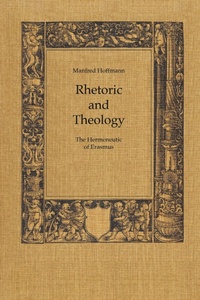
Rhetoric and Theology
The Hermeneutic of Erasmus
Published on 15. December 1993
Book
Paperback/Softback
306 pages
978-1-4875-8686-7 (ISBN)
Description
Departing from the traditional focus on Erasmus as philologist and moralist, Rhetoric and Theology shows how Erasmus attempted to interpret Scripture by way of a rhetorical theology that focuses on the figurative, metaphorical quality of language, with a view to moral and theological reform.
Manfred Hoffmann concentrates on the theological scources of Erasmus' hermeneutic from 1518 to 1535, especially the Ratio verae theologiae, the Ecclesiastes, and the exegesis of Old and New Testament texts. He shows that Erasmus' hermeneutic is based on the concept of language as mediation. Words do not have the power to represent the truth unambiguously, but they appeal to our understanding in ways that draw us to the truth through the process of interpretation. For Erasmus it is through allegory that the divine Word carries out its mediation between letter and spirit.
Erasmus used the tools of rhetoric to read and understand Scripture, and thereby constructed a theological framework that has a direct relationship with his hermeneutic. Rhetorical theologians imitate the invention, disposition, inverbation, and delivery of divine speech by clarifying its composition, ordering its subject matter, internalizing its content, and communicating its transforming power of persuasion. Rhetoric provided Erasmus with the tools for finding theological loci in Scripture, drawing from it a repertoire for knowing and living, and translating it into sacred oratory.
Manfred Hoffmann concentrates on the theological scources of Erasmus' hermeneutic from 1518 to 1535, especially the Ratio verae theologiae, the Ecclesiastes, and the exegesis of Old and New Testament texts. He shows that Erasmus' hermeneutic is based on the concept of language as mediation. Words do not have the power to represent the truth unambiguously, but they appeal to our understanding in ways that draw us to the truth through the process of interpretation. For Erasmus it is through allegory that the divine Word carries out its mediation between letter and spirit.
Erasmus used the tools of rhetoric to read and understand Scripture, and thereby constructed a theological framework that has a direct relationship with his hermeneutic. Rhetorical theologians imitate the invention, disposition, inverbation, and delivery of divine speech by clarifying its composition, ordering its subject matter, internalizing its content, and communicating its transforming power of persuasion. Rhetoric provided Erasmus with the tools for finding theological loci in Scripture, drawing from it a repertoire for knowing and living, and translating it into sacred oratory.
More details
Series
Language
English
Place of publication
Toronto
Canada
Target group
College/higher education
Professional and scholarly
Product notice
Paperback (trade)
Illustrations
1 b&w illustration
Dimensions
Height: 229 mm
Width: 152 mm
Thickness: 18 mm
Weight
467 gr
ISBN-13
978-1-4875-8686-7 (9781487586867)
Copyright in bibliographic data and cover images is held by Nielsen Book Services Limited or by the publishers or by their respective licensors: all rights reserved.
Schweitzer Classification
Other editions
Additional editions
E-Book
12/1993
1st Edition
University of Toronto Press
€31.95
Available for download
Person
Manfred Hoffmann was Professor of Church History and Historical Theology, Candler School of Theology and Graduate Division of Religion, Emory University.