

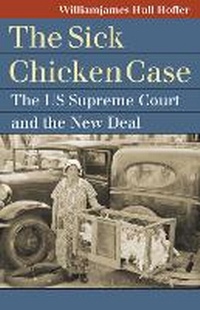
The "Sick Chicken" Case
The US Supreme Court and the New Deal
Published on 6. February 2025
Book
Hardback
184 pages
978-0-7006-3815-4 (ISBN)
Description
The defining legal history of a landmark decision by the US Supreme Court that gutted a key piece of FDR's New Deal.On May 25, 1935, in the midst of the Great Depression, the US Supreme Court handed down a series of decisions that dealt mortal blows to New Deal legislation and presidential initiatives-a day known to New Dealers as Black Monday. The most significant of these decisions was A.L.A. Schechter Poultry v. U.S., which members of the press promptly labeled the "sick chicken case." In this decision, the Court declared the National Industrial Recovery Act unconstitutional, thus abolishing the National Recovery Administration and the hundreds of codes it had enacted. President Franklin D. Roosevelt denounced the Court's action, which started him down the road to his ill-fated plan to pack the Court in 1937.
As Williamjames Hull Hoffer shows, however, the sick chicken case is about much more than a single piece of New Deal legislation. It is a window into American society during the Great Depression and the New Deal-a 1930s America before World War II and the Cold War, the age of radio and movie palaces, and a time of experimentation with government that some likened to fascism or communism, or maybe both. More than a landmark law case that threatened the New Deal, but ultimately did not, Schechter Poultry is not just about a sick chicken; it is about a sick nation trying to heal itself.
As Williamjames Hull Hoffer shows, however, the sick chicken case is about much more than a single piece of New Deal legislation. It is a window into American society during the Great Depression and the New Deal-a 1930s America before World War II and the Cold War, the age of radio and movie palaces, and a time of experimentation with government that some likened to fascism or communism, or maybe both. More than a landmark law case that threatened the New Deal, but ultimately did not, Schechter Poultry is not just about a sick chicken; it is about a sick nation trying to heal itself.
Reviews / Votes
Hoffer offers a skillful and insightful account of not only the Schechter litigation itself, but also of the political, economic, regulatory, and jurisprudential context from which it emerged, as well as its aftermath and legacy. His analysis is refreshingly impartial and levelheaded. Even those who may differ on some points of interpretation will profit from engagement with this lucid and informative study."-Barry Cushman, author of Rethinking the New Deal Court: The Structure of a Constitutional Revolution"Williamjames Hull Hoffer has brought to life an important Supreme Court opinion that provides not only a history of the Court during the New Deal but a potential window to the future as the so-called administrative state has come under risk in the federal courts. A fundamental question in both A.L.A Schechter Poultry and the present is how far the federal government can go in protecting the national health and the economy through expert staffed federal agencies. Hoffer's exceptional historical presentation is both timely and worthwhile to historians, political scientists, and that part of the public interested in nation's governance."-Joshua E. Kastenberg, author of Goldwater v. Carter: Foreign Policy, China, and the Resurgence of Executive Branch PrimacyMore details
Language
English
Place of publication
Kansas
United States
Target group
College/higher education
Dimensions
Height: 216 mm
Width: 140 mm
ISBN-13
978-0-7006-3815-4 (9780700638154)
Copyright in bibliographic data and cover images is held by Nielsen Book Services Limited or by the publishers or by their respective licensors: all rights reserved.
Schweitzer Classification
Other editions
Additional editions
E-Book
03/2025
University Press of Kansas
€29.49
Available for download
Person
Williamjames Hull Hoffer is a professor of history at Seton Hall University, the author of Plessy v. Ferguson: Race and Inequality in Jim Crow America, and coauthor of The Supreme Court: An Essential History, both from Kansas.