

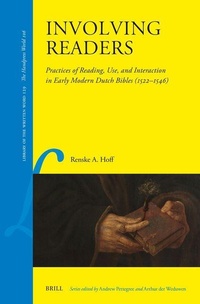
Involving Readers
Practices of Reading, Use, and Interaction in Early Modern Dutch Bibles (1522-1546)
Published on 23. September 2024
Book
Leather / fine binding
352 pages
978-90-04-69651-8 (ISBN)
Description
This volume explores how and by whom early modern Dutch Bibles were used. Through a detailed analysis of paratextual features and readers' traces in over 180 surviving Bible copies, Renske Hoff shows how individuals manifested their faith in owning, reading, and personalising the Bible, in a period characterised by religious turmoil.
From nuns and countesses to tailors and merchants: Bibles were read by a diverse public. Printer-publishers shaped the contents and paratextual features of their Bible editions to suit the varied wishes of the reading public. Readers themselves added marginalia, corrected the text, or pasted texts and images in their books, displaying their creativity as users as well as stressing the malleability of the material Bible.
From nuns and countesses to tailors and merchants: Bibles were read by a diverse public. Printer-publishers shaped the contents and paratextual features of their Bible editions to suit the varied wishes of the reading public. Readers themselves added marginalia, corrected the text, or pasted texts and images in their books, displaying their creativity as users as well as stressing the malleability of the material Bible.
More details
Series
Language
English
Place of publication
Leiden
Netherlands
Target group
Professional and scholarly
Product notice
Cloth
With dust jacket
Dimensions
Height: 241 mm
Width: 160 mm
Thickness: 23 mm
Weight
816 gr
ISBN-13
978-90-04-69651-8 (9789004696518)
Copyright in bibliographic data and cover images is held by Nielsen Book Services Limited or by the publishers or by their respective licensors: all rights reserved.
Schweitzer Classification
Person
Renske A. Hoff, PhD (2022, University of Groningen and KU Leuven) is Assistant Professor of Middle Dutch Literature at Utrecht University. She specialises in fifteenth- and sixteenth-century book history, with a particular focus on the use of religious manuscripts and early printed books.
Content
Acknowledgements
List of Figures and Tables
Abbreviations
Note on Translations and Quotations
1 Introduction
?1?Bible Production in Antwerp, ca. 1500-1550
?2?Jacob van Liesvelt and Henrick Peetersen van Middelburch
?3?A History of Reading: Developments and Approaches
?4?Research Corpus and Scope
?5?Formative Spaces and Transformative Practices: Structure of the Study
Part 1: Formative Spaces: Paratext and the Construction of Meaning and Reading Practice
Introduction to Part 1
2 Constructive Paratext: Shaping an Active Reader and Framing the Text
?1?Blank Space: Flyleaves, Margins, and Indentations
?2?Title Pages
?3?Prologues
?4?Calendars and Almanacs
?5?Terminal Paratext
?6?Conclusion
3 Directive Paratext: Shaping Understandings and Facilitating Discontinuous Practices
?1?Printed Marginalia: Letters, Manicules, Cross-references, and Glosses
?2?Intertitles and Summaries
?3?Woodcuts and Maps
?4?Table of Contents
?5?Liturgical Reading Aids
?6?Topical Register
?7?Conclusion
Part 2: Transformative Practices: Readers' Responses, Adjustments, and Traces
Introduction to Part 2
4 The Life of the Book: an Overview of Traces, Readers, and Owners
?1?A Categorisation of Traces of Reading, Use, and Ownership
?2?The Omnipresence of Traces
?3?A Sociography of Book Owners
?4?Conclusion
5 Dynamic Interactions with Text and Paratext
?1?Reflecting on Textual and Paratextual Content
?2?Accommodating Reading Practices
?3?Conclusion
6 Interacting with the Book as Object
?1?Assessing Identity
?2?Leaving Material Traces
?3?Conclusion
7 Conclusions
Appendix: Overview of Owners and Traces
Bibliography
Index
List of Figures and Tables
Abbreviations
Note on Translations and Quotations
1 Introduction
?1?Bible Production in Antwerp, ca. 1500-1550
?2?Jacob van Liesvelt and Henrick Peetersen van Middelburch
?3?A History of Reading: Developments and Approaches
?4?Research Corpus and Scope
?5?Formative Spaces and Transformative Practices: Structure of the Study
Part 1: Formative Spaces: Paratext and the Construction of Meaning and Reading Practice
Introduction to Part 1
2 Constructive Paratext: Shaping an Active Reader and Framing the Text
?1?Blank Space: Flyleaves, Margins, and Indentations
?2?Title Pages
?3?Prologues
?4?Calendars and Almanacs
?5?Terminal Paratext
?6?Conclusion
3 Directive Paratext: Shaping Understandings and Facilitating Discontinuous Practices
?1?Printed Marginalia: Letters, Manicules, Cross-references, and Glosses
?2?Intertitles and Summaries
?3?Woodcuts and Maps
?4?Table of Contents
?5?Liturgical Reading Aids
?6?Topical Register
?7?Conclusion
Part 2: Transformative Practices: Readers' Responses, Adjustments, and Traces
Introduction to Part 2
4 The Life of the Book: an Overview of Traces, Readers, and Owners
?1?A Categorisation of Traces of Reading, Use, and Ownership
?2?The Omnipresence of Traces
?3?A Sociography of Book Owners
?4?Conclusion
5 Dynamic Interactions with Text and Paratext
?1?Reflecting on Textual and Paratextual Content
?2?Accommodating Reading Practices
?3?Conclusion
6 Interacting with the Book as Object
?1?Assessing Identity
?2?Leaving Material Traces
?3?Conclusion
7 Conclusions
Appendix: Overview of Owners and Traces
Bibliography
Index