

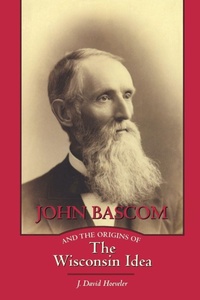
John Bascom and the Origins of the Wisconsin Idea
Published on 30. August 2017
Book
Paperback/Softback
248 pages
978-0-299-30784-4 (ISBN)
Description
In the Progressive Era of American history, the state of Wisconsin gained national attention for its innovative economic and political reforms. Amidst this ferment, the ""Wisconsin Idea"" was popularized?the idea that a public university should improve the lives of people beyond the borders of its campus.
During his term as governor (1901?1906), Robert La Follette routinely consulted with University of Wisconsin researchers to devise groundbreaking programs and legislation. Although the Wisconsin Idea is often attributed to a 1904 speech by Charles Van Hise, then president of the University of Wisconsin, David Hoeveler argues that it originated decades earlier, in the creative and fertile mind of John Bascom.
A philosopher, theologian, and sociologist, Bascom (1827?1922) deeply influenced a generation of students at the University of Wisconsin, including La Follette and Van Hise. Hoeveler documents how Bascom drew concepts from German idealism, liberal Protestantism, and evolutionary theory, transforming them into advocacy for social and political reform. He was a champion of temperance, women's rights, and labor, all of which brought him controversy as president of the university from 1874 to 1887. In a way unmatched by any of his peers at other institutions, Bascom outlined a social gospel that called for an expanded role for state governments and universities as agencies of moral improvement.
Hoeveler traces the intellectual history of the Wisconsin Idea from the nineteenth century to such influential Progressive Era thinkers as Richard T. Ely and John R. Commons, who believed university researchers should be a vital source of expertise for government and citizens.
During his term as governor (1901?1906), Robert La Follette routinely consulted with University of Wisconsin researchers to devise groundbreaking programs and legislation. Although the Wisconsin Idea is often attributed to a 1904 speech by Charles Van Hise, then president of the University of Wisconsin, David Hoeveler argues that it originated decades earlier, in the creative and fertile mind of John Bascom.
A philosopher, theologian, and sociologist, Bascom (1827?1922) deeply influenced a generation of students at the University of Wisconsin, including La Follette and Van Hise. Hoeveler documents how Bascom drew concepts from German idealism, liberal Protestantism, and evolutionary theory, transforming them into advocacy for social and political reform. He was a champion of temperance, women's rights, and labor, all of which brought him controversy as president of the university from 1874 to 1887. In a way unmatched by any of his peers at other institutions, Bascom outlined a social gospel that called for an expanded role for state governments and universities as agencies of moral improvement.
Hoeveler traces the intellectual history of the Wisconsin Idea from the nineteenth century to such influential Progressive Era thinkers as Richard T. Ely and John R. Commons, who believed university researchers should be a vital source of expertise for government and citizens.
Reviews / Votes
Identifies the philosopher, theologian, and sociologist [John Bascom] as the originator of the notion of the 'Wisconsin Idea,' or the idea that public universities should benefit people beyond the borders of a campus."" - Chronicle of Higher Education""A satisfying biography for anyone interested in progressive politics, nineteenth-century intellectual thought, or university history."" - Michigan Historical Review
""Comprehensive and insightful. Hoeveler shows that John Bascom played a pivotal role in the foundation of the American public university as a radically new institution of higher learning, dedicated to producing better citizens and serving as a resource for government of the commonwealth."" - John D. Buenker, author of The Progressive Era, 1893?1914
More details
Language
English
Place of publication
Wisconsin
United States
Target group
College/higher education
Product notice
Paperback (trade)
Illustrations
9 black & white illustrations
Dimensions
Height: 229 mm
Width: 152 mm
Thickness: 13 mm
Weight
330 gr
ISBN-13
978-0-299-30784-4 (9780299307844)
Copyright in bibliographic data and cover images is held by Nielsen Book Services Limited or by the publishers or by their respective licensors: all rights reserved.
Schweitzer Classification
Person
J. David Hoeveler is a Distinguished Professor of History at the University of Wisconsin?Milwaukee. He is the author of seven books, including Creating the American Mind, The Evolutionists, and Watch on the Right.
Content
List of Illustrations
Acknowledgments
Introduction
1 Preparations
2 A Political Professor
3 Wisconsin: A State and Its University
4 New Theology, New University
5 The University and the Social Gospel
6 Progressivism 1: Temperance
7 Progressivism 2: Women
8 Progressivism 3: Money and Class
9 The Wisconsin Idea
Postscript
A Bascom Bibliography
Index
Acknowledgments
Introduction
1 Preparations
2 A Political Professor
3 Wisconsin: A State and Its University
4 New Theology, New University
5 The University and the Social Gospel
6 Progressivism 1: Temperance
7 Progressivism 2: Women
8 Progressivism 3: Money and Class
9 The Wisconsin Idea
Postscript
A Bascom Bibliography
Index