

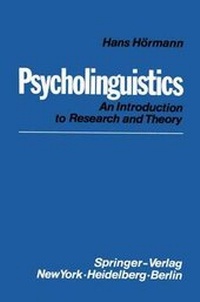
Psycholinguistics
An Introduction to Research and Theory
Published on 1. January 1971
Book
Paperback/Softback
392 pages
978-3-540-05665-2 (ISBN)
Description
I have attempted to make a virtue out of this necessity. In this book the reader will be obliged to change his standpoint again and again; he will be asked to view the subject from different angles and, at the same time, to take note of these changes. I am attempting to familiarize the reader with the field of psycholinguistics by making him aware of the fact that research results are dependent upon particular viewpoints, that each viewpoint is based upon certain assumptions, and that each has its own limitations. If this book succeeds in its purpose, these maneuvers, the obstacles in the way, the bridging operations needed, the sight of the barren stretches as well as of exciting perspectives should fit together to form a cognitive map of psycholinguistics. But even if it is possible to open up the territory to the reader, he will soon discover that, in this map, the unknown and explored areas are very unevenly distributed. It is impossible to consider the psychology of language without taking into account certain philosophical points of view. Yet, to do so is ex tremely difficult. Without a philosophical orientation one cannot appre ciate the limitations imposed by historical origins, nor can one understand the full implications of the given point of view. But these philosophical aspects cannot be presented in advance, as a separate introduction, because they form part of the psychological arguments which, at the same time, presuppose some familiarity with philosophy.
More details
Edition
Softcover reprint of the original 1st ed. 1971
Language
English
Place of publication
Heidelberg
Germany
Publishing group
Springer Berlin
Target group
Professional and scholarly
Product notice
Paperback (trade)
Illustrations
black & white illustrations
Dimensions
Height: 23.5 cm
Width: 15.5 cm
Thickness: 20 mm
Weight
591 gr
ISBN-13
978-3-540-05665-2 (9783540056652)
DOI
10.1007/978-3-642-96058-1
Schweitzer Classification
Other editions
New editions
Book
12/1979
2nd Edition
Springer
€85.55
Article exhausted; check different version
Additional editions
Book
12/1971
Springer
€36.53
No shipping information available
Persons
Content
1 Introduction: Organism, Language and World.- Characterization of the field in which language becomes possible and necessary.- - Organism and environment.- - Language as stimulus.- - Language as response.- - Speaker and listener.- - Language as a system of signs.- - Development from a historical to a structural orientation in linguistics.- - Saussure's distinction between langue and parole.- - Carroll's definition of language.- - Linguistics and psycholinguistics..- 2 Sign, Expression and Symbol.- Bühler's organon model of the sign.- - Expression and language.- - Animal language and evolution of language.- - Langer's treatment of the tendency to symbolize.- - Meaning as representation.- - Behavioristic and neobehavioristic approaches to psycholinguistics..- 3 Linguistic Units.- Description of the speech event.- - Phonetics.- - Articulatory, acoustic and auditory approaches.- - The morpheme.- - Martinet's dual scheme of analysis.- - The phoneme.- - Distinctive feature analysis.- - Grammar as combinatorics of language.- - Chomsky's generative grammar..- 4 Language and Communication.- The concept of information.- - Sender, channel of communication, receiver.- - 'Bit' as unit of information.- - Continuous variation and discrete events.- - Capacity of communication.- - Classifying processes in speech perception.- - Liberman's motor theory of speech perception.- - Disturbance of speech perception through masking noise.- - Competition of speech events.- - The concept of channel capacity..- 5 The Probability Structure of Language.- Speech perception and probability of occurrence.- - Zipf's curve and its interpretation.- - Thorndike-Lorge frequency count.- - Coding processes in speech perception.- - Language as a Markov process.- - Approximations to genuine language..- - Transitional probabilities as determinants of the perception and learning of verbal material..- 6 Phenomenology of Verbal Associations.- From a sequential to an associationist viewpoint.- - The concept of association.- - Galton and Marbe.- - Association experiments and everyday verbal behavior.- - Norms of association and their range of application.- - Group and personality factors in the differentiation of verbal habits.- - Jung's investigations and Laffal's critique..- 7 The Mechanism' of Association.- Syntagmatic and paradigmatic associations.- - Association and context.- - Strength of verbal habits.- - Verbal 'relatedness' as an approach to the concept of meaning.- - Noble's attempt to quantify meaning..- 8 The Philosophical Background to Modern Psycholinguistics.- Meaning as inherent bipolar connection.- - The designating function of language.- - Adaequatio rei et intellectus.- - Language and meta-language.- - Empiricist criteria of truth.- - Pragmatism and operationalism.- - Between-world of meaning.- - Meaning as context.- - Role of language-user.- - Morris.- - Meaning as behavior..- 9 The Field Concept of Meaning.- Concept of a lexical field.- - Trier.- - Porzig's 'essential relations'.- - The conceptualization of associative meaning.- - Deese's investigations..- 10 Mediation Theories of Language Processes.- Chains of associations.- - Semantic generalization.- - Mediating associations.- - Bousfield's mediation theory.- - The mediation process in relation to classification and differentiation.- - Osgood's model.- - Emotional components of meaning.- - Semantic differential.- - Application and critique of the semantic differential.- - Denotation and connotation..- 11 The Conditioning Theory of Meaning: Its Achievement, Weakness and Further Development.- Experimental modification of meaning.- - Semantic satiation.- - Model of bilingualism.- - Mowrer's theory of the sentence.- - The negation of the meaning problem in Skinner.- - Operant conditioning of verbal behavior.- - Chomsky's critique of Skinner.- - Meaning as disposition.- - Bloomfield's conception of meaning as stimulus and response.- - A non-behavioristic cognitive conception of meaning..- 12 The Imitation of Sounds and Sound Symbolism.- Imitation of sounds as the germ of human speech.- - Humboldt's dichotomy.- - Evolution of onomatopoeia.- - Traces of sound symbolism in linguistic behavior.- - 'maluma' and 'takete'.- - Matching experiments in the mother tongue and an unknown second language.- - Concept of physiognomy.- - Werner's theory of symbol formation..- 13 The Psychological Reality of Grammar.- Limits of the Markov model.- - Concept of grammaticality.- - Linguistics and psycholinguistics.- - Effect of syntactical structure upon learning and retention.- - What functions as a unit?.- - Temporal characteristics of speech perception and speech production.- - Syntactical and lexical selection.- - Role of generative grammar in psycholinguistics.- - Johnson's hierarchical model.- - Lashley's view of the temporal organization of speech events.- - Plan and Impulsfigur.- - The concept of recoding.- - Miller's studies of transformations..- 14 Genetic and Child Psychology as a Testing Ground for Psycholinguistics.- Trial and error as a principle of language acquisition.- - Mowrer's autism-theory.- - 'Mama'.- - Language as part of the total dynamics of the child.- - Language as a link between practical events.- - The interaction of language and total situation.- - Language and thought in the work of Vigotsky.- - The role of consciousness.- - Meaning as awareness of constancy.- - Classification processes in language acquisition.- - The word as a 'lure to cognition'.- - Genesis of predication.- - The acquisition of linguistic rules.- - The role of imitation..- 15 The Influence of Language on Man's View of the World.- Semantic implications of grammatical word classes.- - The object-forming function of language.- - Formation of categories through language.- - Language as a teacher of discrimination and non-discrimination.- - Kinship terms as an illustration.- - Status and solidarity of address.- - Whorf and the thesis of linguistic relativity.- - Lenneberg's methodological argument.- - Color coding and its problems.- - Glanzer's verbal-loop hypothesis.- - Towards linguistic universals.- - General Semantics..- Author Index.