

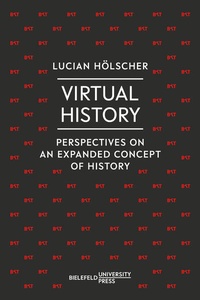
Virtual History
Perspectives on an Expanded Concept of History
Published on 3. April 2026
Book
Paperback/Softback
72 pages
978-3-69129-037-0 (ISBN)
Description
We call "virtual history" a history that goes beyond past events to include possible yet unrealized courses of events. Some are eventually perceived as illusions, while others are revived when the conditions of their former emergence are recognized in the present again. Unlike counterfactual historiography, virtual historiography does not take its starting point from the present but from the expectations of contemporaries who designed a future for themselves. A chronological virtual history would consist of several parallel histories that are sometimes recognized as realistic representations of the past and sometimes rejected as unrealistic. However, other possible representations are also conceivable. To expand its representation of past realities, virtual historiography draws on new sources and disciplines. It interprets historical dates and time intervals as bridges between events and documents the time figures in which events align to form historical processes.
More details
Other editions
Additional editions
Britta Hochkirchen | Chris Lorenz | Ruta Kazlauskaite
Virtual History
Perspectives on an Expanded Concept of History
Online / Databases
12/2025
Bielefeld University Press
Unfortunately, price unknown
Available (delivery time upon request)
Persons
Editor
Lucian Hölscher is a German historian whose specialties include social and cultural history, the history of religion, and the history of the future of the modern era. He completed his Ph.D. on Öffentlichkeit und Geheimnis under Reinhart Koselleck in 1979 and collaborated with him in the 1980s on the publication of the encyclopedia Geschichtliche Grundbegriffe at Bielefeld University. In 1991, he took the Chair of Modern History and Theory of History in Bochum. His publications include Die Entdeckung der Zukunft (1999; 2nd edition, 2020), Neue Annalistik (2003), Geschichte der protestantischen Frömmigkeit (2005), Semantik der Leere (2009), Zeitgärten. Zeitfiguren in der Geschichte der Neuzeit (2020) and Schattenwelten. Die dunkle Seite der Aufklärung (2023).
Contributions
Britta Hochkirchen is a postdoctoral researcher at the chair for early modern and modern art history at Friedrich Schiller University Jena. From 2017 until 2024, she was principal investigator of two sub-projects in the collaborative research center 1288 "Practices of Comparing" at Bielefeld University. This context gave rise to the research project 'Modernity' in Relation. Curatorial practices of comparing in twentieth-century art exhibitions. Her other research interests focus on art in the age of Enlightenment and the role of the image in theory of history. Her publications include: Bildkritik im Zeitalter der Aufklärung. Jean-Baptiste Greuzes Darstellungen der verlorenen Unschuld (2018); "Beyond Representation: Pictorial Temporality and the Relational Time of the Event," in History and Theory 60 (March 2021), no. 1, 102-116; with Bettina Brandt (eds.), Reinhart Koselleck und das Bild (2021).
Chris Lorenz is professor emeritus of Historical Theory and German Historical Culture at the Vrije Universiteit Amsterdam. Since 2016, he has been connected to the 'Institute for Social Movements' at Ruhr-University Bochum as an International Research Fellow. His research focuses on historical theory, the comparative history of historiography, the influence of neoliberalism and New Public Management in higher education and research, and the rise of neonationalism / populism in historiography and in political discourse. His most recent publications include: "Ist es wirklich wahr? Einige Überlegungen zu Wahrheit/Post-Wahrheit," in: Mojib Latif (ed.), Wert der Wahrheit: Wissenschaftliche Perspektiven (2024), 79-89; "Fiktion und Fiktionalität in der Geschichte," in: Michele Barricelli, Nicola Brauch, Estevão de Rezende Martins, Friedrich Jaeger, and Jörn Rüsen (eds.), Handbuch der Historik (2025), 249-257.
Ruta Kazlauskaite is a political scientist at the Faculty of Social Sciences, University of Helsinki. Her research focuses on emotional manipulation, disinformation, and propaganda in extended reality (VR/AR/MR), exploring how immersive technologies reshape political communication and public memory. She currently leads the project Halbwachs in the Metaverse: Storyliving and democracy in the age of immersive spatial computing (2025-2028), funded by the Kone Foundation. Her work has appeared in leading journals such as Memory Studies, Rethinking History, Memory, Mind & Media, International Journal of Heritage Studies, Journal of the Philosophy of History, Emotions and Society, and Ethnicities.