

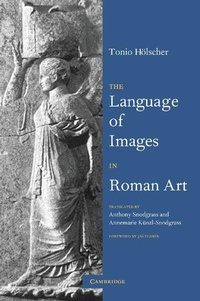
The Language of Images in Roman Art
Art as a Semantic System in the Roman World. Translated by Anthony Snodgrass / Anne-Marie Künzl-Snodgrass / Introduction by Jas' Elsner
Published on 18. November 2004
Book
Paperback/Softback
188 pages
978-0-521-66569-8 (ISBN)
Description
This book, first published in 2004, develops a theory for the understanding of Roman pictorial art. By treating Roman art as a semantic system it establishes a connection between artistic forms and the ideological messages contained within. The history of Roman art traditionally followed the model of a sequence of stylistic phases affecting the works of their era in the manner of a uniform Zeitgeist. By contrast, the author shows different stylistic forms being used for different themes and messages. The reception of Greek models, a key phenomenon of Roman art, thus appear in a new light. The formulations of specific messages are established from Greek art types of different eras serving to express Roman ideological values: classical forms for the grandeur of the state, Hellenistic forms for the struggling effort of warfare. In this way a conceptual and comprehensible pictorial language arose, uniting the multicultural population of the Roman state.
Reviews / Votes
'... a deeply thoughtful and illuminating explanation of how the Roman adoption of Greek forms and styles worked in terms of visual communication.' Art History 'Tonio Hoelscher's essay, The Language of Images in Roman Art ... [is] a lucid English translation ... [and] offers perhaps the most theoretically sophisticated answer to the old question of Rome's relationship to Greece. ... Hoelscher's essay was a landmark in the historiography of Roman art ... Tonio Hoelscher's interpretative framework has withstood the test of time. With the availability of his essay to a wider audience, this powerful tool can be applied to the full range of roman art's stylistic diversity.' The Times Literary Supplement '... reaches to the heart of our understanding of Roman art, addressing its dependence upon and manipulation of Greek artistic forms. ... for a short work this book is full of insights, ideas, and provocations.' Journal of Roman StudiesMore details
Language
English
Place of publication
Cambridge
United Kingdom
Target group
Professional and scholarly
College/higher education
Product notice
Paperback (trade)
Illustrations
52 Halftones, unspecified
Dimensions
Height: 229 mm
Width: 152 mm
Thickness: 10 mm
Weight
282 gr
ISBN-13
978-0-521-66569-8 (9780521665698)
Copyright in bibliographic data and cover images is held by Nielsen Book Services Limited or by the publishers or by their respective licensors: all rights reserved.
Schweitzer Classification
Other editions
Additional editions
Tonio Hoelscher
The Language of Images in Roman Art
Art as a Semantic System in the Roman World. Translated by Anthony Snodgrass / Anne-Marie Künzl-Snodgrass / Introduction by Jas' Elsner
Book
11/2004
Cambridge University Press
€97.70
Shipment within 15-20 days
Persons
Tonio Hoelscher is Professor of Classical Archaeology at the University of Heidelberg. His publications focus on public monuments, political iconography and urbanism in Ancient Greece and Rome and on general art and cultural theory. His is a member of various scientific institutions, including the Academia Europae, London. Anthony Snodgrass is Emeritus Professor of Classical Archaeology in the University of Cambridge whose books include Homer and the Artists (Cambridge University Press, 1998). Jas' Elsner is Humfry Payne Senior Research Fellow in Classical Art and Archaeology in the University of Oxford. His books include Art and the Roman Viewer (Cambridge University Press, 1995) and Imperial Rome and Christian Triumph (1998).
Content
Foreword; Preface; 1. Introduction; 2. The Greek paradigm: example for lifestyle, academic subject, or building block of imperial culture?; 3. The monuments: questions, categories, theses; 4. Battle-scenes: the tradition of Hellenistic pathos; 5. Battle-scenes: their reception in Rome; 6. State ceremonial: the tradition of Classical dignity; 7. The semantic system: the elements and their use; 8. The semantic system: premises and structure; 9. The origins of the system: dynamics and statics; 10. Language of imagery and style; 11. Formal system and style in the theory of rhetoric and of imagery; 12. Conclusion: language of imagery and culture of empire; Bibliography, supplementary bibliography.