

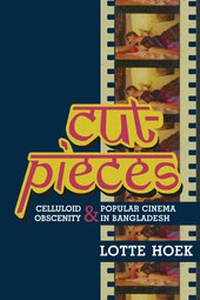
Cut-Pieces
Celluloid Obscenity and Popular Cinema in Bangladesh
Published on 19. November 2013
Book
Hardback
272 pages
978-0-231-16288-3 (ISBN)
Description
Imagine watching an action film in a small-town cinema hall in Bangladesh, and in between the gun battles and fistfights a short pornographic clip appears. This is known as a cut-piece, a strip of locally made celluloid pornography surreptitiously spliced into the reels of action films in Bangladesh. Exploring the shadowy world of these clips and their place in South Asian film culture, Lotte Hoek builds a rare, detailed portrait of the production, consumption, and cinematic pleasures of stray celluloid. Hoek's innovative ethnography plots the making and reception of Mintu the Murderer (2005, pseud.), a popular, Bangladeshi B-quality action movie and fascinating embodiment of the cut-piece phenomenon. She begins with the early scriptwriting phase and concludes with multiple screenings in remote Bangladeshi cinema halls, following the cut-pieces as they appear and disappear from the film, destabilizing its form, generating controversy, and titillating audiences. Hoek's work shines an unusual light on Bangladesh's state-owned film industry and popular practices of the obscene.
She also reframes conceptual approaches to South Asian cinema and film culture, drawing on media anthropology to decode the cultural contradictions of Bangladesh since the 1990s.
She also reframes conceptual approaches to South Asian cinema and film culture, drawing on media anthropology to decode the cultural contradictions of Bangladesh since the 1990s.
Reviews / Votes
Hoek's journeys to towns with considerable distance from Dhaka are a thrill to read; viewings of Mintu the Murderer are vivid in no small terms, and the local color of hanging out at tea stalls and backrooms were page-turners. This is an inspired book, showing the life of a film from its conception to exhibition, or in this case to its ban. -- Lalitha Gopalan, University of Texas at Austin The theoretical and literary sophistication of this study of the oscillating visibility of obscenity in Bangladesh is remarkable. Taking one film as her 'field site' and using effervescent prose, Hoek presents a superb study of the production-consumption continuum of 'unstable celluloid' and richly conjures Dhaka's film studios, location shooting, and the country's small town movie theaters. The artisanal inventiveness of Bangladeshi purveyors of 'hot spice' provides a welcome counterweight to 'gentrified' Bollywood. Hoek's exceptional ethnography of the abject, the dilapidated, the mofussil, demonstrates magnificently how cinema, like almost everything else, fails to live up to its own ideals. -- Christopher Pinney, University College London Students of media anthropology and film studies cannot afford to miss out on this spectacular book. South AsiaMore details
Series
Language
English
Place of publication
New York
United States
Product notice
Trade binding
Illustrations
<B>B&W Illus.: </B>11,
Dimensions
Height: 229 mm
Width: 152 mm
Weight
482 gr
ISBN-13
978-0-231-16288-3 (9780231162883)
Copyright in bibliographic data and cover images is held by Nielsen Book Services Limited or by the publishers or by their respective licensors: all rights reserved.
Schweitzer Classification
Other editions
Additional editions
E-Book
08/2015
1st Edition
Columbia University Press
from
€29.95
Available for download
Book
11/2013
Columbia University Press
€34.69
Shipment within 10-20 days
Person
Lotte Hoek is a lecturer in social anthropology at the University of Edinburgh. She received her Ph.D. from the Amsterdam Institute for Social Science Research, and her research focuses on visual culture and the anthropology of media.
Content
Note on Transliteration, Translation, and Pseudonyms Acknowledgments Introduction: Before Mintu the Murderer 1. Writing Gaps : The Script of Mintu the Murderer 2. A Handheld Camera Twisted Rapidly: The Technology of Mintu the Murderer 3. Actress /Character: The Heroines of Mintu the Murderer 4. Cutting and Splicing: The Editor and Censor of Mintu the Murderer 5. Noise: The Public Sphere of Mintu the Murderer 6. Unstable Celluloid: The Exhibiti on of Mintu the Murderer Conclusion: After Mintu the Murderer Notes Bibliography Index