

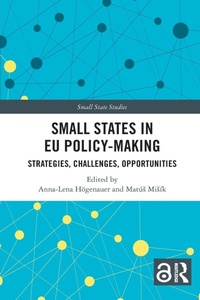
Small States in EU Policy-Making
Strategies, Challenges, Opportunities
1st Edition
Published on 29. August 2025
Book
Paperback/Softback
192 pages
978-1-032-46227-1 (ISBN)
Description
Small States in EU Policy-Making analyses how small states try to impact European Union policy-making through a range of strategies.
With the last rounds of enlargement and Brexit, the number and weight of small states in the European Union have steadily increased. At the same time, small states face distinct challenges in different institutions, which may impact their strategies. Nonetheless, the existing literature primarily focuses on the Council of the European Union and the European Council and offers few insights into how small states navigate the other institutions. The contributions to this volume examine how small states can wield influence in different institutions, arguing that they do indeed pursue different strategies depending on institutional context. The policy case studies on the EU's foreign and security policies confirm these findings: small states can have influence in EU policy-making and can create situations where their needs are met. They are most likely to succeed when they build foreign policy coalitions, when they anticipate major economic developments and when they manage to acquire a high level of expertise in a policy area. However, the case studies also show that there is a risk of small states becoming policy-takers in cases where they cannot provide leadership in terms of ideas and expertise and/or fail to build political weight through coalitions.
This book will be of interest to academics and practitioners of European politics and the EU in particular, as well as policy-makers and practitioners working on small states.
The Open Access version of this book, available at http://www.taylorfrancis.com, has been made available under a Creative Commons Attribution-Non Commercial-No Derivatives (CC-BY-NC-ND) 4.0 license.
With the last rounds of enlargement and Brexit, the number and weight of small states in the European Union have steadily increased. At the same time, small states face distinct challenges in different institutions, which may impact their strategies. Nonetheless, the existing literature primarily focuses on the Council of the European Union and the European Council and offers few insights into how small states navigate the other institutions. The contributions to this volume examine how small states can wield influence in different institutions, arguing that they do indeed pursue different strategies depending on institutional context. The policy case studies on the EU's foreign and security policies confirm these findings: small states can have influence in EU policy-making and can create situations where their needs are met. They are most likely to succeed when they build foreign policy coalitions, when they anticipate major economic developments and when they manage to acquire a high level of expertise in a policy area. However, the case studies also show that there is a risk of small states becoming policy-takers in cases where they cannot provide leadership in terms of ideas and expertise and/or fail to build political weight through coalitions.
This book will be of interest to academics and practitioners of European politics and the EU in particular, as well as policy-makers and practitioners working on small states.
The Open Access version of this book, available at http://www.taylorfrancis.com, has been made available under a Creative Commons Attribution-Non Commercial-No Derivatives (CC-BY-NC-ND) 4.0 license.
More details
Series
Language
English
Place of publication
London
United Kingdom
Publishing group
Taylor & Francis Ltd
Target group
College/higher education
Professional and scholarly
Academic and Postgraduate
Illustrations
8 s/w Tabellen, 11 s/w Zeichnungen, 11 s/w Abbildungen
8 Tables, black and white; 11 Line drawings, black and white; 11 Illustrations, black and white
Dimensions
Height: 234 mm
Width: 156 mm
Thickness: 11 mm
Weight
322 gr
ISBN-13
978-1-032-46227-1 (9781032462271)
Copyright in bibliographic data and cover images is held by Nielsen Book Services Limited or by the publishers or by their respective licensors: all rights reserved.
Schweitzer Classification
Other editions
Additional editions
Anna-Lena Hoegenauer | Matus Misik
Small States in EU Policy-Making
Strategies, Challenges, Opportunities
Book
04/2024
1st Edition
Routledge
€168.10
Shipment within 10-20 days
Anna-Lena Hoegenauer | Matus Misik
Small States in EU Policy-Making
Strategies, Challenges, Opportunities
E-Book
04/2024
1st Edition
Taylor & Francis
€42.99
Available for download
Anna-Lena Hoegenauer | Matus Misik
Small States in EU Policy-Making
Strategies, Challenges, Opportunities
E-Book
04/2024
1st Edition
Taylor & Francis
€42.99
Available for download
Persons
Anna-Lena Hoegenauer is Associate Professor at the Department of Social Sciences at the University of Luxembourg. Her research focuses on questions of multilevel governance, EU politics and parliamentary democracy. She is Associate Editor of PRX and a member of the editorial boards of Politics and Governance and of Small States & Territories.
Matus Misik is Associate Professor at the Department of Political Science at Comenius University Bratislava. His research interests include small states and energy security in the EU. He is the author of External Energy Security in the European Union (Routledge, 2019), co-author of Energy Transitions in Central and Eastern Europe (2024) and has published articles in journals including Nature Energy, Energy, Energy Policy and Geopolitics.
Matus Misik is Associate Professor at the Department of Political Science at Comenius University Bratislava. His research interests include small states and energy security in the EU. He is the author of External Energy Security in the European Union (Routledge, 2019), co-author of Energy Transitions in Central and Eastern Europe (2024) and has published articles in journals including Nature Energy, Energy, Energy Policy and Geopolitics.
Content
1. Introduction: The Challenges and Opportunities of EU Membership for Small States. Section I: Small states in the EU's institutions and policy processes. 2. Small Member States in the European Commission of the 21st Century; 3. Small States in the European Parliament: Does Size Make a Difference? 4. Bringing the European Parliament: Does Size Make a Difference? 5. Small states coalition-building in EU policymaking: the cases of the Nordic and Baltic countries. 6. Small-State Veto Power in the European Union? National Interests and Coalition-Building Capacity of the Member States in Central and Eastern Europe. Section II: Small states in foreign, security and trade policy. 7. The Economic Diplomacy of Luxembourg within the European Union framework: between agility and stability. 8. Small states, subregional minilateralism, and European foreign policy; 9. Small State Influence in EU Security Policymaking: PESCO, Frontex, and the Integration Dilemma; 10. How did the challenges and opportunities translate into small state strategies? A case study of Estonia's role in shaping EU cybersecurity policy; 11. Conclusion: Size Is Not Everything