

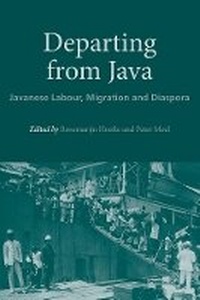
Departing from Java
Javanese Labour, Migration and Diaspora
Will be published approx. on 1. July 2018
Book
Paperback/Softback
302 pages
978-87-7694-246-5 (ISBN)
Description
From colonial times through to the present day, large numbers of Javanese have left their homes to settle in other parts of Indonesia or much further afield. Frequently this dispersion was forced, often with traumatic results. Today, Javanese communities are found as near to home as Kalimantan and as far away as Suriname and the Netherlands. Meanwhile, migrant workers from Java continue to seek short-term employment in places like Malaysia and Dubai.
This volume traces the different ways in which Javanese migrants and migrant communities are connected in their host society and with Java as a real or imagined authoritative source of norms, values and loyalties. It underlines the importance of diaspora as a process in order to understand the evolving notions of a Javanese homeland across time and space. Even though Java as the point of departure links the different contributions, their focus is more on the process of migration and experiences in destination countries. They examine historical developments and geographical variations in the migrants' social and political positions, mechanisms of authority, and social relations with other migrants.
The volume also examines how ethnicity, class, gender, religion and hierarchy have shaped and still inform the dynamics of diasporic communities.
This volume traces the different ways in which Javanese migrants and migrant communities are connected in their host society and with Java as a real or imagined authoritative source of norms, values and loyalties. It underlines the importance of diaspora as a process in order to understand the evolving notions of a Javanese homeland across time and space. Even though Java as the point of departure links the different contributions, their focus is more on the process of migration and experiences in destination countries. They examine historical developments and geographical variations in the migrants' social and political positions, mechanisms of authority, and social relations with other migrants.
The volume also examines how ethnicity, class, gender, religion and hierarchy have shaped and still inform the dynamics of diasporic communities.
More details
Series
Language
English
Place of publication
Copenhagen
Denmark
Target group
College/higher education
Illustrations
9 tables, 2 maps, 12 figures
Dimensions
Height: 229 mm
Width: 152 mm
ISBN-13
978-87-7694-246-5 (9788776942465)
Copyright in bibliographic data and cover images is held by Nielsen Book Services Limited or by the publishers or by their respective licensors: all rights reserved.
Schweitzer Classification
Persons
Rosemarijn Hoefte is Professor of the History of Suriname after 1873 at the University of Amsterdam and a senior researcher at KITLV / Royal Netherlands Institute of Southeast Asian and Caribbean Studies in Leiden.
Peter Meel is director of research of the Leiden University Institute for History.
Peter Meel is director of research of the Leiden University Institute for History.