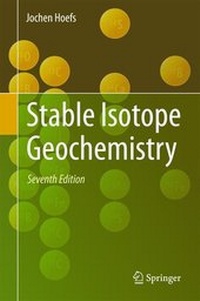
Stable Isotope Geochemistry is an introduction to the use of stable isotopes in the geosciences. For students and scientists alike the book will be a primary source of information with regard to how and where stable isotopes can be used to solve geological problems. It is subdivided into three parts: i) theoretical and experimental principles, ii) fractionation processes of light and heavy elements, iii) the natural variations of geologically important reservoirs. In the last decade, major advances in multicollector-ICP-mass-spectrometry enable the precise determination of a wide range of transition and heavy elements. Progress in analysing the rare isotopes of certain elements allows the distinction between mass-dependent and mass-independent fractionations. These major advances in analytical techniques make an extended new edition necessary. Special emphasis has been given to the growing field of "non-traditional" isotope systems. Many new references have been added, which will enable quick access to recent literature.
Reviews / Votes
"Hoef's systematic approach to
individual isotope systems makes for a clear book that is a great reference to
read up on that 'new' isotope system that one is about to explore. Summing Up:
Recommended. Upper-division undergraduates through faculty." (J. S. Lackey,
Choice, Vol. 53 (5), January, 2016)
Edition
Language
Place of publication
Publishing group
Springer International Publishing
Target group
Professional and scholarly
Professional/practitioner
Edition type
Illustrations
98
3 s/w Abbildungen, 98 farbige Abbildungen
98 Illustrations, color; 3 Illustrations, black and white; XV, 389 p. 101 illus., 98 illus. in color.
Dimensions
Height: 23.5 cm
Width: 15.5 cm
Weight
ISBN-13
978-3-319-19715-9 (9783319197159)
DOI
10.1007/978-3-319-19716-6
Schweitzer Classification
Jochen Hoefs has been working in the field of stable isotope geochemistry of the elements hydrogen, lithium, carbon, oxygen and sulfur since 1965. His main scientific interests include the stable isotope geochemistry of the mantle and lower crust, the genesis of basaltic and granitic magmas, water/rock interactions under hydrothermal conditions, the history of the ocean and the atmosphere and the application of stable isotopes to environmental problems. He has published about 150 scientific papers, mostly in international journals.
Theoretical and Experimental Principles.- Isotope Fractionation Processes of Selected Elements.- Variations of Stable Isotope Ratios in Nature.