

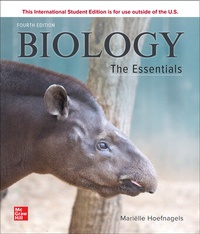
Biology: The Essentials ISE
4th Edition
Will be published approx. on 15. April 2021
Book
Paperback/Softback
706 pages
978-1-260-59761-5 (ISBN)
Description
Biology: The Essentials epitomizes what the market has come to recognize as Marielle Hoefnagels distinct and student-friendly writing-style. Marielle presents up-to-date information through What's the Point?, Why We Care, and Burning Questions; which are pedagogical tools designed to demonstrate to readers, and her own students, that biology is everywhere. Biology: The Essentials offers a broader and more conceptual introduction to biology, simplifying the more complex biological content to the essential elements that students need to act as framework for the details.
More details
Edition
4th edition
Language
English
Place of publication
OH
United States
Target group
College/higher education
US School Grade: From College Freshman to College Graduate Student
Illustrations
600 Illustrations
Dimensions
Height: 269 mm
Width: 234 mm
Thickness: 25 mm
Weight
1402 gr
ISBN-13
978-1-260-59761-5 (9781260597615)
Copyright in bibliographic data and cover images is held by Nielsen Book Services Limited or by the publishers or by their respective licensors: all rights reserved.
Schweitzer Classification
Other editions
Previous edition
Marielle Hoefnagels
ISE Biology: The Essentials
Book
02/2018
3rd Edition
McGraw-Hill Education
€73.15
Article exhausted; check for reprint
Person
Marielle Hoefnagels is Professor Emerita in the School of Life Sciences at the University of Oklahoma, where she taught courses in introductory biology, mycology, and science writing. She also frequently gave presentations on study skills and related topics to student groups across campus. She received the University of Oklahoma General Education Teaching Award, the Longmire Prize (the Teaching Scholars Award from the College of Arts and Sciences), and the Holden Faculty Award (to recognize outstanding faculty who teach freshmen and sophomores). She was also awarded honorary memberships in several student honor societies. Dr. Hoefnagels received her BS in environmental science from the University of California at Riverside, her MS in soil science from North Carolina State University, and her PhD in plant pathology from Oregon State University. Her dissertation work focused on the use of bacterial biological control agents to reduce the spread of fungal pathogens on seeds. In addition to authoring Biology: The Essentials and Biology: Concepts and Investigations, her scholarly publications focused on creating investigative teaching laboratories and integrating technology into introductory biology classes. She also maintains a blog on teaching nonmajors biology.
Content
Unit 1: Science, Chemistry, and Cells
1. Scientific Study of Life
2. The Chemistry of Life
3. Cells
4. The Energy of Life
5. Photosynthesis
6. Respiration and Fermentation
Unit 2: DNA, Inheritance, and Biotechnology
7. DNA Structure and Gene Function
8. DNA Replication, Binary Fission, and Mitosis9. Sexual Reproduction and Meiosis
10. Patterns of Inheritance
11. DNA Technology
Unit 3: Evolution and Diversity
12. Forces of Evolutionary Change
13. Evidence of Evolution
14. Speciation and Extinction
15. Evolution and Diversity of Microbial Life
16. Evolution and Diversity of Plants
17. Evolution and Diversity of Animals
Unit 4: Ecology
18. Populations
19. Communities and Ecosystems
20. Preserving Biodiversity
Unit 5: Plant Anatomy and Physiology
21. Plant Form and Function
22. Reproduction and Development of Flowering Plants
Unit 6: Animal Anatomy and Physiology
23. Animal Tissues and Organ Systems
24. The Nervous System and the Senses
25. The Endocrine System
26. The Skeletal and Muscular Systems
27. The Circulatory and Respiratory Systems
28. The Digestive and Urinary Systems
29. The Immune System
30. Animal Reproduction and Development
1. Scientific Study of Life
2. The Chemistry of Life
3. Cells
4. The Energy of Life
5. Photosynthesis
6. Respiration and Fermentation
Unit 2: DNA, Inheritance, and Biotechnology
7. DNA Structure and Gene Function
8. DNA Replication, Binary Fission, and Mitosis9. Sexual Reproduction and Meiosis
10. Patterns of Inheritance
11. DNA Technology
Unit 3: Evolution and Diversity
12. Forces of Evolutionary Change
13. Evidence of Evolution
14. Speciation and Extinction
15. Evolution and Diversity of Microbial Life
16. Evolution and Diversity of Plants
17. Evolution and Diversity of Animals
Unit 4: Ecology
18. Populations
19. Communities and Ecosystems
20. Preserving Biodiversity
Unit 5: Plant Anatomy and Physiology
21. Plant Form and Function
22. Reproduction and Development of Flowering Plants
Unit 6: Animal Anatomy and Physiology
23. Animal Tissues and Organ Systems
24. The Nervous System and the Senses
25. The Endocrine System
26. The Skeletal and Muscular Systems
27. The Circulatory and Respiratory Systems
28. The Digestive and Urinary Systems
29. The Immune System
30. Animal Reproduction and Development