

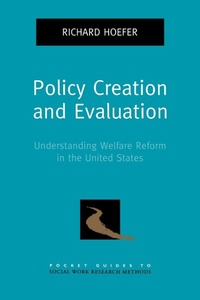
Policy Creation and Evaluation
Understanding Welfare Reform in the United States
Published on 17. November 2011
Book
Paperback/Softback
230 pages
978-0-19-973519-8 (ISBN)
Description
Although practitioners do not often identify an explicit focus on social welfare policy, the analysis (what it is) and evaluation (what it does) of policy is basic to social work practice. This unique pocket guide presents a case study on one of the most important domestic policy decisions in the post-WWII era, the passage of the Personal Responsibility and Work Opportunity Reconciliation Act (PRWORA) of 1996. This law ended welfare as we knew it by creating the Temporary Assistance to Needy Families (TANF) program and closing the Aid to Families with Dependent Children program.
Examining the law through three decision-making models assists readers in understanding TANF's historical antecedents, its political and power implications, and the way in which it meets social and economic goals. Individual chapters demonstrate how programs such as TANF are evaluated and the methods that can be used, such as primarily qualitative, primarily quantitative, and mixed methods evaluation techniques. Illustrating the advantages and disadvantages of each approach for evaluation, Hoefer makes use of the numerous studies undertaken in the thirteen years since welfare reform and its 2006 reauthorization. Part history text, readers will also learn about the details of the TANF legislation creation and evaluation, but will finish with a greater understanding of the policy creation and evaluation processes.
This pocket guide will be useful to researchers as well as students in advanced social policy courses seeking to understand the two stages of policy-making, to possibly develop policy, to be able to describe the impact of social policy on social problems.
Examining the law through three decision-making models assists readers in understanding TANF's historical antecedents, its political and power implications, and the way in which it meets social and economic goals. Individual chapters demonstrate how programs such as TANF are evaluated and the methods that can be used, such as primarily qualitative, primarily quantitative, and mixed methods evaluation techniques. Illustrating the advantages and disadvantages of each approach for evaluation, Hoefer makes use of the numerous studies undertaken in the thirteen years since welfare reform and its 2006 reauthorization. Part history text, readers will also learn about the details of the TANF legislation creation and evaluation, but will finish with a greater understanding of the policy creation and evaluation processes.
This pocket guide will be useful to researchers as well as students in advanced social policy courses seeking to understand the two stages of policy-making, to possibly develop policy, to be able to describe the impact of social policy on social problems.
More details
Series
Language
English
Place of publication
New York
United States
Target group
College/higher education
Dimensions
Height: 210 mm
Width: 140 mm
Thickness: 13 mm
Weight
287 gr
ISBN-13
978-0-19-973519-8 (9780199735198)
Copyright in bibliographic data and cover images is held by Nielsen Book Services Limited or by the publishers or by their respective licensors: all rights reserved.
Schweitzer Classification
Other editions
Additional editions
E-Book
10/2011
1st Edition
OUP eBook
€22.99
Available for download
Person
Richard Hoefer, PhD, is Roy E. Dulak Professor for Community Research at the School of Social Work, University of Texas at Arlington.
Content
Preface ; 1. Social Policy Creation and Evaluation ; Part I. Social Policy Creation ; 2. Using the Historical Approach ; 3. Using the Politics and Power Approach ; 4. Using the "Rational Actor" Approach ; Summary of the Three Models ; Part II. Social Policy Evaluation ; 5. Using Qualitative Methods to Understand What the Policy Did ; With Regina Aguirre, PhD ; 6. Using Quantitative Methods to Understand What the Policy Did ; 7. Using Mixed Methods to Understand What the Policy Did ; 8. Conclusion: Understanding Social Policy Creation and Evaluation ; Glossary ; References ; Index