


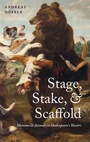
Stage, Stake, and Scaffold
Humans and Animals in Shakespeare's Theatre
Published on 9. January 2014
Book
Paperback/Softback
330 pages
978-0-19-870101-9 (ISBN)
Description
The powerful exchanges between stage, stake, and scaffold - the theatre, the bear garden and the spectacle of public execution - crucially informed Shakespeare's explorations into the construction and workings of 'the human'. The theatre's family resemblance to animal baiting and the spectacle of punishment, its sharing of the same basic type of performance space -- a theatre-in-the-round, a scaffold, stake or platform surrounded by spectators -- bred an ever-ready potential for a transfer of images and meanings. The staging of one of these kinds of performance is always framed by an awareness of the other two, whose presence is never quite erased and often, indeed, emphatically foregrounded. Situating Shakespearean drama within its material environment, Andreas Hoefele explores how this spill-over affects the way Shakespeare models his human characters and his understanding of 'human character' in general. His dramatis personae are infused with a degree of animality that a later, more specifically Cartesian, anthropology would categorically efface. Readings based on such an anthropology tend to reduce Shakespeare's teeming multitude of animal references to a stable marker of moral, social, and ontological difference, 'beast' being everything 'man' is not or ought not to be. In contrast, Hoefele argues that Shakespearean notions of humanity rely just as much on inclusion as on exclusion of the animal. Humans and animals face each other across the species divide, but the divide proves highly permeable.
Reviews / Votes
[a] sophisticated study of how early modern Europeans conceived of the human being in relation to other species. * Russ McDonald, Times Literary Supplement * [a] diverting study * Steven Poole, The Guardian * Stage, Stake and Scaffold is an excellent part of the growing field of animal studies within the broader study of Shakespeares work. Hoefele's work has much to offer for scholars interested in Shakespeares works, staging practices, and the culture of spectacle and violence that informs Renaissance dramatic literature and history. * Marina Gerzic, Parergon - Journal of the Australian and New Zealand Association for Medieval and Early Modern Studies * This is fascinating stuff * The Stage * Andreas Hoefele's Stage, Stake, and Scaffold provides the most complete exploration yet of the relation between Shakespeares theater and the spectacles of blood sport and criminal punishment concurrently available to the poets original audiences ... such impressive depth and precision * Bruce Boehrer, Modern Philology * Stage, Stake, and Scaffold is, however, an often subtle and hugely enjoyable book, which offers fresh, persuasive readings of the Shakespeare canon and challenges us to recognise the complex collusions of bloodsport, punishment and play. * Helen Smith, Literature & History * ... an illuminating, intriguing, and thoroughly researched work ... Stage, Stake and Scaffold can offer those working on animals in Shakespeare, specifically the dualism between man and beast, a refreshing new take on the role and importance of actual and metaphorical animals and creatures in Shakespearean drama. * Kimbrina Davey, Notes and Queries *More details
Language
English
Place of publication
Oxford
United Kingdom
Target group
College/higher education
Professional and scholarly
Illustrations
11 black-and-white halftones
Dimensions
Height: 233 mm
Width: 157 mm
Thickness: 19 mm
Weight
488 gr
ISBN-13
978-0-19-870101-9 (9780198701019)
Copyright in bibliographic data and cover images is held by Nielsen Book Services Limited or by the publishers or by their respective licensors: all rights reserved.
Schweitzer Classification
Other editions
Additional editions
Book
05/2011
1st Edition
Oxford University Press
€93.90
Shipment within 15-20 days
Person
Andreas Hoefele is Professor of English at Munich University. His publications include books on Shakespeare's stagecraft, late 19th-century parody and on Malcolm Lowry, as well as numerous articles on Renaissance and 20th-century themes and six novels. He is a member of the Heidelberg and of the Bavarian Academies of Science and President of the German Shakespeare Society.
Content
BIBLIOGRAPHY; INDEX