

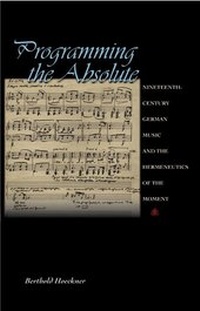
Programming the Absolute
Nineteenth-Century German Music and the Hermeneutics of the Moment
Published on 10. November 2002
Book
Hardback
432 pages
978-0-691-00149-4 (ISBN)
Description
Programming the Absolute discusses the notorious opposition between absolute and program music as a true dialectic that lies at the heart of nineteenth-century German music. Beginning with Beethoven, Berthold Hoeckner traces the aesthetic problem of musical meaning in works by Schumann, Wagner, Liszt, Mahler, and Schoenberg, whose private messages and public predicaments are emblematic for the cultural legacy of this rich repertory. After Romanticism had elevated music as a language "beyond" language, the ineffable spurred an unprecedented proliferation of musical analysis and criticism. Taking his cue from Adorno, Hoeckner develops the idea of a "hermeneutics of a moment," which holds that musical meaning crystallizes only momentarily--in a particular passage, a progression, even a single note. And such moments can signify as little as a fleeting personal memory or as much as the whole of German music.
Although absolute music emerged with a matrix of values--the integrity of the subject, the aesthetic autonomy of art, and the intrinsic worth of high culture--that are highly contested in musicology today, Hoeckner argues that we should not completely discard the ideal of a music that continues to offer moments of transcendence and liberation. Passionately and artfully written, Hoeckner's quest for an "essayistic musicology" displays an original intelligence willing to take interpretive risks. It is a provocative contribution to our knowledge about some of Europe's most important music--and to contemporary controversies over how music should be understood and experienced.
Although absolute music emerged with a matrix of values--the integrity of the subject, the aesthetic autonomy of art, and the intrinsic worth of high culture--that are highly contested in musicology today, Hoeckner argues that we should not completely discard the ideal of a music that continues to offer moments of transcendence and liberation. Passionately and artfully written, Hoeckner's quest for an "essayistic musicology" displays an original intelligence willing to take interpretive risks. It is a provocative contribution to our knowledge about some of Europe's most important music--and to contemporary controversies over how music should be understood and experienced.
Reviews / Votes
"Hermeneutics of the moment, both musical and historical, is the subject of this excellent book... Closely argued and full of fresh, interesting observations, Hoeckner moves the discourse on hermeneutics to new level."--ChoiceMore details
Language
English
Place of publication
New Jersey
United States
Target group
Professional and scholarly
College/higher education
Product notice
Trade binding
Illustrations
43 musical scores. 3 tables. 11 halftones. 3 line illus.
Dimensions
Height: 229 mm
Width: 152 mm
Weight
652 gr
ISBN-13
978-0-691-00149-4 (9780691001494)
Copyright in bibliographic data and cover images is held by Nielsen Book Services Limited or by the publishers or by their respective licensors: all rights reserved.
Schweitzer Classification
Other editions
Additional editions
Berthold Hoeckner
Programming the Absolute
Nineteenth-Century German Music and the Hermeneutics of the Moment
E-Book
07/2022
1st Edition
Princeton University Press
€119.99
Available for download
Person
Berthold Hoeckner is Associate Professor of Music and the Humanities at the University of Chicago.
Content
List of Figures and Tables ix List of Examples xi Preface xv Introduction Musical Moments and the Moment of German Music 1 Chapter One Beethoven's Star 12 Chapter Two Schumann's Distance 51 Chapter Three Elsa's Scream 115 Chapter Four Liszt's Prayer 155 Chapter Five Schoenberg's Gaze 189 Chapter Six Echo's Eyes 224 Notes 266 Bibliography 317 Index 339