

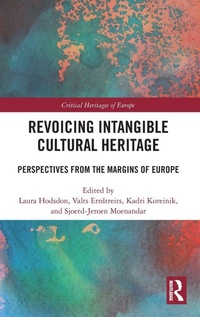
Revoicing Intangible Cultural Heritage
Perspectives from the Margins of Europe
1st Edition
Published on 13. June 2025
Book
Hardback
246 pages
978-1-032-59729-4 (ISBN)
Description
Revoicing Intangible Cultural Heritage draws upon an original, wide-ranging dataset to show that the dynamics and ethics of participation in European national minority cultures' intangible cultural heritage (ICH) are more nuanced than has previously been articulated.
Arguing for an approach to analysing ICH that reflects societal change in regions that are historically those of national minorities, contributions to the volume focus on three regions across four countries. This allows for comparative exploration of exemplar contexts that span a range of circumstances in which European national minority cultures thrive and strive for voice and recognition. It explores how a wide range of people engage with national minorities' ICH and seeks a better understanding of the ethical and practical dimensions of this participation. It proposes a heritage literate 'revoicing' of ICH: to create socially positive pathways to resilient ICH, and in turn ensure ICH is an arena where these positive social relations are shaped as part of an evolving ecosystem into the future.
Revoicing Intangible Cultural Heritage takes an interdisciplinary approach ideally placed to interrogate the interplay of different groups with ICH from multiple perspectives. This makes the book essential reading for academics and students working in heritage studies, sociolinguistics, cultural and event studies, sociology, creative practice, and cultural geography.
The Open Access version of this book, available at http://www.taylorfrancis.com, has been made available under a Creative Commons Attribution-Non Commercial-No Derivatives (CC BY-NC-ND) 4.0 license.
Arguing for an approach to analysing ICH that reflects societal change in regions that are historically those of national minorities, contributions to the volume focus on three regions across four countries. This allows for comparative exploration of exemplar contexts that span a range of circumstances in which European national minority cultures thrive and strive for voice and recognition. It explores how a wide range of people engage with national minorities' ICH and seeks a better understanding of the ethical and practical dimensions of this participation. It proposes a heritage literate 'revoicing' of ICH: to create socially positive pathways to resilient ICH, and in turn ensure ICH is an arena where these positive social relations are shaped as part of an evolving ecosystem into the future.
Revoicing Intangible Cultural Heritage takes an interdisciplinary approach ideally placed to interrogate the interplay of different groups with ICH from multiple perspectives. This makes the book essential reading for academics and students working in heritage studies, sociolinguistics, cultural and event studies, sociology, creative practice, and cultural geography.
The Open Access version of this book, available at http://www.taylorfrancis.com, has been made available under a Creative Commons Attribution-Non Commercial-No Derivatives (CC BY-NC-ND) 4.0 license.
More details
Series
Language
English
Place of publication
London
United Kingdom
Publishing group
Taylor & Francis Ltd
Target group
College/higher education
Professional and scholarly
Postgraduate
Illustrations
7 s/w Abbildungen, 5 s/w Photographien bzw. Rasterbilder, 2 s/w Zeichnungen
2 Line drawings, black and white; 5 Halftones, black and white; 7 Illustrations, black and white
Dimensions
Height: 240 mm
Width: 161 mm
Thickness: 19 mm
Weight
561 gr
ISBN-13
978-1-032-59729-4 (9781032597294)
Copyright in bibliographic data and cover images is held by Nielsen Book Services Limited or by the publishers or by their respective licensors: all rights reserved.
Schweitzer Classification
Other editions
Additional editions
Laura Hodsdon | Valts Ernstreits | Kadri Koreinik
Revoicing Intangible Cultural Heritage
Perspectives from the Margins of Europe
E-Book
06/2025
Routledge
€0.00
Available for download
Laura Hodsdon | Valts Ernstreits | Kadri Koreinik
Revoicing Intangible Cultural Heritage
Perspectives from the Margins of Europe
E-Book
06/2025
Routledge
€0.00
Available for download
Persons
Laura Hodsdon is Associate Professor in Heritage, Culture & Society at Falmouth University. She was Project Leader of the Re:voice project and its UK Principal Investigator. Her research focuses on heritage and landscapes, with particular interests in social justice and how different people engage with heritage.
Valts Ernstreits is Director of the University of Latvia Livonian Institute, Culture Policy Advisor to the Minister of Culture of the Republic of Latvia, and was Latvia Principal Investigator for Re:voice. Being Livonian himself, he has been involved in Livonian revitalisation efforts, and his research interests include building digital resources and developing approaches for the research, safeguarding, and accessibility of Livonian language and cultural sources, as well as lexicography, language standardisation, and intangible heritage.
Kadri Koreinik is Associate Professor of Language Sociology at the Institute of Estonian and General Linguistics at the University of Tartu, and was Re:voice's Estonia Principal Investigator. With a background and training in social sciences, she is interested in extralinguistic factors (ideologies, policies, migration) which have impacts on (socio)linguistic and social change.
Sjoerd-Jeroen Moenandar is Assistant Professor at the Minorities & Multilingualism programme at the University of Groningen and led the Frisian Re:voice team. He is a narratologist and has a special interest in how storytelling is used to create individual and collective identities.
Valts Ernstreits is Director of the University of Latvia Livonian Institute, Culture Policy Advisor to the Minister of Culture of the Republic of Latvia, and was Latvia Principal Investigator for Re:voice. Being Livonian himself, he has been involved in Livonian revitalisation efforts, and his research interests include building digital resources and developing approaches for the research, safeguarding, and accessibility of Livonian language and cultural sources, as well as lexicography, language standardisation, and intangible heritage.
Kadri Koreinik is Associate Professor of Language Sociology at the Institute of Estonian and General Linguistics at the University of Tartu, and was Re:voice's Estonia Principal Investigator. With a background and training in social sciences, she is interested in extralinguistic factors (ideologies, policies, migration) which have impacts on (socio)linguistic and social change.
Sjoerd-Jeroen Moenandar is Assistant Professor at the Minorities & Multilingualism programme at the University of Groningen and led the Frisian Re:voice team. He is a narratologist and has a special interest in how storytelling is used to create individual and collective identities.
Content
Introduction: Intangible cultural heritage at the margins of Europe; Part I CONTEXTS; 1. Revoicing intangible cultural heritage; 2. 'By the community, for the community': Boundary narratives, boundary work, and intangible cultural heritage; 3. Heritage discourse and voices of change; Part II ANALYSES; Voices; 4. 'Torches aloft' to Glastonbury: the discursive construction of heritage events in Cornwall; 5. Intangible cultural heritage as a tool for sustaining language: a Livonian case study; 6. 'You get an upgrade in Frisian'. Processes of identity formation and negotiation around Frisian theatre; Spaces; 7. What is the post-industrial rural for? Intangible cultural heritage, rural world-making and core-periphery imaginaries; 8. Revoicing Livonian cultural landscapes on opposite sides of the Gulf of Riga; 9. Taking up space: physical and affective geographies of intangible cultural heritage events; Negotiations; 10. Rules of engagement at intangible cultural heritage events; 11. The filmmakers' gaze: navigating the zone of cultural osmosis in capturing heritage events; 12. Negotiations and co-creations in the resourcing of intangible cultural heritage s: Towards resilient intangible cultural heritage and positive social relationsevents; Part III FUTURES; 13. Revoicing beyond Europe? Conversations in global contexts; 14. Revoicing cultural landscape