

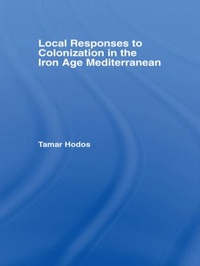
Local Responses to Colonization in the Iron Age Meditarranean
1st Edition
Published on 18. August 2006
Book
Hardback
10 pages
978-0-415-37836-9 (ISBN)
Description
The first study to bring together such a breadth of data, this book compares responses to colonization in the Iron-Age Mediterranean.
From North Syria to Sicily and North Africa, Tamar Hodos explores the responses to these colonies in areas where Greeks and Phoenicians were in competition with one another via the same local communities.
Highlighting the diversity of interest displayed by local populations in these foreign cultural offering, Hodos charts their selective adaptation, modification and reinterpretation of Greek and Phoenician goods and ideas as their own cultures evolve.
For students of archaeology and history, this will provide an essential resource for their degree course studies.
From North Syria to Sicily and North Africa, Tamar Hodos explores the responses to these colonies in areas where Greeks and Phoenicians were in competition with one another via the same local communities.
Highlighting the diversity of interest displayed by local populations in these foreign cultural offering, Hodos charts their selective adaptation, modification and reinterpretation of Greek and Phoenician goods and ideas as their own cultures evolve.
For students of archaeology and history, this will provide an essential resource for their degree course studies.
Reviews / Votes
'This book's great contribution is an up-to-date survey of the literature and regional archaeological evidence, and serious examination of much of the received wisdom on the dynamics of acculturation... the choice of focus and regions, and engagement with comparative method and theoretical perspective, makes Hodos's book a timely and very useful study, one that is not afraid to tackle important issues and opens new vistas.' - Carla Antonaccio, Antiquity'This book is a welcome contribution in an area where theoretical developments have recently outpaced archaeological syntheses, and the book provides an excellent overview of the cultural ferment of Iron Age colonial contexts.' - Adam Rabinowitz, Bryn Mawr Classical Revie
'Ultimately, while one might not agree with some interpretations or the selection and use of data, one must agree that Weiberg thinks about Bronze Age in new ways. She has certainly succeeded in making me rethink the Early Helladic period.' -- Daniel J. Pullen (Florida State University) American Journal of Archaeology 'This book's great contribution is an up-to-date survey of the literature and regional archaeological evidence, and serious examination of much of the received wisdom on the dynamics of acculturation... the choice of focus and regions, and engagement with comparative method and theoretical perspective, makes Hodos's book a timely and very useful study, one that is not afraid to tackle important issues and opens new vistas.' - Carla Antonaccio, Antiquity
'This book is a welcome contribution in an area where theoretical developments have recently outpaced archaeological syntheses, and the book provides an excellent overview of the cultural ferment of Iron Age colonial contexts.' - Adam Rabinowitz, Bryn Mawr Classical Review
More details
Language
English
Place of publication
London
United Kingdom
Publishing group
Taylor & Francis Ltd
Target group
College/higher education
Professional and scholarly
Postgraduate
Dimensions
Height: 234 mm
Width: 156 mm
Weight
592 gr
ISBN-13
978-0-415-37836-9 (9780415378369)
Copyright in bibliographic data and cover images is held by Nielsen Book Services Limited or by the publishers or by their respective licensors: all rights reserved.
Schweitzer Classification
Other editions
Additional editions
Book
10/2008
1st Edition
Routledge
€89.43
Shipment within 15-20 days
E-Book
09/2006
Routledge
€77.99
Available for download
E-Book
09/2006
Routledge
€77.99
Available for download
Person
Content
Acknowledgements. Illustrations List. Introduction. When is the Iron Age? Early Exchanges. Colonization in the Ancient World. Colonialism in the Ancient World. What is a Colony and When is it Not? What Comes Next. North Syria. Sicily. North Africa. Conclusions. Bibliography