

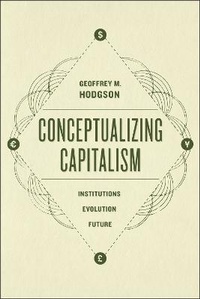
Conceptualizing Capitalism - Institutions, Evolution, Future
Published on 22. September 2015
Book
Hardback
456 pages
978-0-226-16800-5 (ISBN)
Description
A few centuries ago, capitalism set in motion an explosion of economic productivity. Markets and private property had existed for millennia, but what other key institutions fostered capitalism's relatively recent emergence? Until now, the conceptual toolkit available to answer this question has been inadequate, and economists and other social scientists have been diverted from identifying these key institutions. With Conceptualizing Capitalism, Geoffrey M Hodgson offers readers a more precise conceptual framework. Drawing on a new theoretical approach called legal institutionalism, Hodgson establishes that the most important factor in the emergence of capitalism - but also among the most often overlooked - is the constitutive role of law and the state. While private property and markets are central to capitalism, they depend upon the development of an effective legal framework. Applying this legally grounded approach to the emergence of capitalism in eighteenth - century Europe, Hodgson identifies the key institutional developments that coincided with its rise.
That analysis enables him to counter the widespread view that capitalism is a natural and inevitable outcome of human societies, showing instead that it is a relatively recent phenomenon, contingent upon a special form of state that protects private property and enforces contracts. After establishing the nature of capitalism, the book considers what this more precise conceptual framework can tell us about the possible future of capitalism in the twenty-first century, where some of the most important concerns are the effects of globalization, the continuing growth of inequality, and the challenges to America's hegemony by China and others.
That analysis enables him to counter the widespread view that capitalism is a natural and inevitable outcome of human societies, showing instead that it is a relatively recent phenomenon, contingent upon a special form of state that protects private property and enforces contracts. After establishing the nature of capitalism, the book considers what this more precise conceptual framework can tell us about the possible future of capitalism in the twenty-first century, where some of the most important concerns are the effects of globalization, the continuing growth of inequality, and the challenges to America's hegemony by China and others.
Reviews / Votes
"In standard economics, capitalism has become an ill-defined concept, its analysis flawed from the very initial definition. Hodgson's book reintroduces a sharp and precise definition, showing how a successful analysis of capitalism requires an understanding of the interactions of numerous complementary institutions, including sophisticated legal institutions. This is a remarkable and highly original piece of interdisciplinary scholarship that will greatly contribute to the understanding of contemporary capitalist economies." (Ugo Pagano, University of Siena and Central European University)More details
Language
English
Place of publication
Chicago
United States
Publishing group
The University of Chicago Press
Target group
College/higher education
Dimensions
Height: 233 mm
Width: 160 mm
Thickness: 34 mm
Weight
828 gr
ISBN-13
978-0-226-16800-5 (9780226168005)
Copyright in bibliographic data and cover images is held by Nielsen Book Services Limited or by the publishers or by their respective licensors: all rights reserved.
Schweitzer Classification
Other editions
Additional editions
E-Book
12/2022
1st Edition
University of Chicago Press
€23.53
Available for download
Person
Geoffrey M. Hodgson is research professor at Hertfordshire Business School, University of Hertfordshire, England, and the author or coauthor of over a dozen books, including Darwin's Conjecture and From Pleasure Machines to Moral Communities, both also published by the University of Chicago Press.