

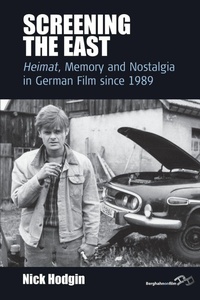
Screening the East
Heimat, Memory and Nostalgia in German Film since 1989
1st Edition
Published on 1. May 2013
Book
Paperback/Softback
272 pages
978-1-78238-134-1 (ISBN)
Description
Screening the East considers German filmmakers' responses to unification. In particular, it traces the representation of the East German community in films made since 1989 and considers whether these narratives challenge or reinforce the notion of a separate East German identity. The book identifies and analyses a large number of films, from internationally successful box-office hits, to lesser-known productions, many of which are discussed here for the first time. Providing an insight into the films' historical and political context, it considers related issues such as stereotyping, racism, regional particularism and the Germans' confrontation with the past.
Reviews / Votes
"Hodgin ... brings extensive historical and sociological knowledge to his perceptive discussion of complex topics such as nostalgia for the GDR and debates over how its ambiguous history should be represented ... by bringing to the attention of English-speaking readers many less-known films and filmmakers, this readable study provides a valuable resource on recent German film history." ? Choice"This book is highly welcome since so far only few publications on afterlife of the GDR in German film exist. Hodgin's study is based on over eighty films and with that covers two decades (1989 to 2008). This comprehensive body of material and the long period covered make this publication a valuable overview...The author shows with this book a profound knowledge of German film." ? H-Net
" [This book] is very welcome... and recommended. The well-informed survey at the beginning of it makes it easy for newcomers to the subject as well as experts in various subject areas to find a rewarding access to this topic. This study shows the author's profound knowledge of contemporary German film dealing with the aftermath of the GDR. The comprehensive filmography is remarkable for its socio-political and aesthetic contextualization. A particular merit lies in the inclusion of films that are little know." ? H-Soz-u-Kult
"...this monograph by the British cultural historian and scholar of film Nick Hodgin is especially welcome. On the basis of a wide range of sources-more than eighty thematically relevant films, some of which are relatively unknown and only accessible with difficulty-it deals with German films produced between 1989 and 2008...Inspired by reading this book, one would like to read more, which suggests that it is worth continuing to work with film as a historical source for recent German history." ? German Historical Institute London Bulletin
"...contains useful and nuanced readings of the best-known films dealing with themes related to unification, as well as highlighting some equally interesting lesser-known works, in order to provide a rounded picture of German cinema's engagement with these issues in the past 17 years. I am not aware of any other publication that covers such a range of material and this in itself makes the book a valuable contribution to the field." ? David Clarke, University of Bath
"This is an extremely rich study of the representation of east German identity and the former GDR in post-unification cinema. The author clearly has an encyclopaedic knowledge of the films of this period ... Hodgin's book breaks genuinely new ground." ? Sean Allan, University of Warwick
"The book reveals an excellent knowledge of German culture and cinema, and combines methodological soundness with an ability to talk about films in a lively way free of jargon. Screening the East should not be missed by anybody interested in German cinema and culture, as well as cinema as discourse on history and space." ? Ewa Mazierska, University of Central Lancashire
"Screening the East provides insightful readings of contemporary classics such as Good Bye, Lenin! and The Lives of Others alongside films which complement these popular memories of life on the other side of the Wall by an eastern and, arguably, more authentic perspective. This is an engaging and important contribution to German cinema and cultural studies, providing a wealth of contextual detail." ? Daniela Berghahn, Reader in Film Studies, Royal Holloway, University of London
More details
Series
Language
English
Place of publication
Oxford
United Kingdom
Target group
College/higher education
Product notice
Paperback (trade)
Illustrations
20 Illustrations
Dimensions
Height: 229 mm
Width: 152 mm
Thickness: 13 mm
Weight
346 gr
ISBN-13
978-1-78238-134-1 (9781782381341)
DOI
10.3167/9780857451286
Copyright in bibliographic data and cover images is held by Nielsen Book Services Limited or by the publishers or by their respective licensors: all rights reserved.
Schweitzer Classification
Other editions
Additional editions
E-Book
05/2011
1st Edition
Berghahn Books
€32.49
Available for download
E-Book
05/2011
1st Edition
Berghahn Books
€19.49
Available for download
Person
Nick Hodgin teaches German and Film Studies at the University of Lancaster (UK). He has published widely on German film and German cultural studies, including the co-edited volume on GDR culture, The GDR Remembered. Representing the East German tate since 1989 (Camden House, 2011). His current projects focus on visual culture in the GDR, international documentary cinema, and contemporary German filmmakers.
Content
List of Illustrations
Acknowledgements
Introduction
Films and Identity: Reflecting the Nation
Heimat, Memory and Nostalgia
Chapter 1. Mapping Identity
After Unity: Stereotypes and Dissent
A Post-GDR Identity?
Ostalgie - Recharging the Batteries of Identity
Chapter 2. Heimat Stories: East Meets West
The Heimatfilm: Past Genres for Present Tensions
Heimatas Refuge
Locating Heimat in the GDR
Screening Heimat in the GDR
Contesting Heimat
An Island Mentality:D Brocken
Heimat Found?Go Trabi Go II. Das war der wilde Osten
Conclusion: Triumph of the Underdog
Chapter 3. Lost Landscapes
Provincial Fears and Loathing
Escaping Heimat
Failed Utopia?
Paradise Lost?
Post-unification Landscapes: Charting Memory
Stories from the Margins
Still Life: Representing the East
Memory and Loss
Neben der Zeit: Memories in Ruins, Ruined Memories
Landscape and Meaning
Chapter 4. At the Back of Beyond: Heimat East
On the Road Again
The Occidental Tourists: Wir Koennen auch anders
Resisting Stereotypes
On the Run
The Community as Mob
Borderland/Bored Land
Community Undone
Chapter 5. Berlin: Disorientation/Reorientation
After Unification: Lapsus memoriae?
No-Man's Land
Orientations
Haunted by the Past
Disorientation
New Cartographies: Berlin is in Germany
Chapter 6. Good Bye, Ostalgie?
Commodifying the Past
Disneyland GDR
Reimagining the GDR
Recycling the Past: Der Zimmerspringbrunnen
Reconstructing the GDR
Between Ostalgie and Westalgie
Fade to Grey: NVA
Stasiland GDR
Conclusion
A Community Apart?
Towards Normalization?
Filmography
Bibliography
Index
Acknowledgements
Introduction
Films and Identity: Reflecting the Nation
Heimat, Memory and Nostalgia
Chapter 1. Mapping Identity
After Unity: Stereotypes and Dissent
A Post-GDR Identity?
Ostalgie - Recharging the Batteries of Identity
Chapter 2. Heimat Stories: East Meets West
The Heimatfilm: Past Genres for Present Tensions
Heimatas Refuge
Locating Heimat in the GDR
Screening Heimat in the GDR
Contesting Heimat
An Island Mentality:D Brocken
Heimat Found?Go Trabi Go II. Das war der wilde Osten
Conclusion: Triumph of the Underdog
Chapter 3. Lost Landscapes
Provincial Fears and Loathing
Escaping Heimat
Failed Utopia?
Paradise Lost?
Post-unification Landscapes: Charting Memory
Stories from the Margins
Still Life: Representing the East
Memory and Loss
Neben der Zeit: Memories in Ruins, Ruined Memories
Landscape and Meaning
Chapter 4. At the Back of Beyond: Heimat East
On the Road Again
The Occidental Tourists: Wir Koennen auch anders
Resisting Stereotypes
On the Run
The Community as Mob
Borderland/Bored Land
Community Undone
Chapter 5. Berlin: Disorientation/Reorientation
After Unification: Lapsus memoriae?
No-Man's Land
Orientations
Haunted by the Past
Disorientation
New Cartographies: Berlin is in Germany
Chapter 6. Good Bye, Ostalgie?
Commodifying the Past
Disneyland GDR
Reimagining the GDR
Recycling the Past: Der Zimmerspringbrunnen
Reconstructing the GDR
Between Ostalgie and Westalgie
Fade to Grey: NVA
Stasiland GDR
Conclusion
A Community Apart?
Towards Normalization?
Filmography
Bibliography
Index