

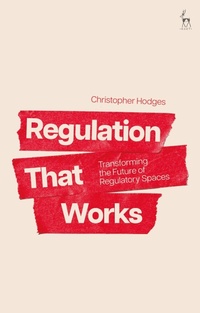
Regulation That Works
Transforming the Future of Regulatory Spaces
Will be published approx. on 22. January 2026
Book
Hardback
320 pages
978-1-5099-8916-4 (ISBN)
Description
This book explains what regulation is - and is not.
It clarifies how regulation actually works, and how it can be made better. It also sets out how regulation should be done given fundamental challenges and changes to how we have done it. What is regulation trying to achieve? Is there too much red tape? Does regulation impede growth and innovation? Does regulation provide protection, and stability, and fair behaviours? Is it effective? How do we know if it succeeds?
The book illustrates competing regulatory models, and how multiple tools work - but also how things need to work differently in the future.
Given the pace of change in new technologies, creating unknown and uncontrollable risks, and the global nature of these technologies, we can only keep ourselves safe if we modernise how we 'do' regulation and work in collaborative ecosystems in which everyone works together to identify and control new harms. We should be aiming to achieve multiple outcomes, including protection as well as fair markets, facilitating innovation, and economic growth and social cohesion.
The book elucidates how this is all possible - if we organise ourselves and behave in new ways. Examples show sectors where all of this is already being applied - in Australia, Canada, New Zealand, and the UK.
This is a revolutionary book, and a must-read for anyone who wants to effect change in their regulatory spaces.
It clarifies how regulation actually works, and how it can be made better. It also sets out how regulation should be done given fundamental challenges and changes to how we have done it. What is regulation trying to achieve? Is there too much red tape? Does regulation impede growth and innovation? Does regulation provide protection, and stability, and fair behaviours? Is it effective? How do we know if it succeeds?
The book illustrates competing regulatory models, and how multiple tools work - but also how things need to work differently in the future.
Given the pace of change in new technologies, creating unknown and uncontrollable risks, and the global nature of these technologies, we can only keep ourselves safe if we modernise how we 'do' regulation and work in collaborative ecosystems in which everyone works together to identify and control new harms. We should be aiming to achieve multiple outcomes, including protection as well as fair markets, facilitating innovation, and economic growth and social cohesion.
The book elucidates how this is all possible - if we organise ourselves and behave in new ways. Examples show sectors where all of this is already being applied - in Australia, Canada, New Zealand, and the UK.
This is a revolutionary book, and a must-read for anyone who wants to effect change in their regulatory spaces.
More details
Language
English
Place of publication
Oxford
United Kingdom
Publishing group
Bloomsbury Publishing PLC
Target group
Professional and scholarly
College/higher education
Dimensions
Height: 222 mm
Width: 145 mm
Thickness: 23 mm
Weight
579 gr
ISBN-13
978-1-5099-8916-4 (9781509989164)
Copyright in bibliographic data and cover images is held by Nielsen Book Services Limited or by the publishers or by their respective licensors: all rights reserved.
Schweitzer Classification
Person
Christopher Hodges is Emeritus Professor of Justice Systems, University of Oxford, UK.
Content
Part A: Theories, Models, Regulation as a System
1. What is Regulation?
2. Scientific Evidence on how Humans Behave
3. New Models
4. A Regulatory System and its Functions
5. How to do Outcome-Based Collaborative Regulation
Part B: Operating a Regulatory System Approach
6. Transformation of Practice on Intervention and Enforcement
7. Tools for a Regulatory System
Part C: Problems, Criticisms, Challenges and Future Solutions
8. Problems and Criticisms of Regulation
9. New Regulatory Systems to Support Innovation
10. The Future of Regulation (And What We Need to Do)
1. What is Regulation?
2. Scientific Evidence on how Humans Behave
3. New Models
4. A Regulatory System and its Functions
5. How to do Outcome-Based Collaborative Regulation
Part B: Operating a Regulatory System Approach
6. Transformation of Practice on Intervention and Enforcement
7. Tools for a Regulatory System
Part C: Problems, Criticisms, Challenges and Future Solutions
8. Problems and Criticisms of Regulation
9. New Regulatory Systems to Support Innovation
10. The Future of Regulation (And What We Need to Do)