

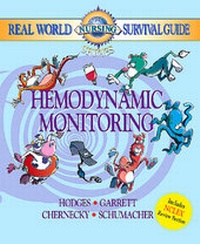
Real World Nursing Survival Guide: Hemodynamic Monitoring
Published on 21. January 2005
Book
Paperback/Softback
224 pages
978-0-7216-0375-9 (ISBN)
Description
The latest title in the Real World Nursing Survival Guide series, this fun and engaging book makes it easy to review must-know concepts associated with hemodynamic monitoring. Its lighthearted, cartoon-filled approach guides readers through challenging concepts and procedures. The book begins with an overview of five main concepts: cardiac output, stroke volume, preload, afterload, and contractility. It discusses equipment used for specific procedures, followed by discussions of specific aspects of hemodynamic monitoring including cardiac output, intra-arterial, central venous, pulmonary artery, and mixed venous oxygenation. The final chapter focuses on clinical applications with case studies, clinical interventions, and exercises.
The unique presentation of content narrows the gap between the knowledge a student learns during nursing school and the wisdom they need to survive in the real world.
Material is presented using adult learning principles and various active-learning strategies to engage readers of all ages, backgrounds, and learning styles.
A consistent chapter format - using the headings What it is, What you need to know, What you do, and Do you understand? - breaks down information into small segments and facilitates understanding.
Special icons for Lifespan Considerations, Cultural Implications, Web Links, Cautions, Monitoring and Initial Treatment help readers quickly identify special content in the chapter.
A variety of memory-reinforcing activities such as mnemonic devices, fill-in the blank, matching, word jumbles, true/false, and crossword puzzles promote learning and understanding.
Clinical terms and shorthand expressions are highlighted in colored text within parentheses after the explanation, to expose readers to terminology used in the practice setting.
Boxed Take Home Points distill years of nursing experience into practical, "real world" advice from the experts.
More than 100 NCLEX-style questions, divided by chapter, are included in a section at the end of the book so readers can test their knowledge and review challenging concepts.
Full-color illustrations demonstrate key concepts and principles of hemodynamic monitoring, including various complications.
Original cartoon-character illustrations and a cartoon camel walk readers through subjects that nursing students have identified as difficult, using a lighthearted approach.
Waveforms at the end of each chapter allow readers to practice their interpretation.
The unique presentation of content narrows the gap between the knowledge a student learns during nursing school and the wisdom they need to survive in the real world.
Material is presented using adult learning principles and various active-learning strategies to engage readers of all ages, backgrounds, and learning styles.
A consistent chapter format - using the headings What it is, What you need to know, What you do, and Do you understand? - breaks down information into small segments and facilitates understanding.
Special icons for Lifespan Considerations, Cultural Implications, Web Links, Cautions, Monitoring and Initial Treatment help readers quickly identify special content in the chapter.
A variety of memory-reinforcing activities such as mnemonic devices, fill-in the blank, matching, word jumbles, true/false, and crossword puzzles promote learning and understanding.
Clinical terms and shorthand expressions are highlighted in colored text within parentheses after the explanation, to expose readers to terminology used in the practice setting.
Boxed Take Home Points distill years of nursing experience into practical, "real world" advice from the experts.
More than 100 NCLEX-style questions, divided by chapter, are included in a section at the end of the book so readers can test their knowledge and review challenging concepts.
Full-color illustrations demonstrate key concepts and principles of hemodynamic monitoring, including various complications.
Original cartoon-character illustrations and a cartoon camel walk readers through subjects that nursing students have identified as difficult, using a lighthearted approach.
Waveforms at the end of each chapter allow readers to practice their interpretation.
More details
Series
Language
English
Place of publication
London
United Kingdom
Publishing group
Elsevier Health Sciences
Target group
College/higher education
Dimensions
Height: 235 mm
Width: 191 mm
Weight
470 gr
ISBN-13
978-0-7216-0375-9 (9780721603759)
Copyright in bibliographic data and cover images is held by Nielsen Book Services Limited or by the publishers or by their respective licensors: all rights reserved.
Schweitzer Classification
Persons
Author
Critical Care Nurse Clinician, St. Joseph Hospital, Augusta, GA
Critical Care Nurse Clinician, St. Joseph Hospital, Augusta, GA
Professor, Department of Physiological and Technological Nursing, School of Nursing, Georgia Health Sciences University, Augusta, GA
Associate Professor, Georgia Health Sciences University, School of Nursing, Augusta, GA
Content
1. Understanding the Heart & Lungs
2. Hemodynamic Theory
3. Hemodynamic Monitoring Equipment
4. Arterial Pressure Monitoring
5. Right Atrial/Central Venous Pressure Monitoring
6. Pulmonary Artery Pressure Monitoring
7. Pulmonary Artery Pressures and Waveforms
8. Cardiac Output Measurements & Hemodynamic Calculations
9. Mixed Venous Oxygenation Monitoring
10. Non-invasive Hemodynamic Monitoring
11. Clinical Application: Case Studies, Clinical Interventions & Exercises
Appendix: Esophageal Doppler Monitoring
NCLEX (R) Examination Review
2. Hemodynamic Theory
3. Hemodynamic Monitoring Equipment
4. Arterial Pressure Monitoring
5. Right Atrial/Central Venous Pressure Monitoring
6. Pulmonary Artery Pressure Monitoring
7. Pulmonary Artery Pressures and Waveforms
8. Cardiac Output Measurements & Hemodynamic Calculations
9. Mixed Venous Oxygenation Monitoring
10. Non-invasive Hemodynamic Monitoring
11. Clinical Application: Case Studies, Clinical Interventions & Exercises
Appendix: Esophageal Doppler Monitoring
NCLEX (R) Examination Review