

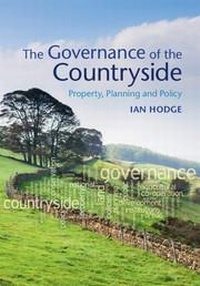
The Governance of the Countryside
Property, Planning and Policy
Will be published approx. on 4. February 2016
Book
Hardback
392 pages
978-0-521-62396-4 (ISBN)
Description
Conflicts over the conservation of biodiversity, changing patterns in land use, pollution, climate change, public access and increasing demands for food and energy security lead to the creation of policies designed to reconcile interests and promote society's objectives. This book examines the origins and evolution of the institutions that determine the use and management of land and the delivery of ecosystem services, through private property rights, markets and public policies. Divided into five accessible parts, the book provides detailed coverage of the institutions, property and governance of the countryside, historical models, governance under sectoral policies and alternative approaches. It is carefully developed to meet the needs of anyone studying or interested in agricultural sciences, countryside management, rural environment and geography. Students, lecturers, policy makers, managers and consultants in these areas will find this a valuable resource.
More details
Language
English
Place of publication
Cambridge
United Kingdom
Target group
College/higher education
Professional and scholarly
Product notice
Laminated cover
Illustrations
32 Tables, black and white; 58 Halftones, unspecified; 17 Line drawings, unspecified
Dimensions
Height: 254 mm
Width: 180 mm
Thickness: 21 mm
Weight
920 gr
ISBN-13
978-0-521-62396-4 (9780521623964)
Copyright in bibliographic data and cover images is held by Nielsen Book Services Limited or by the publishers or by their respective licensors: all rights reserved.
Schweitzer Classification
Other editions
Additional editions
E-Book
02/2016
Cambridge University Press
€71.49
Available for download
E-Book
01/2016
Cambridge University Press
€84.49
Available for download
Person
Ian Hodge is Professor of Rural Economy in the Department of Land Economy and Fellow of Hughes Hall at the University of Cambridge, where he has held appointments since 1983. He has over 40 years' experience of working in the areas of agricultural and environmental economics and policy, rural development and land use and countryside governance. He is currently a member of the Defra Economic Advisory Panel, previously a member of the MAFF/Defra Agricultural Economics Academic Panel, English Nature Socio-Economic Advisory Group, MAFF Task Force for the Hills and was a technical advisor to the Salmon and Freshwater Fisheries Review Group.
Content
Preface; Part I. Introduction: 1. The place of the countryside; 2. Institutions, property and governance; 3. Institutions in the countryside; Part II. Historical Models: 4. Co-operation for production: common fields and enclosure; 5. Delivering diversity: the great estates and the management of the land; Part III. Governance under Sectoral Policies: 6. Agricultural policies, farming and the environment; 7. Land, development and planning; 8. Protected areas: the example of National Parks; 9. Wildlife conservation: National Nature Reserves, Sites of Special Scientific Interest and large-scale conservation areas; 10. Public rights of way and access to the countryside; 11. The control of agricultural pollution; 12. The development of agri-environment policy; Part IV. Alternative Approaches to Governance: 13. Reconstituting markets; 14. Co-ordination, co-operation and collective action; 15. Public land ownership; Part V. Conclusions: 16. Conclusions: ecosystem governance and resilient countrysides; References; Index.