

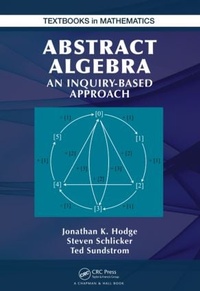
Abstract Algebra
An Inquiry Based Approach
1st Edition
Published on 21. December 2013
Book
Hardback
596 pages
978-1-4665-6706-1 (ISBN)
Description
To learn and understand mathematics, students must engage in the process of doing mathematics. Emphasizing active learning, Abstract Algebra: An Inquiry-Based Approach not only teaches abstract algebra but also provides a deeper understanding of what mathematics is, how it is done, and how mathematicians think.
The book can be used in both rings-first and groups-first abstract algebra courses. Numerous activities, examples, and exercises illustrate the definitions, theorems, and concepts. Through this engaging learning process, students discover new ideas and develop the necessary communication skills and rigor to understand and apply concepts from abstract algebra. In addition to the activities and exercises, each chapter includes a short discussion of the connections among topics in ring theory and group theory. These discussions help students see the relationships between the two main types of algebraic objects studied throughout the text.
Encouraging students to do mathematics and be more than passive learners, this text shows students that the way mathematics is developed is often different than how it is presented; that definitions, theorems, and proofs do not simply appear fully formed in the minds of mathematicians; that mathematical ideas are highly interconnected; and that even in a field like abstract algebra, there is a considerable amount of intuition to be found.
The book can be used in both rings-first and groups-first abstract algebra courses. Numerous activities, examples, and exercises illustrate the definitions, theorems, and concepts. Through this engaging learning process, students discover new ideas and develop the necessary communication skills and rigor to understand and apply concepts from abstract algebra. In addition to the activities and exercises, each chapter includes a short discussion of the connections among topics in ring theory and group theory. These discussions help students see the relationships between the two main types of algebraic objects studied throughout the text.
Encouraging students to do mathematics and be more than passive learners, this text shows students that the way mathematics is developed is often different than how it is presented; that definitions, theorems, and proofs do not simply appear fully formed in the minds of mathematicians; that mathematical ideas are highly interconnected; and that even in a field like abstract algebra, there is a considerable amount of intuition to be found.
Reviews / Votes
"This book arose from the authors' approach to teaching abstract algebra. They place an emphasis on active learning and on developing students' intuition through their investigation of examples. ... The text is organized in such a way that it is possible to begin with either rings or groups."-Florentina Chirtes, Zentralblatt MATH 1295
More details
Series
Language
English
Place of publication
Bosa Roca
United States
Publishing group
Taylor & Francis Inc
Target group
College/higher education
Undergraduate students majoring in mathematics or as secondary school teachers in mathematics; professional mathematicians.
Illustrations
31 s/w Abbildungen, 52 s/w Tabellen
52 Tables, black and white; 31 Illustrations, black and white
Dimensions
Height: 254 mm
Width: 178 mm
Weight
1230 gr
ISBN-13
978-1-4665-6706-1 (9781466567061)
Copyright in bibliographic data and cover images is held by Nielsen Book Services Limited or by the publishers or by their respective licensors: all rights reserved.
Schweitzer Classification
Other editions
New editions
Book
12/2023
2nd Edition
Chapman & Hall/CRC
€144.60
Shipment within 15-20 days
Persons
Jonathan K. Hodge, Steven Schlicker, Ted Sundstrom
Content
The Integers. Other Number Systems. Rings. Polynomial Rings. More Ring Theory. Groups. Special Topics. Appendix.